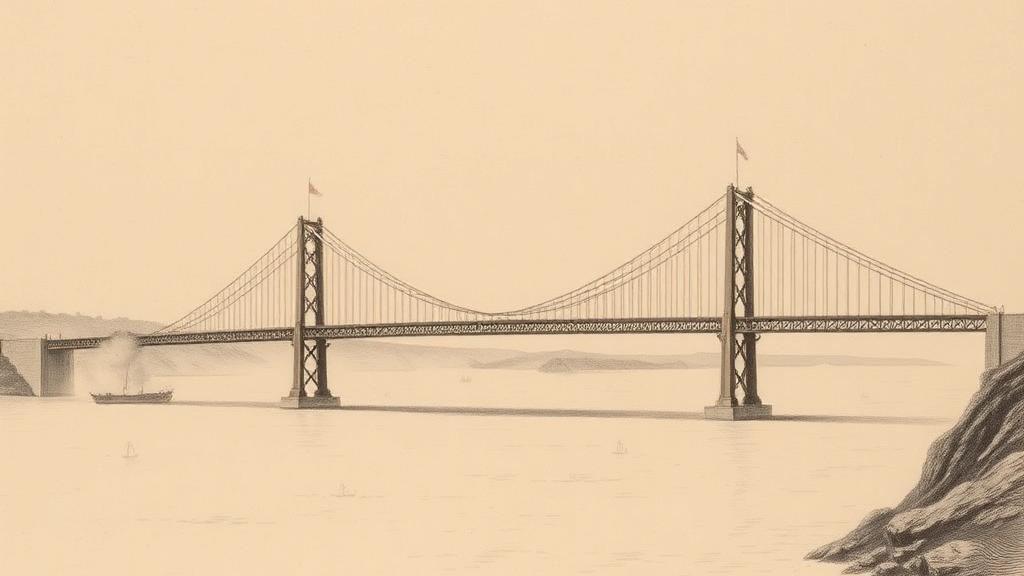
1915 Çanakkale Bridge, or the span whose length was chosen on purpose
For the better part of the twentieth century, the crossing at Lâpseki meant a ferry. On good days the boats ran every hour. On foggy days — and the Dardanelles narrows to barely 1,200 metres here, channelling the cold air off the Aegean — the schedule slipped, and trucks queued for kilometres on the European shore. A journey from Istanbul to Izmir that should have taken three hours could swallow a whole afternoon.
On 18 March 2022, the ferry became optional.
The date was not chosen for scheduling convenience. The 1915 Çanakkale Bridge, opened that morning by President Recep Tayyip Erdoğan, takes its name and its opening day from the naval engagement of 18 March 1915 — the moment Ottoman shore batteries and sea mines stopped the British and French fleet cold in the Dardanelles, the battle that preceded and defined the Gallipoli campaign. The centenary had passed in 2015 without a bridge. The 107th anniversary was another matter.
The numbers in this structure are deliberate everywhere you look. The main span runs 2,023 metres — thirty-two longer than the Akashi Kaikyō in Japan, the previous record holder. That figure is not a quirk of the strait’s topography. It is 2023: the hundredth year of the Turkish Republic, founded in 1923. The engineers, working for a Turkish-South Korean consortium — Limak, Yapı Merkezi, DL Holdings, and SK Ecoplant — with detailed design by Denmark’s COWI, were given a target span and built to it.
The structure itself earns its records on the merits. The two steel towers rise 318 metres, taller than any other suspension-bridge pylon anywhere. Each cable runs 4,163 metres and is spun from 144 strands, 127 wires per strand, at 5.75 mm wire diameter. The deck is 45 metres wide, carrying six motorway lanes at 70 metres above the water — clearance enough for the supertankers running through to the Black Sea. Construction began on 18 March 2017 — the same date again — and the bridge opened a full year ahead of schedule.
The Dardanelles is not a gentle building site. The designers at COWI had to solve for seismic loading, sustained high winds, and the live risk of a wayward tanker striking a tower. The foundations sit on a gravel bed reinforced with 196 steel pipes, each 2.5 metres in diameter, designed to spread catastrophic horizontal forces across the seafloor without shattering the piers. The deck sections were profiled as aerofoils after wind-tunnel testing — partly because the engineers knew the name Galloping Gertie, and did not want it applied to their work.
The Dardanelles has been a contested chokepoint since before it had a name in Greek. Xerxes crossed it in 480 BCE on a pair of pontoon bridges — boats roped together with flaxen and papyrus cables, the first recorded attempt to span this water. Every generation since has improvised: galleys, ferries, fog schedules. The 1915 Çanakkale Bridge is the first permanent fixed link in 2,500 years of trying.
For all of recorded history, the strait was somewhere you crossed on someone else’s schedule — the boatman’s, the fleet’s, the fog’s. Since March 2022, you drive. The numbers in the span will still be there when the centennial they commemorated has itself become ancient history.
Sources
- 1915 Çanakkale Bridge — Wikipedia — Opening date, name significance, main span, tower height, historical context, Xerxes pontoon bridges.
- 1915 Çanakkale Bridge — Structurae — Engineering specifications: span dimensions, cable details, navigation clearance, construction start date.
- COWI on the 1915 Çanakkale Bridge — Stirworld — Foundation engineering, aerodynamic solutions, seismic design, construction timeline.