ai · 3 min read
AlphaFold 2 and the fifty-year fold
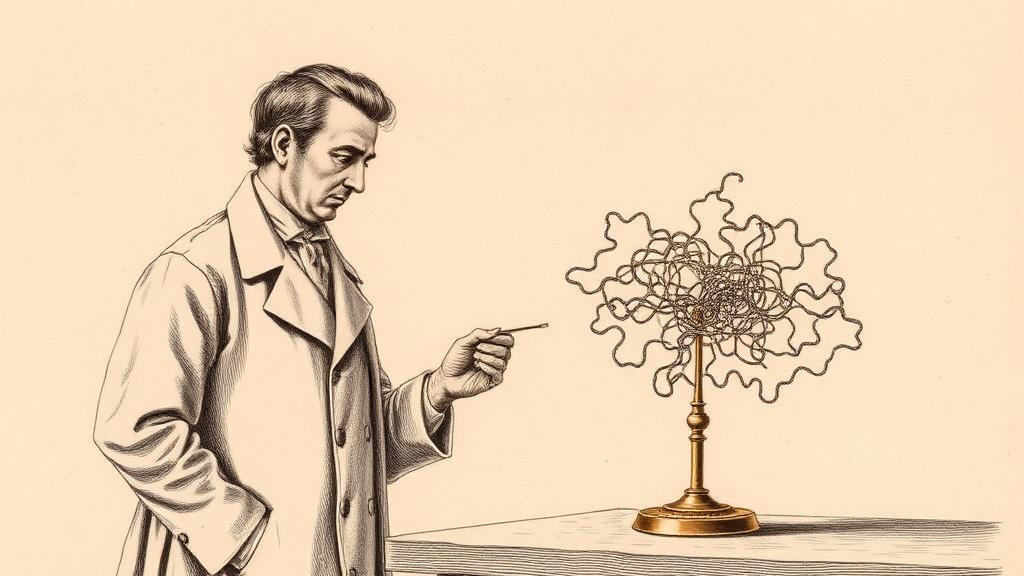
In 1969, Cyrus Levinthal ran a calculation and established that the protein folding problem was, mathematically, unsolvable by brute force. A single small protein of one hundred amino acids could theoretically adopt 10^300 distinct three-dimensional configurations. Sample them at the speed of modern processors and you would still be searching long after the last star had gone cold. Actual proteins, however, fold in milliseconds. They did not read the calculation.
The puzzle Levinthal identified had a name before it had a solution: the protein folding problem. Christian Anfinsen had won the Nobel Prize in Chemistry in 1972 for demonstrating that a protein’s amino acid sequence encodes its three-dimensional shape — the information is there, in the string of letters. But recovering that shape from the string remained open for fifty years. The CASP competition, launched in 1994 as a biannual blind test, had been chipping at it ever since. By 2018, the strongest methods rarely exceeded a Global Distance Test score of 50 on the hardest targets — a measure of how closely predicted atomic positions matched reality, on a scale of 0 to 100.
Then, on November 30, 2020, the CASP14 results came in.
DeepMind’s AlphaFold 2 team, led by John Jumper and Demis Hassabis in London, had spent roughly a year rebuilding their system from scratch after CASP13, where AlphaFold 1 had already surprised the field with a GDT of 68.5. The new model used an attention-based neural network to reason jointly over evolutionary sequence relationships and the geometry of residue pairs — the same attention mechanism that had recently transformed natural language processing. It did not search conformational space; it had learned, from roughly 170,000 known structures in the Protein Data Bank, what good folds look like.
AlphaFold 2 scored a median GDT of 92.4 across all CASP14 targets, with average errors of about 1.6 angstroms — roughly the width of one atom. It correctly predicted 88 of the 97 structures submitted. The second-best team finished in the low 50s. The gap between first and second place was larger than the gap between second place and everyone else combined. CASP co-founder John Moult, normally restrained, called it “a very special moment.”
The measure came from Andrei Lupas, director of the Max Planck Institute for Developmental Biology in Tübingen. His lab had been unable to determine the structure of a particular membrane protein for close to a decade. When he submitted the sequence to AlphaFold 2, the prediction solved it. “AlphaFold’s astonishingly accurate models have allowed us to solve a protein structure we were stuck on for close to a decade,” he later said.
The full methodology appeared in Nature in July 2021, authored by Jumper, Evans, and twenty-nine co-authors. DeepMind and the European Bioinformatics Institute released a free, open database the same month; by July 2022 it catalogued structures for around 200 million proteins from more than a million species — virtually the entire known proteome of life. Drug discovery timelines that once assumed years of crystallography work collapsed to seconds of database lookup. In 2024, Hassabis and Jumper shared the Nobel Prize in Chemistry for the work.
Levinthal’s paradox still stands. The machine did not solve it; it stepped around it, learning from the shapes that evolution had already found. The fold was always in the sequence. It just needed something patient enough — and large enough — to read it.
Sources
- AlphaFold — Wikipedia — CASP13 and CASP14 scores, database statistics, Nobel Prize.
- Highly accurate protein structure prediction with AlphaFold — Jumper et al., Nature, 2021 — primary paper; GDT 92.4, 1.6 Å accuracy, methodology.
- AlphaFold: a solution to a 50-year-old grand challenge in biology — DeepMind — CASP14 announcement, Lupas quote, competition context.
- AlphaFold developers Demis Hassabis and John Jumper share the 2023 Lasker Award — NIH/PMC — biographical context on the team.