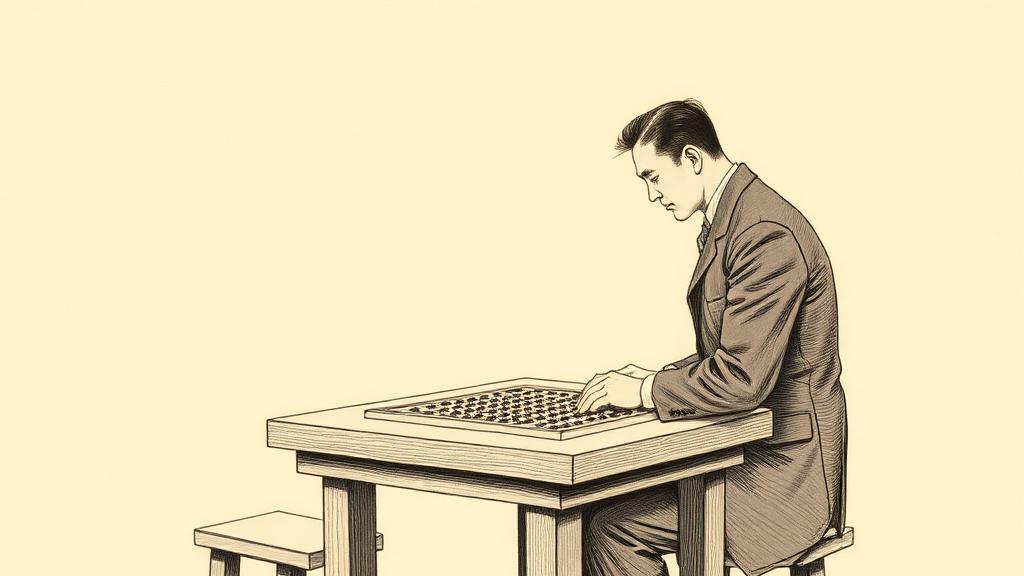
AlphaGo defeats Lee Sedol, and the room goes quiet
Halfway through Game 2 in Seoul, the television commentary breaks off. AlphaGo has just placed its stone on the fifth line — a shoulder hit that no professional player would consider in that position. The broadcast cuts to Lee Sedol’s face. He stares at the board, stands up, and leaves the room to think.
The match ran from March 9 to 15, 2016, at the Four Seasons Hotel in Seoul. Lee Sedol held 18 world titles and a reputation for the kind of creative, aggressive play that other professionals described as genius. DeepMind’s AlphaGo had beaten the European champion Fan Hui the previous autumn, but Lee was considered a different order of magnitude entirely. The professional consensus was that a machine capable of defeating a top-nine-dan player remained five to ten years away.
Go has approximately 10^170 possible board configurations — a googol times more complex than chess, more positions than atoms in the observable universe. The brute-force search that gave Deep Blue its chess crown in 1997 does not scale. What DeepMind built instead was closer to pattern intuition: two deep neural networks trained on roughly thirty million historical moves. A “policy network” selected which moves to consider; a “value network” predicted who was winning from any given position. Underneath both ran a Monte Carlo tree search — exploring possibilities probabilistically rather than exhaustively. The system then sharpened itself through self-play, each loss a correction signal.
Game 4, Move 78. Three games in, AlphaGo led 3-0, and Lee Sedol was, by his own account, feeling powerless. Then, deep into the fourth game, Lee placed a stone that AlphaGo estimated had a one-in-ten-thousand chance of being played. The move — a wedge in the center of the board that Go commentators call kami no itte, the divine move — introduced complexity the system had never encountered. It played a string of weak moves and resigned on move 180. The commentators wept. Lee pressed his hand to his mouth. He later called it the move he was most proud of in his entire career.
AlphaGo’s 4-1 win did something more lasting than settle a bet. It showed that a system trained by reinforcement learning could achieve what researchers had long called intuition — the capacity to generate good solutions to problems too large to reason through explicitly. Go mastery had seemed categorical: the kind of knowledge only minds shaped by three thousand years of human practice could hold. The match showed otherwise. Within two years, AlphaGo Zero taught itself the game from scratch — no human games, only self-play — and surpassed its predecessor’s level in forty days. The techniques migrated to protein folding, drug discovery, and robotic control. The board was the laboratory; the territory that opened behind it was much larger.
Lee Sedol retired in 2019, saying there was no longer any point in competing against something that could not be defeated. He was wrong about the humans — they kept finding uses for the intuition they hadn’t lost — but right about something harder to name: after March 2016, the game was different.
Sources
- AlphaGo versus Lee Sedol — Wikipedia — match dates, location, game results, Move 37 in game 2, Move 78 (kami no itte) in game 4, Lee Sedol’s reactions, Lee’s 2019 retirement
- AlphaGo — Google DeepMind — technical architecture (policy and value networks, Monte Carlo tree search, self-play training), successor systems including AlphaGo Zero and AlphaZero
- After 3 Losses, Master Go Player Scores A Win Against Computer — NPR — Game 4, Lee Sedol’s victory, emotional reactions from players and commentators