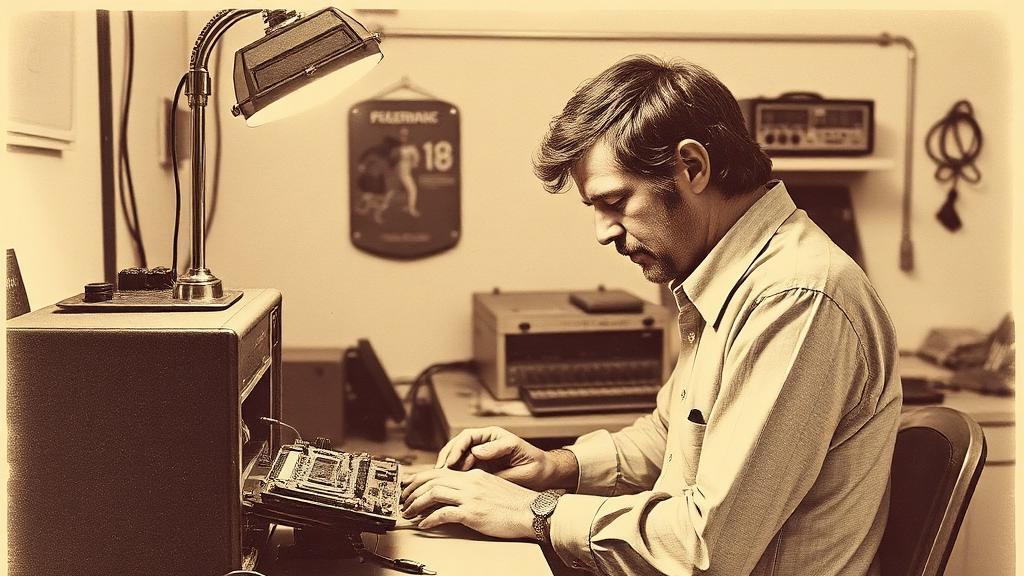
The Apple I, or the board Steve Wozniak almost gave away
The first time Steve Wozniak demonstrated the circuit board he’d designed, he handed out photocopies of its schematic at the Homebrew Computer Club and charged nothing. This was the spring of 1976, the club was meeting in Menlo Park, and Wozniak’s assumption was simple: he had built the machine for himself, and sharing designs was what you did at Homebrew. The idea of charging for it, or for anything derived from it, had not seriously occurred to him.
Steve Jobs, who was somewhere in the room, noticed this.
Wozniak had been attending Homebrew meetings since March 1975, drawn in by the frenzy over the Altair 8800. He was an engineer at Hewlett-Packard, spending his evenings thinking about a cheaper and cleaner design. The enabling move came in late 1975, when MOS Technology introduced its 6502 processor at a trade show in San Francisco for $25 apiece — against the $150 Intel was charging for comparable silicon. By March 1, 1976, Wozniak had a complete board design: a 6502 running at 1 MHz, 4 kilobytes of RAM, and built-in video circuitry.
That video circuitry was the quiet breakthrough. Every machine competing for hobbyist attention in 1976 required an expensive external terminal to show output. Wozniak’s design connected directly to a standard television set. For a buyer willing to supply a keyboard, a power supply, and a TV, there was a working computer at the end of the wire — not a front panel of blinking lights, not a traffic light to argue with in binary, but an actual cursor on an actual screen.
Before he offered it commercially, Wozniak offered it to his employer. Hewlett-Packard declined five times. He was obligated by his employment agreement to give them right of first refusal, and he did so faithfully before each relevant club meeting, and each time HP’s position was some version of: not a business product. By the standards of 1976, they were not obviously wrong.
Apple Computer was incorporated on April 1, 1976 — the date was not chosen for its symbolism — by Wozniak, Jobs, and a third partner, Ronald Wayne, who drafted the partnership agreement and then sold his 10 percent stake back for $800. The founding capital was roughly $1,300, assembled by selling Wozniak’s HP-65 scientific calculator and Jobs’s Volkswagen Microbus.
The first real order came from Paul Terrell, who had opened the Byte Shop in Mountain View after seeing a Homebrew demonstration. His offer: fifty units at $500 each, but fully assembled — not bare boards for hobbyists to finish themselves. Jobs used the purchase order to secure thirty-day parts credit from Cramer Electronics, assembled the boards in his family’s garage on Crist Drive in Los Altos, and delivered on time. The retail price became $666.66 — Wozniak liked repeating digits, and a one-third markup on $500 produced exactly that (Wikipedia).
Apple built roughly 200 Apple I boards in all. As of 2022, somewhere between 62 and 82 survive with known locations. Several have sold at auction for six figures.
The Apple I itself was a thin product — bare, expensive, limited to buyers who could assemble the rest of it themselves. What it actually built was a company that knew how to take an order, source parts on credit, manufacture at a kitchen table, and deliver to a retailer on schedule. Those disciplines carried directly to the Apple II, which arrived in 1977 already in a plastic case with a built-in keyboard, and which made Apple a real company. The garage was not a myth. It was a production floor.
Sources
- Apple I — Wikipedia — design timeline, MOS 6502 pricing, Wozniak’s HP rejections, the Byte Shop deal, $666.66 pricing rationale, survival count.
- Apple-1 — Computer History Museum — technical specifications, built-in video circuitry, Homebrew Club context, historical significance.