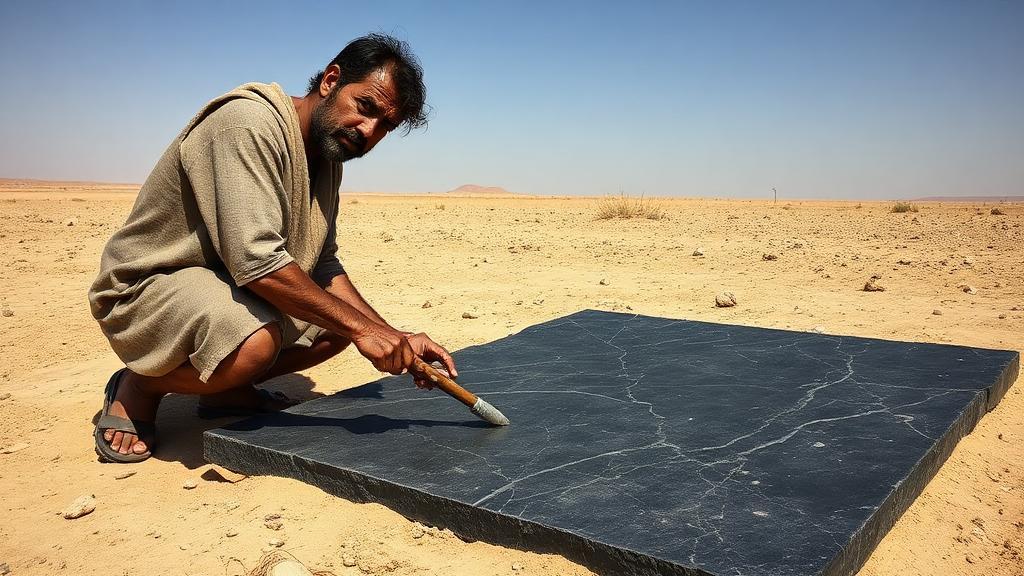
Arabic script: a king's epitaph in the Syrian desert
On December 7, 328 CE, somewhere in the Syrian steppe about a hundred kilometres south of Damascus, a stonemason chiseled six lines into a slab of black basalt. The inscription was an epitaph for Imru’ al-Qays ibn 'Amr, a Lakhmid king who had, by his own account, subdued half of Arabia and appointed tribal nobles as lieutenants for the Romans. Scholars would not lay eyes on it for another 1,573 years — it surfaced near the village of al-Namara in April 1901 and now sits in the Louvre under catalogue number AO 4083. The king has a museum case. His alphabet has the world.
The Namara inscription is the oldest text that scholars broadly agree is written in Arabic rather than in its direct ancestor, the Nabataean script — and that boundary is not a technicality. Nabataean was the writing of the traders who built Petra: a Semitic consonant alphabet descended from Aramaic, which itself descended from Phoenician. By the 3rd century CE, the cursive form Nabataean scribes used on papyrus had drifted so far from older formal inscriptions that what emerged at Namara was something genuinely new.
What pushed it over the line was speed. Nabataean scribes writing on papyrus stopped lifting their pens between letters, because ink on reed demanded flow. The ligatures that habit created pulled neighboring letter-shapes toward each other until several became nearly identical — a visual collision of formerly distinct characters. Arabic resolved the ambiguity with diacritical dots: a mark above or below a shared letterform to distinguish one consonant from another. The same basic stroke dotted below is a bā’; dotted once above, a tā’. Twenty-eight consonants carved out of a script built for twenty-two, using the cheapest possible annotation.
Here is the wrinkle. Nabataean had 22 phonemes; Arabic needed 28. Borrowing a script with too few sounds should have been a dead end. But Arabic did not borrow and stop — it patched the deficit, added the dots, and later added vowel marks as well. The ḥarakāt, small strokes indicating short vowels, were formalized around 786 CE by the grammarian al-Khalīl ibn Aḥmad al-Farāhīdī. The Namara stone shows almost none of this later apparatus. It is the script at its roughest: dots sparse, vowels absent, letterforms still in negotiation between one script and the next.
What happened after that negotiation settled is one of the faster expansions in the history of writing. When the Quran was committed to writing in the 7th century, Arabic script was already in place, and the Islamic conquests carried it from Spain to Central Asia within a century. Persian adopted it, then Urdu, Ottoman Turkish, Malay, and dozens of others — a script born in the cursive economy of Nabataean papyrus scribes now serves readers across a sweep of territory that no single empire ever held.
The king’s empire lasted a generation. The script on his tombstone is still spreading.
Sources
- History of the Arabic alphabet — Wikipedia — emergence from Nabataean, the Namara and Zabad inscriptions, development of the diacritical dot system.
- Namara inscription — Wikipedia — exact date (December 7, 328 CE), discovery in April 1901, content of the epitaph, Louvre catalogue number AO 4083.
- The Nabataean script: a bridge between Aramaic and Arabic — Paths of Jordan — the mechanism of transition from Nabataean to Arabic, the role of cursive ligatures in shaping the connected baseline, the phoneme mismatch (22 vs 28).