ASCII: the seven-bit truce that taught computers to speak
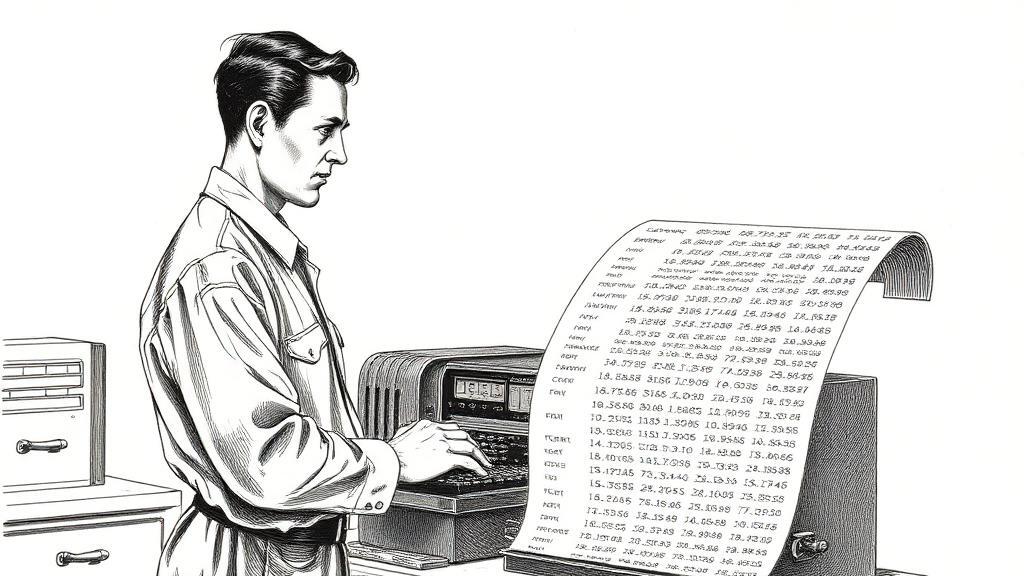
In the teleprinter networks of the 1950s, a single corrupted bit could unspool an entire message. The culprit was ITA2, the dominant character code of the era — five bits, thirty-two slots, too cramped to hold both letters and figures without a shift key. Two special codes, FIGS and LTRS, toggled the machine between modes. It worked until line noise swallowed a shift code, and everything that followed printed as numeric gibberish. One bad byte, and the rest of the transmission was unreadable.
Bob Bemer had been watching this for years. An IBM programmer who spent the late 1950s cataloguing the character codes in use across the industry — he counted more than sixty — Bemer sent a formal proposal to the American Standards Association in 1961 calling for a unified code. The ASA’s X3.4 subcommittee had already been meeting since October 1960, drawing in representatives from IBM, AT&T, and the Teletype Corporation. On June 17, 1963, they settled on a standard: the American Standard Code for Information Interchange. ASCII.
The code used seven bits, giving 128 possible characters, and the number was a considered compromise. Six bits yielded only sixty-four slots — not enough for capital letters, digits, and punctuation together. Eight felt wasteful at 1963 telephone rates, where every transmitted bit cost money. The eighth bit was reserved for parity: an error-detection technique that let receiving machines flag corrupted transmissions. Seven bits of message, one of check, nothing left over.
The first version had a conspicuous gap: no lowercase letters. Several committee members considered them unnecessary — computers produced all-caps reports, and that was enough. Bemer had pushed for lowercase and was overruled; those letters appeared only in the 1967 revision, meaning four years of ASCII documents read like telegrams. The deeper irony was IBM. When the company launched the System/360 in 1964, it encoded the machines in EBCDIC — a rival format built for punch cards that IBM had developed internally. The person most responsible for a universal standard now worked for the company most conspicuously ignoring it.
The market moved slowly. The mandate did not. On March 11, 1968, President Lyndon Johnson ordered all federal computers and telecommunications systems to use ASCII. Vendors wanting government contracts had no choice. In a single memo, the standard IBM had tried to sideline became the effective law of data transmission.
What a writing system ultimately earns is longevity. UTF-8, now the encoding of roughly 98 percent of the web, was designed from the start to be backward-compatible: any document containing only ASCII characters is byte-for-byte valid UTF-8. A file typed in 1968 opens in a modern browser without complaint. Most formats from that era require archaeology. ASCII required only patience.
The 128 characters that a committee agreed on in 1963 are still inside every URL, every email header, every line of source code typed today. The alphabet grew. The encoding stayed.
Sources
- ASCII — Wikipedia — development timeline, X3.4 committee composition, Johnson’s 1968 federal mandate, EBCDIC competition, UTF-8 backward compatibility.
- The Birth of ASCII (1963) — Unicode FYI — Bob Bemer’s role, the sixty-encoding survey, the seven-bit engineering rationale, the parity-bit compromise.
- ASCII 1963 — ascii-code.com — technical specifications of the first edition, absence of lowercase letters in the original standard, IBM EBCDIC rivalry.