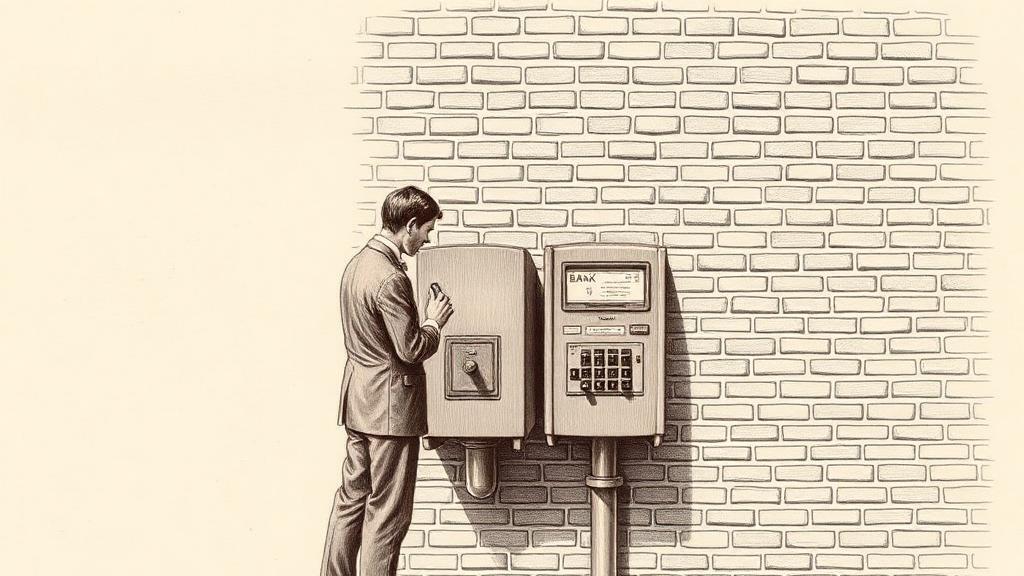
The hole in the wall: Barclays Bank, Enfield, 1967
On 27 June 1967, a velvet curtain was drawn back outside a Barclays branch in Enfield, north London, to reveal a grey metal box bolted to the brick wall. Sir Thomas Bland, the bank’s deputy chairman, did the honours. The machine’s first customer was Reg Varney, a comedy actor best known for the sitcom On the Buses, who collected the maximum permitted withdrawal of £10 in one-pound notes and declared it “quite enough for a wild weekend.” The cash machine had arrived, and it looked almost exactly as sensible and slightly absurd as you might expect.
The contraption was the invention of John Shepherd-Barron, managing director of De La Rue Instruments, the banknote printing firm (Wikipedia). The idea came to him while lying in his bath. He had missed his bank that previous Saturday by one minute — the branch locked, his weekend suddenly cashless — and worked out that evening how a vending machine might dispense money in the same way a chocolate dispenser released its cargo. He brought the proposal to Barclays, the bank agreed to six machines, and the prototype was branded Barclaycash.
The machine, formally called the De La Rue Automatic Cash System, worked on a mechanism that bore little resemblance to what would follow. Plastic cards didn’t yet exist. Instead, customers received paper vouchers impregnated with carbon-14, a mildly radioactive isotope, whose signal the machine read against a four-digit PIN (Barclays Archives). Shepherd-Barron had originally proposed a six-digit code, but tested the system on his wife Caroline, who could reliably recall only four. The four-digit PIN has remained the global standard ever since.
The radioactive paper is the detail that tends to lodge in the memory. Shepherd-Barron ran the numbers and was unbothered: by his calculation, a customer would need to swallow 136,000 vouchers before suffering any ill effects. Since the machine retrieved the voucher after each transaction, the risk was essentially theoretical. As it turned out, he was right.
There is a complication in the story’s tidy narrative. James Goodfellow, a Scottish engineer working for the Westminster Bank, had filed a patent in May 1966 — more than a year before Enfield — for a system using reusable plastic cards and a PIN, which more closely resembles the devices we use today than Shepherd-Barron’s carbon-14 tokens do (Wikipedia). Goodfellow received an OBE in 2006, nearly forty years after the velvet curtain. History tends to remember the machine that was switched on.
Barclays ordered fifty more machines after the Enfield launch. Other banks followed, other countries followed, and by the 1980s cash dispensers were unremarkable urban furniture. The plastic card arrived; the radioactive voucher vanished; the PIN stayed. The deeper shift was structural: money could now be extracted from a bank without a banker present, at any hour, against a number rather than a teller’s discretion. The rules governing who could access their own funds, and when, had been rewritten without anyone quite announcing it.
The ledger that had once required a clerk at a desk now folded itself into the wall.
Sources
- John Shepherd-Barron — Wikipedia — biography, bathtub inspiration, radioactive voucher details, wife Caroline’s four-digit preference, and the global PIN standard.
- From the archives: the ATM is 50 — Barclays — June 27, 1967 launch at Enfield, Reg Varney’s inaugural withdrawal, Sir Thomas Bland, and early expansion.
- James Goodfellow — Wikipedia — rival May 1966 patent and the disputed invention credit.