BASIC, or the language designed to be learned in an afternoon
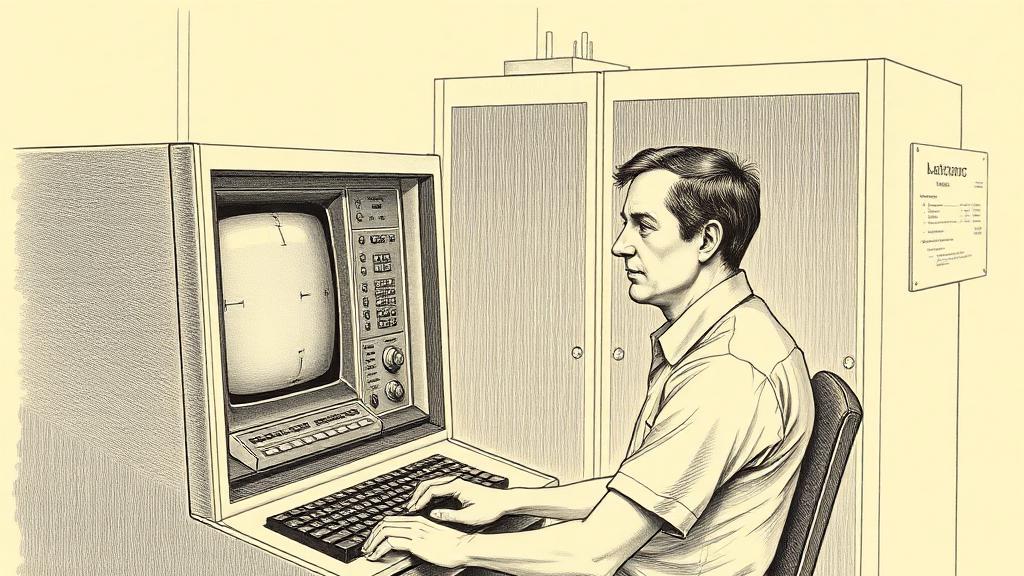
At 4 a.m. on May 1, 1964, in the basement of College Hall at Dartmouth, John Kemeny and a student programmer sat down at neighboring terminals and each typed a short program. Then both typed RUN. When two correct answers came back — the same two answers, from the same machine, at the same moment — they knew the thing worked. Time-sharing and BASIC had arrived together, like twins that couldn’t exist without each other.
The problem Kemeny wanted to solve had nothing to do with speed. Fortran was fast; COBOL was comprehensive; ALGOL 60 was elegant enough to inspire academic papers for a decade. But all three assumed you already knew what you were doing. Kemeny, a Hungarian-Jewish refugee who arrived in America at fourteen and spent his doctoral years at Princeton as Albert Einstein’s mathematical assistant, had a different constituency in mind: the history student, the economics major, the freshman who had never seen a compiler and had no intention of becoming one of the people who wrote them.
With Thomas Kurtz, his colleague in the mathematics department, Kemeny designed BASIC — Beginner’s All-Purpose Symbolic Instruction Code — to be learned in an afternoon. Where FORTRAN specified a loop with the barely-mnemonic DO 100 I = 1, 10, 2, BASIC offered FOR I = 1 TO 10 STEP 2: plain English, high-school algebra, no memorization required. The language also ran interactively, giving error messages in real time on the terminal rather than dumping a stack trace on a printout you collected the next morning. That meant a broken program was a problem you fixed in seconds, not one you pieced together from yesterday’s output.
The Dartmouth Time-Sharing System they built alongside it was just as important. In 1963, Kemeny secured a National Science Foundation grant to bring a GE-225 computer to campus and build something that hadn’t existed before: a general-purpose time-sharing system serving dozens of simultaneous users, each with the illusion of sole occupancy. The NSF reviewers doubted it could be done; they doubted it especially because Kemeny planned to build it with undergraduates. He did it with undergraduates. Within a few years, a significant portion of the Dartmouth student body could write programs, and high schools across the country were dialing into Dartmouth’s machine over telephone lines to do the same.
Kemeny and Kurtz gave the language away. In January 1975, Bill Gates and Paul Allen saw the Altair 8800 on the cover of Popular Electronics, telephoned the manufacturer with a bluff — they had a BASIC interpreter ready, they said, though they hadn’t written a line of it yet — then spent the next several weeks writing one from nothing but the Altair’s technical manual, with no actual machine to test on. That interpreter became Microsoft’s first commercial product. By the end of the 1980s, BASIC was burned into the ROM of virtually every home computer ever sold. Kemeny didn’t see a dollar.
Most programmers who came of age on BASIC eventually moved on to something more capable. But the machine they moved on to almost certainly ran, a decade earlier, on a language someone gave away in a Dartmouth basement.
Sources
- BASIC — Wikipedia — Technical details, the FORTRAN loop comparison, Microsoft BASIC’s origins, and spread to microcomputers.
- BASIC at Dartmouth — Dartmouth College — The 4 a.m. first run on May 1, 1964; the NSF grant; scope of student adoption.
- John Kemeny — Encyclopaedia Britannica — Kemeny’s background and career at Dartmouth.
- John G. Kemeny — Wikipedia — Kemeny as Einstein’s mathematical assistant at Princeton; Hungarian refugee background.