BMC Mini: the box that rewired the small car
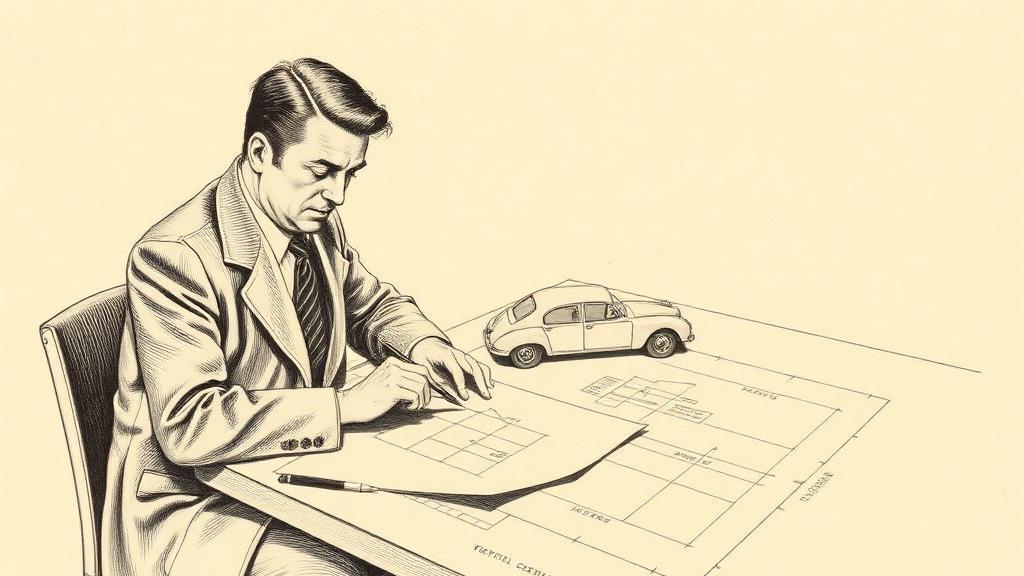
The brief Alec Issigonis received from BMC chairman Leonard Lord in 1957 was a box: 10 feet long, 4 feet wide, 4 feet tall, and 80 percent of the floor devoted to passengers. His response, sketched across engineering pads in pencil, became the car that reordered how the industry thinks about small vehicles.
The Suez Crisis of 1956 had exposed Britain’s dependence on imported oil. Petrol rationing returned. The streets began filling with German bubble cars — three-wheeled, two-stroke novelties that Leonard Lord found intolerable. He summoned Issigonis, who had already designed the Morris Minor, pulled him off an existing project, and gave him the brief.
Issigonis solved the packaging problem in a chain of interlocking decisions. He turned the 848cc A-Series engine sideways, mounting it transversely across the front of the car. The four-speed gearbox went into the sump below, sharing oil with the engine — a single sealed unit that left no wasted space behind it. Front-wheel drive followed naturally from the transverse layout. Ten-inch wheels replaced conventional 13s, shrinking the wheel arches. Alex Moulton supplied rubber-cone springs in place of conventional coils, keeping the floor flat and the handling sharp. The prototype was ready by the summer of 1958; Leonard Lord climbed in, drove a lap of the factory, and told Issigonis to have it in production within a year.
The Mini appeared on 26 August 1959 as both the Austin Seven and the Morris Mini-Minor, priced just under £500. Sales were modest at first — around 20,000 in the first year — but climbed past 200,000 annually by 1962. It became the car of 1960s London: pop stars, dispatch riders, and duchesses all wedged into the same cabin. Issigonis reportedly found the celebrity attention baffling. The principle he had written in his notebooks was simpler than stardom: “People who buy small cars are the same size as those who buy big ones.” He had built for human bodies, not demographics.
The car that Issigonis designed for economy turned out to be fast. Racing constructor John Cooper persuaded BMC to build a performance version in 1961, and on 25 January 1964, Paddy Hopkirk and co-driver Henry Liddon drove a 997cc Cooper S to victory at the Monte Carlo Rally — ahead of Ferraris, Fords, and full-size Citroëns. The car weighed 635 kilograms. It won on balance and cornering grip, both consequences of the same transverse geometry that had been chosen to save space, not win rallies. Timo Mäkinen repeated the feat in 1965; Rauno Aaltonen in 1967.
The Mini ran in continuous production until 2000, 5.3 million copies. In 1999, automotive journalists voted it the second most influential car of the twentieth century, after the Ford Model T. The reason is architectural: the transverse front-wheel-drive layout Issigonis devised under rationing pressure is now the standard configuration for virtually every compact car on the planet. Volkswagen, Honda, Toyota, Fiat — the details vary; the geometry does not.
The box Leonard Lord asked for in 1957 has been reproduced, refined, and resized in hundreds of millions of cars. It has simply gotten a lot more air conditioning.
Sources
- Mini (Mark I) — Wikipedia — launch date, engine specs, 10-inch wheels, 80% passenger ratio, early production figures.
- Alec Issigonis — Wikipedia — biographical details, Suez Crisis connection, Alex Moulton’s suspension, ADO15 prototype timeline, 5.3 million production total.
- Alec Issigonis’ Sketch Books — British Motor Museum — Issigonis’s design notebooks and the “People who buy small cars” principle.
- 50 Years of the Mini Cooper’s Monte Carlo Victory — BMW Group Press — Hopkirk 1964, Mäkinen 1965, Aaltonen 1967.