Brahmi script: from Ashoka's pillars to three billion living letters
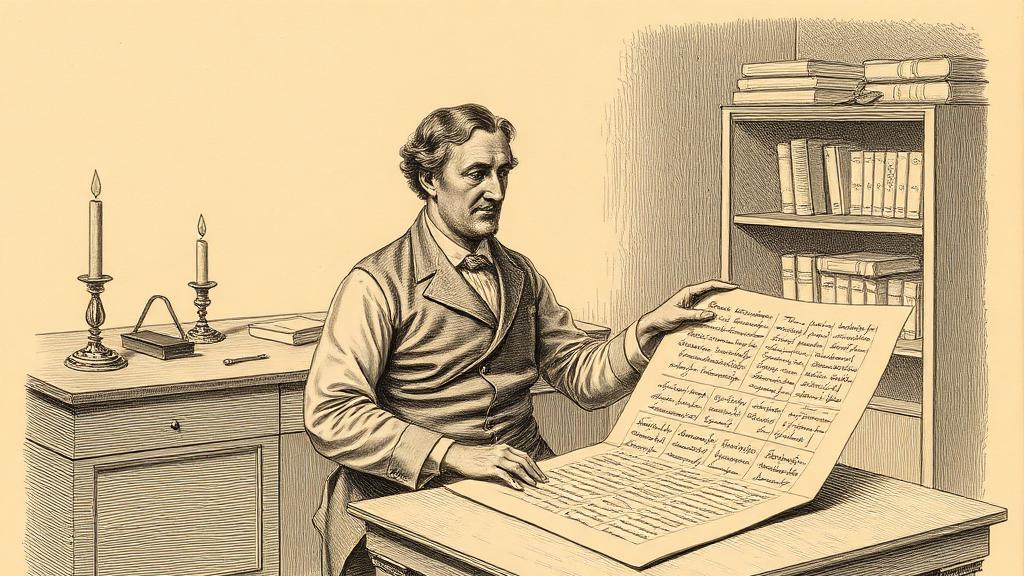
In the winter of 1837, a military engineer named Captain Edward Smith was poking through the jungle ruins of a Buddhist monument near the village of Sanchi, in what is now Madhya Pradesh. He made rubbings of the characters carved into its stone railings — dense, looping rows that no European could read — and posted them to James Prinsep, secretary of the Asiatic Society of Bengal in Calcutta, describing them as “trivial fragments of rude writing” (Live History India). Prinsep thought otherwise. He noticed that almost every inscription ended with the same two characters. He guessed the word was danam — donation — the standard closing formula for a dedicatory gift. He was right, and that single word cracked open a script that had been unreadable for nearly two thousand years.
The script was Brahmi: a syllabic alphabet — or abugida — in which each consonant carries an inherent “a” vowel and additional vowels are indicated by diacritical strokes above, below, or beside the letter (Omniglot). It had emerged in India by at least the 3rd century BCE, possibly earlier, though the earliest inscriptions no one disputes are the rock and pillar edicts of the Mauryan Emperor Ashoka, carved at more than thirty sites stretching from present-day Afghanistan to Bangladesh, between roughly 268 and 232 BCE (Wikipedia).
Ashoka had reasons to reach for an enduring medium. In his eighth regnal year — around 260 BCE — he invaded the Kalinga kingdom on India’s east coast and watched an estimated 100,000 people die. The aftermath changed him. He converted to Buddhism and resolved to govern by dharma rather than by conquest, and he wanted the whole empire to know it. His edicts, inscribed on polished sandstone pillars set at crossroads and on cliff faces visible to travelers, proclaimed equal justice, hospitals for humans and animals, the uselessness of ceremony without moral substance. They were also, incidentally, the most ambitious exercise in Brahmi writing that had yet been attempted.
The script itself rewards a closer look. Its inventors organized the consonants not alphabetically but phonetically: gutturals, palatals, retroflexes, dentals, and labials — grouped by where in the mouth they are formed. This is still how modern phoneticians classify consonants. Whether that structural insight arrived via Aramaic-speaking traders under the Achaemenid empire, or was worked out from older Indus traditions, remains genuinely uncertain; the gap between the Indus script’s disappearance around 1500 BCE and Brahmi’s first firm appearance is too wide for confident claims in either direction.
What is not contested is what happened next. One comprehensive survey found 198 scripts that ultimately descend from Brahmi: Devanagari, which carries Hindi, Sanskrit, Marathi, and Nepali; Bengali; Tamil; Telugu; Tibetan; Thai; Burmese; Khmer; Javanese; the Baybayin of the Philippines. All of them inherited the same consonant-grid logic, the same vowel-diacritic system, the same phonetic organization. The shapes have diverged over twenty-three centuries, but the underlying grammar of each is recognizably Brahmi’s.
When Prinsep published his full decipherment in the Journal of the Asiatic Society of Bengal in 1838, he also revealed what Ashoka’s inscriptions had been saying all along. The edicts spoke of a ruler who called himself “Devanampiya Piyadasi” — Beloved of the Gods, Pleasing to See. A Sri Lankan scholar named George Turnour matched the title to Emperor Ashoka, grandson of Chandragupta. A ruler who had tried to apologize to his own empire, in a script no one living could any longer read, had finally been heard.
Prinsep died in London two years later, aged forty-one, his health broken by the Calcutta heat. The scripts he opened are still being written by roughly three billion people.
Sources
- Brahmi script — Wikipedia — dating (3rd century BCE), Ashokan edicts as earliest indisputably dated inscriptions, origins debate, 198 descendant scripts, phonetic organization of consonants.
- Brahmi — Omniglot — abugida structure, consonant-diacritic system, earliest appearance, relationship to Aramaic and Indus hypotheses.
- James Prinsep: Decoding Ancient India — Live History India — the Sanchi rubbings, Captain Smith’s note, the danam breakthrough, Prinsep’s 1838 publication, George Turnour’s identification of Ashoka, Prinsep’s death in 1840.