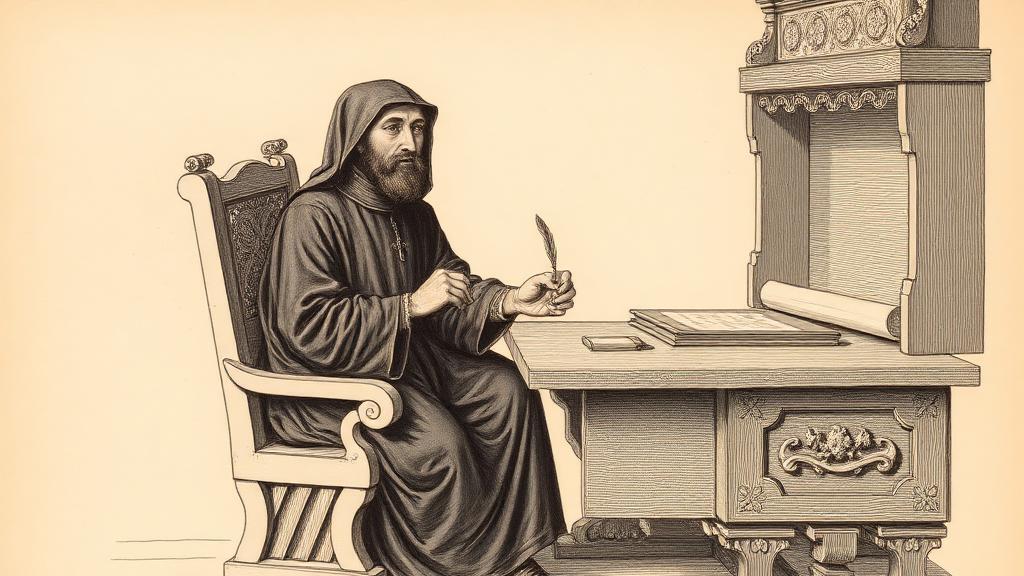
Carolingian minuscule, or how a monk from York gave us lowercase letters
A monk at a Frankish scriptorium in 789 was copying a royal decree — or trying to. The document had arrived from Aachen in the court hand of that particular palace, which looked nothing like the Merovingian cursive he had been trained in, or the Visigothic script he’d borrowed books from, or the Insular hand the Irish missionaries had brought through two generations before. He did what scribes across Charlemagne’s empire routinely did: guessed, and introduced an error that would travel with the text.
This was the practical emergency that Charlemagne’s Admonitio Generalis of 789 addressed, among other things. His empire covered roughly half of Christian Europe — from Brittany to the Elbe, from Frisia to Rome — and its monasteries wrote in scripts so regional and varied that a letter from Tours might be illegible in Salzburg. In 782, Charlemagne recruited Alcuin of York, the preeminent scholar of the British Isles, to run his palace school at Aachen. Alcuin arrived carrying a century of Insular manuscript tradition and strong opinions about legibility.
What emerged from the scriptoria under his influence — most completely after 796, when he became abbot of Saint Martin’s in Tours — was something European writing hadn’t quite had before: a genuine lowercase alphabet. Carolingian minuscule featured rounded, distinct letterforms, consistent character heights, and — crucially — spaces between words. Many earlier scripts had run words together; readers supplied the breaks. Alcuin’s scribes put them on the page. Systematic capital letters at sentence beginnings and proper names completed the picture. The result looked, structurally, like the text you are reading now.
By around 820, most major scriptoria across Europe had adopted some version of it. More than 7,000 manuscripts in this hand survive today, preserving Cicero, Virgil, and Pliny in copies that, for many texts, are the earliest we have.
Here is the part that tends to land hard. In the early 15th century, Italian humanists went hunting through monastery libraries for ancient Roman manuscripts. What they found — and celebrated as authentic antique originals — were Carolingian copies from the 9th and 10th centuries. Scholars including Poggio Bracciolini modeled their humanist hand directly on what they took to be classical Latin script. That hand passed to Venetian printers in the 1460s, who cut it into metal type. The roman and italic typefaces that came out of those presses — Nicolas Jenson’s roman, Aldus Manutius’s italics — are the direct ancestors of every roman font in use today, each one running back, through a chain of productive misreading, to a scriptorium in Tours.
Gothic blackletter eventually came back and dominated northern European writing for another four centuries. But the lowercase alphabet Carolingian minuscule defined never went away. Alcuin’s achievement was not invention so much as standardization: making it possible for a letter written in one province to be read in another, and for a civilization’s texts to survive being copied by people who had never met their authors. The Renaissance thought it had recovered Rome. It had recovered Charlemagne’s proofreader.
Sources
- Carolingian minuscule — Wikipedia — origins, Alcuin’s role at Aachen and Tours, surviving manuscript count, connection to humanist minuscule and modern typefaces.
- Latin Scripts: Carolingian Manuscripts — Hill Museum & Manuscript Library — script features, legibility design, and its role as the model for the modern Roman lowercase.
- Alcuin of York — Wikipedia — Alcuin’s recruitment to Aachen in 782, his appointment as abbot of Tours in 796, his role in the educational reforms.