bridges · 3 min read
Cheongna Haneul Bridge: Incheon's thirty-five-year crossing
On a planning map of Incheon drawn in 1991, a dotted line crossed the West Sea toward Yeongjongdo — the island being cleared for South Korea’s new international airport. Dotted lines on maps mean proposed. This one stayed dotted for thirty-five years. On January 5, 2026, the Cheongna Haneul Bridge opened to traffic, and within eight months vehicle ferry crossings to the island had fallen 41.8 percent.
Yeongjongdo is not quite isolated. The island already had two links to the mainland: the expressway bridge serving the airport and the Incheon Bridge, completed in 2009. Both were financed through private concessions and charged tolls that commuters consistently described as the most expensive per-kilometre driving in South Korea. The idea of a third, public crossing had circulated since 1991, when Cheongna International City — a planned district on the adjacent mainland shore — first appeared in Incheon’s development blueprints. What followed was a thirty-five-year rotation of budget disputes, design revisions, and administrative shelving.
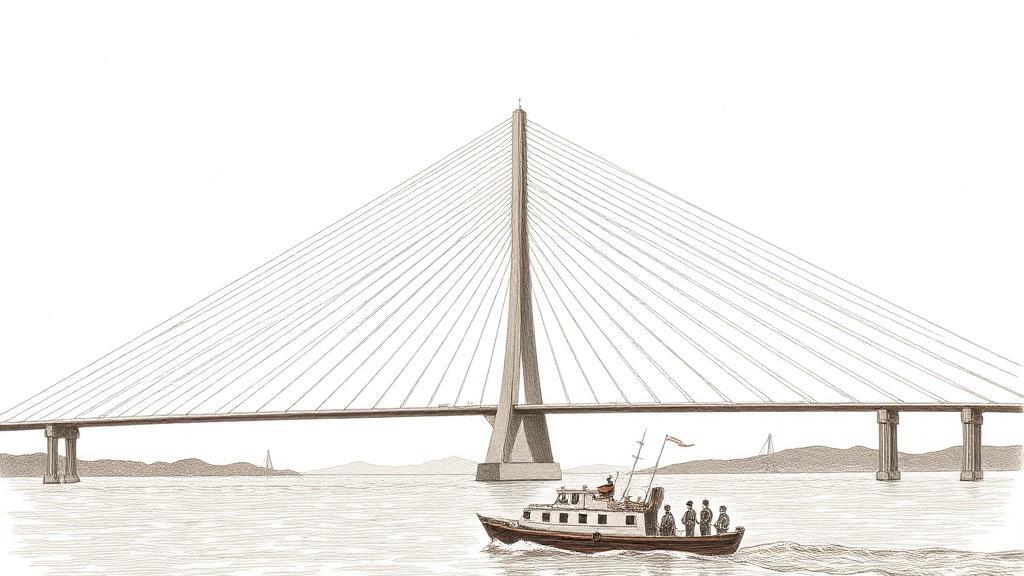
The bridge runs 4.68 kilometres across the sea, with a main cable-stayed span of 560 metres over the deepest channel and towers rising 180 metres. Hyundai Construction, which won the design competition, placed a public observatory inside one of the towers — at 180 metres above open water, the highest bridge observatory above the sea anywhere in the world (Seoul Inside). Six lanes of highway cross below; a cycle-and-pedestrian path runs alongside. Construction began in December 2021 and cost approximately 770.9 billion Korean won, around $560 million.
The engineering liability for a cable-stayed bridge above salt water is the stays themselves. Moisture penetrates any gap in the protective sheathing; saline air then attacks the high-tensile steel wires over decades. The design team addressed this with monitoring sensors embedded in the cables from opening day and built maintenance access to every anchorage point into the structure from the outset. The bridge is not fragile. It is watched.
The surprise came from the accounts department. By September 2026, the bridge was carrying 10.6 million vehicle crossings — growing from roughly 950,000 in January to 1.37 million by September (SBS News). The operators of the airport expressway bridge, whose toll revenues had been deflating since January, filed a lawsuit in September seeking 29.2 billion won in compensation from the Incheon city authority. The bridge that took thirty-five years to approve prompted a lawsuit in nine months.
What the third crossing gave the island was something harder to count than vehicles: resilience. The two existing links occupied a shared geographic corridor, so a collision or closure on the expressway backed up into the tunnel and sometimes halted airport buses mid-route. A crossing on a different alignment broke that dependence. The network had a vulnerability with a geographic shape; the bridge changed the shape.
The observatory at the top of one of the towers rises 180 metres above the channel — the highest above open water anywhere. Visitors pay to stand there and look out across the sea. Below, the ferry route still runs.
Sources
- Cheongna Haneul Bridge — Wikipedia — opening date, main span, tower height, construction timeline, connection to Incheon Airport.
- Cheongna Haneul Bridge Traffic Exceeds 10 Million Vehicles — SBS News English — monthly traffic from January to September 2026, 41.8% ferry vehicle traffic decline, 29.2 billion won lawsuit.
- The bridge that took 35 years to build — Seoul Inside — 35-year planning history, Hyundai Construction design competition, world’s highest bridge observatory above open water.