Chopines, or the politics of walking tall
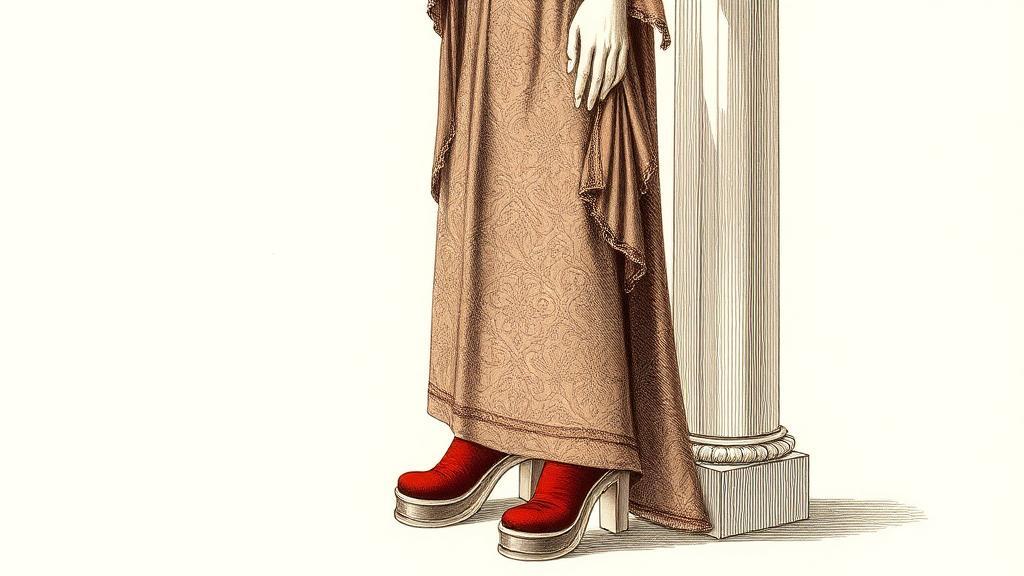
A noblewoman stepping into a Venetian piazza in 1490 did not step so much as float — or rather, totter — supported on either shoulder by a servant. Her shoes were carved from a single block of wood, covered in crimson velvet, and stood twenty inches tall. She could not walk unassisted. She was not expected to. That, in the cold social arithmetic of Renaissance Venice, was rather the point.
The chopine appeared in Venice sometime in the last decades of the fifteenth century, most likely arriving via trade routes from the Ottoman Near East, where similar elevated bath sandals — nalins — had long kept women’s feet dry on wet hammam floors (Fashion History Timeline, FIT). In Venice it found more ambitious employment. The city’s streets were perpetually damp, its alleys frequently flooded, and its noblewomen perpetually attentive to the state of their silk hems. An elevated overshoe solved a practical problem. Then, as tends to happen when practicality intersects with fashion, the solution became the statement.
The chopine — zoccolo in Italian — was a platform built from carved wood or cork, covered in leather, velvet, or gold-embroidered brocade. In Venice the shoes were worn hidden beneath floor-length gowns; the longer the train required to cover them, the more expensive the fabric, and the more evident the wealth. In Spain, where the chapín had its own following, they were worn visible and proudly decorated with metallic lace and brass tacks. Both countries drove the height upward. The tallest surviving example, held today at the Museo Correr in Venice, stands just over fifty centimeters — nearly twenty inches of carved wood (Wikipedia). The wearer’s head would have been level with the mantelpiece.
The city of Venice recognized the hazard. In 1430, the Council passed a law capping chopines at three inches. The law was, to put it charitably, decorative. Sumptuary regulations in Renaissance Italy had roughly the same deterrent effect on aristocratic fashion as polite suggestions. The shoes kept growing. By the sixteenth century, extremely elevated chopines had become the exclusive province of the highest-born women, because only they could afford the servants — typically two — required to move safely in them. The Bata Shoe Museum in Toronto holds a velvet-covered Italian example described, with perfect understatement, as “so tall that the wearer could not walk unaided.”
Shakespeare noticed. In Hamlet, written around 1600, the prince greets a young male actor who has grown since their last meeting: “Your ladyship is nearer to heaven than when I saw you last, by the altitude of a chopine.” The joke landed because English theatergoers in 1600 knew exactly what a chopine was. Venetian fashion — extravagant, slightly absurd, magnificently expensive — had become a European byword.
The chopine’s reign ended roughly as fashion revolutions do: something new arrived that served the same symbolic purpose more elegantly. By the mid-seventeenth century the high-heeled court shoe — slimmer, more manageable, eventually adopted by men — was displacing the chopine. Louis XIV would make the red-heeled pump the definitive emblem of aristocratic status at Versailles within a generation. The height remained. The servants went home.
What the chopine established, quietly and firmly, was that shoe height was a legible social language. A noblewoman in 1490 Venice and a courtier at Versailles in 1680 were communicating the same idea in different dialects: the further your foot is from the ground, the closer your rank is to the sky. The stiletto heel that arrived in the 1950s was, in this sense, the youngest branch of a very old family tree.
Sources
- Chopine — Wikipedia — Origins, heights, Venetian and Spanish variants, Shakespeare’s Hamlet reference, 1430 sumptuary law.
- Chopines — Fashion History Timeline, FIT — Ottoman nalin origins via Venetian trade, construction materials, geographic distribution, social function.
- Bata Shoe Museum — All About Shoes — Museum’s velvet-covered Italian chopine described as requiring a servant to walk; details from the “On a Pedestal” exhibition.