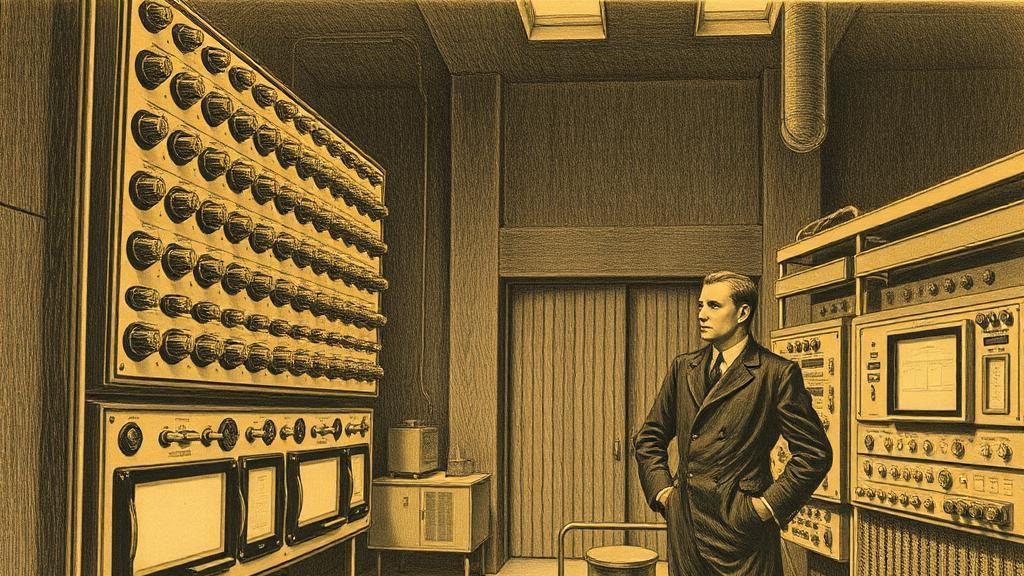
Colossus: the machine that Britain built, classified, and ordered destroyed
On 8 December 1943, in a brick building at the Post Office Research Station in Dollis Hill, North West London, a machine came to life for the first time. It contained 1,600 thermionic valves — glass tubes, each roughly a finger’s width, arranged in banks across a frame the size of a garden shed. Its designer, Tommy Flowers, a senior engineer specialising in telephone switching circuits, watched it run satisfactorily and telephoned the news to Bletchley Park. The machine had no name yet. They would call it Colossus.
The problem it existed to solve had been growing more urgent since 1941. Cryptanalysts at the Government Code and Cypher School at Bletchley were intercepting teleprinter messages between Adolf Hitler and his army commands across occupied Europe, encrypted with the Lorenz SZ42 — a twelve-wheel electromechanical cipher machine the codebreakers codenamed Tunny. Lorenz was far more complex than the Enigma. Breaking a single message by hand could take weeks. Mathematician Max Newman, who ran a section called the Newmanry, convinced himself a machine could determine the wheel settings in hours, if anyone could be persuaded to build one. Wikipedia
Flowers was that anyone. His proposal — replace the second paper tape of the existing Heath Robinson machine with a fully electronic wheel-pattern generator using valves — met immediate scepticism. The received wisdom among engineers was that valves burned out too quickly to be reliable at scale. Flowers disagreed, drawing on his experience with Post Office telephone exchanges: valves lasted perfectly well if kept continuously powered. He started building Colossus anyway, funding part of the work out of his own pocket, in eleven months. The National Museum of Computing
The Mark 1 arrived at Bletchley on 18 January 1944 and successfully attacked its first Lorenz message on 5 February. A Mark 2 — 2,400 valves, five times faster than its predecessor — was operational by 1 June 1944, the morning of D-Day. The machines read paper tape loops at 5,000 characters per second, reducing decryption from weeks to hours. By V-E Day, ten Colossi were running at Bletchley, and 63 million characters of German high-command traffic had passed through them. Computer History Museum
The operators who ran these machines around the clock were, in the main, not the men who built them. By war’s end, 272 Wrens — members of the Women’s Royal Naval Service — staffed the Newmanry alongside 27 men. They set the switches, loaded the tape loops, logged the outputs, and said nothing about any of it for decades.
When the war ended, Flowers was ordered to destroy his documentation. He took his drawings and plans to the boiler room at Dollis Hill and burned them. He received no repayment for the money he had put in himself. The existence of Colossus was not declassified until 1975. By then, ENIAC and the Manchester Baby — machines built after Colossus, in public — had become the official ancestors of the digital computer. Flowers received a modest MBE, an honorary degree, and a line in the histories that his machine had made possible.
A working replica, rebuilt by Tony Sale’s team over fifteen years, was completed at the National Museum of Computing in 2008. It still runs.
Most of the engineers who built Britain’s postwar computers had worked at Bletchley. Officially, they had learned nothing there that was useful.
Sources
- Colossus computer — Wikipedia — Dates, technical specifications (valves, speed), Lorenz context, Flowers’ biography, post-war secrecy and declassification.
- Colossus — The National Museum of Computing — Design rationale, Flowers’ self-funding, declassification delay, the 2008 rebuild.
- 1944 — Computer History Museum — Operational impact, weeks-to-hours reduction, D-Day connection.