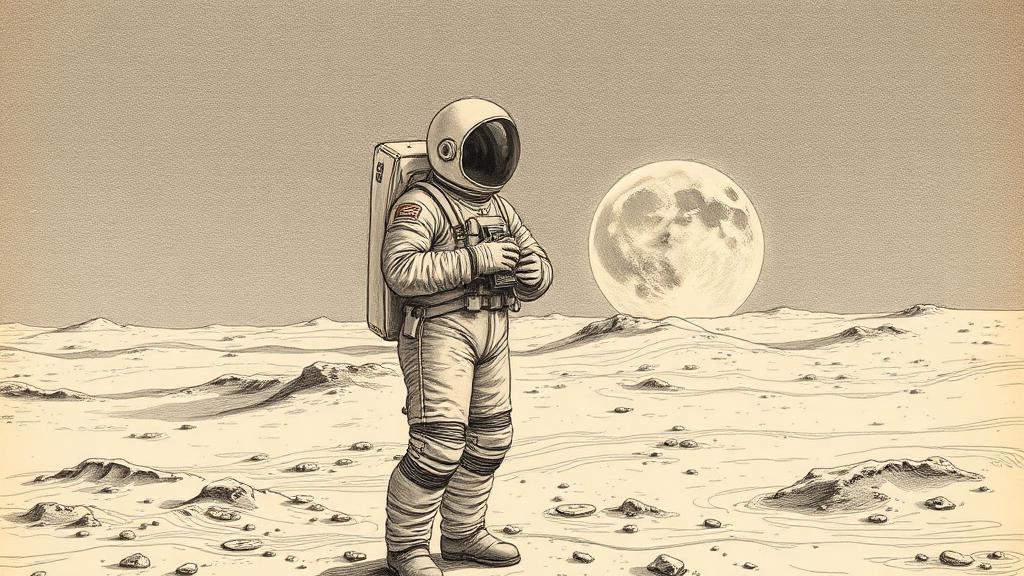
What time is it on the Moon
Sometime in the late 1980s, Neil Ashby sat down with the equations of general relativity and worked out an uncomfortable fact about the GPS satellites then going into orbit. If their clocks ran at exactly the same rate as clocks on the ground, the system would accumulate position errors of about ten kilometres per day. The fix was counterintuitive: set each satellite clock to run slightly slow before launch — by 38.4 microseconds per day — so that once in orbit, relativistic effects would bring it back into sync with Earth. It worked. In 2024, Ashby, then in his eighties and still affiliated with NIST in Boulder, Colorado, found himself doing the same calculation again — for the Moon.
The problem has the same shape. The Moon’s weaker gravitational field and its motion relative to Earth combine to make clocks on the lunar surface tick ahead of Earth clocks by approximately 58.7 microseconds per day — about 21 milliseconds per year. That sounds trivial until you consider that a one-microsecond error in timing maps to roughly 300 feet of position error, the kind of margin that separates a precision landing from a hard impact. With the Artemis program, China’s Chang’e missions, and a growing roster of commercial operators planning long-term lunar operations, someone had to set a common clock.
On April 2, 2024, the Biden White House did exactly that. The Celestial Time Standardization Policy directed NASA to develop a strategy for Coordinated Lunar Time — LTC — by December 31, 2026. The standard would need to do four things: trace logically to UTC, support precision navigation and science, remain self-sufficient if Earth contact was lost, and scale to destinations beyond the Moon. Ashby and his NIST colleague Bijunath Patla supplied the relativistic framework in a paper published in early 2024, proposing a network of atomic clocks on the lunar surface and in orbit — the same architecture GPS uses around Earth, repositioned 384,400 kilometres further out.
That August, the International Astronomical Union gathered at its XXXIInd General Assembly in Cape Town, South Africa. On August 14, member nations voted through Resolution II: a formal mathematical definition of Lunar Coordinate Time, or TCL, constructed using the same relativistic framework the IAU had established for Earth-orbit timekeeping in 1997. The Moon now had a coordinate time ratified by the world’s astronomical community, even before the physical clocks to maintain it were in place.
The self-sufficiency requirement deserves a second look, because it is where the lunar time problem recovers a very old shape. A signal from Earth takes up to 1.3 seconds to reach the lunar surface — far too slow for real-time navigation corrections during a descent. Any lunar time standard must, like Harrison’s chronometer three centuries earlier, hold its own accuracy at the point of use, without reference to a distant master. You cannot phone home when a spacecraft is twenty metres above the landing site.
By December 2025, China’s Academy of Sciences had released LTE440, a lunar time ephemeris accurate to 0.15 nanoseconds over a 25-year span. The tools are assembling before the standard itself is finished — which is roughly how GPS worked too.
Getting the time right on the Moon is, in the end, the same problem as getting it right on a ship in 1759. The ship is simply rather harder to reach.
Sources
- Lunar Time Standard Taking Shape — AIP.org — 58.7 microseconds per day figure, Ashby and Patla roles, NASA SCaN lead, four requirements for LTC
- Celestial Time Standardization Policy — White House OSTP — April 2, 2024 directive, December 2026 deadline, four technical requirements
- A Relativistic Framework to Establish Coordinate Time on the Moon — Ashby & Patla, arXiv:2402.11150 — proposed atomic-clock network architecture, mathematical framework
- IAU XXXII General Assembly Concludes — IAU Press Release iau2410 — Cape Town, August 6–15 2024, Resolution II adopting Lunar Coordinate Time (TCL)
- Lunar Time Ephemeris LTE440 — arXiv:2509.18511 — China Academy of Sciences, December 2025 release, 0.15 ns accuracy over 25 years