Dartmouth, 1956: the summer that named a field
Sometime in the summer of 1956, five people crowded around a dictionary on a stand in a Dartmouth Hall corridor to look up the word heuristic. The five were Oliver Selfridge, Marvin Minsky, John McCarthy, Ray Solomonoff, and Trenchard More — Trenchard More recalled the scene fifty years later, delighted to find the same dictionary still in Dartmouth Hall. Together, on an average afternoon, they were roughly the entire attendance of the most important brainstorming session in the history of computing. They found the definition. They argued about it. They moved on.
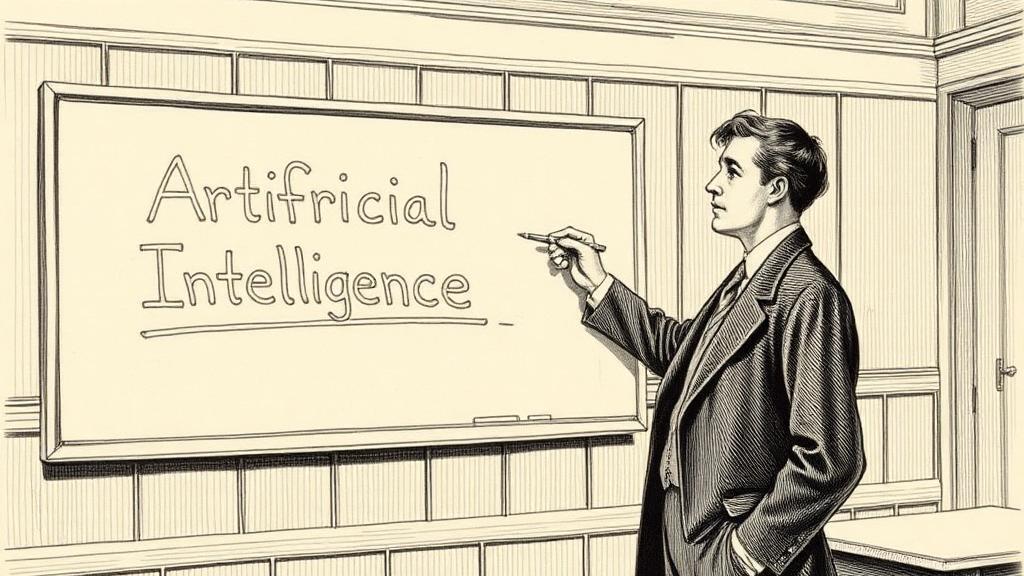
The meeting was called the Dartmouth Summer Research Project on Artificial Intelligence, and the name was the news. McCarthy — a 28-year-old mathematician then on Dartmouth’s faculty — had written the proposal the previous August with three co-authors: Minsky from Harvard, Nathaniel Rochester from IBM, and Claude Shannon, lately of Bell Labs. The Rockefeller Foundation provided half the funding they requested. The project ran June 18 to August 17, 1956, in Hanover, New Hampshire.
Eleven researchers were planned for the full summer; in practice the daily headcount ran between three and eight, with roughly twenty people cycling through for varying stints. Only McCarthy, Minsky, and Solomonoff stayed the whole two months. Of the phrase “artificial intelligence” itself, McCarthy later explained that he had coined it deliberately: “automata studies” — the competing umbrella — felt to him too diffuse to name the specific thing he wanted to chase, which was making machines behave intelligently (McCarthy, Stanford).
The proposal’s central claim was a bet: “every aspect of learning or any other feature of intelligence can in principle be so precisely described that a machine can be made to simulate it.” In 1956 the fastest computers on earth filled rooms and were largely occupied with ballistics tables. The claim was either visionary or reckless. The workshop was an argument about which.
Newell and Simon were the stars. Allen Newell and Herbert Simon had arrived from Carnegie Tech carrying printouts of their Logic Theory Machine — a program that had already proved 38 of the 52 theorems in Whitehead and Russell’s Principia Mathematica, one of them more elegantly than Russell himself had managed. McCarthy recalled they “were the stars of the show,” presenting not just proofs but the architecture behind them: list structures and the IPL programming language. Elsewhere in the same weeks, IBM’s Alex Bernstein was working on a chess program. McCarthy invented alpha-beta pruning on the spot and recommended it. Bernstein was skeptical.
What the summer did not produce was consensus. The session surfaced a split that would define the next four decades: some researchers wanted to replicate brain function through neural networks; others preferred symbolic logic and heuristics. Neither side convinced the other. What the summer did produce was a name, a community, and a research agenda. Symbolic AI, expert systems, natural-language processing, and eventually machine learning all trace their institutional lineage to this one New Hampshire summer. The Dartmouth workshop is sometimes called the Constitutional Convention of AI — and like most constitutional conventions, it mostly settled the question of where the tent was, not what would happen inside it.
They didn’t solve intelligence that summer. They did something harder to undo: they named it.
Sources
- Artificial Intelligence Coined at Dartmouth — Dartmouth College — institutional account of the 1956 project and its founding significance
- Dartmouth Workshop — Wikipedia — dates, attendance figures, proposal text, and overview of outcomes
- The Dartmouth Workshop as Planned and as It Happened — John McCarthy, Stanford — McCarthy’s own account of funding, key presentations, and the origin of the term “artificial intelligence”
- What They Did That Summer in Dartmouth — IEEE Spectrum — Trenchard More’s recollection of the dictionary-lookup scene and the intellectual tensions of the workshop