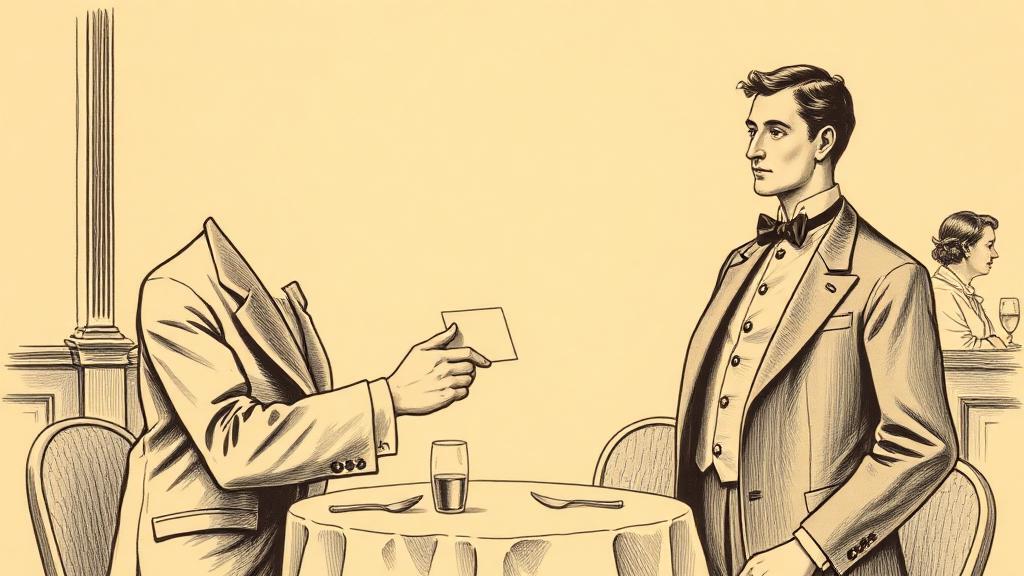
One card, many places, pay later: the Diners Club, 1950
The waiter at Major’s Cabin Grill, a midtown Manhattan restaurant in the shadow of the Empire State Building, had no idea what to make of it. February 1950: a man named Frank McNamara had just handed him a small rectangle of cardboard instead of cash. The waiter carried it to the owner, Major Satz, who shrugged and approved. The transaction went through on a triplicate carbon form. The receipt, the card, the signature — the whole ritual we perform at checkout counters — had just been invented.
The cardboard was Diners Club card number 1000. McNamara carried it; his lawyer Ralph Schneider held 1001; their partner Matty Simmons had 1002. The event entered company lore as “the First Supper,” which is a grand name for a February lunch, and perhaps the first small liberty Diners Club took with the truth.
McNamara incorporated the company on February 8, 1950, with $1.5 million in starting capital. The founding story you have probably heard — an embarrassing dinner where he forgot his wallet — was invented for the press by Simmons, who later admitted it. What McNamara actually recognized, on a commuter train home to Long Island, was that every charge account in America was siloed. Sears let you tab at Sears. Macy’s at Macy’s. Nobody had built a card that worked everywhere.
At launch, 27 restaurants had signed on, their names printed on the card’s back, and there were exactly 200 cardholders — nearly all friends of the founders. The model was straightforward: merchants paid Diners Club 7 percent of each charge; cardholders received one monthly bill. The club was a middleman that let people dine on credit without requiring each restaurant to run its own lending operation.
The elegance nearly killed them. The float — paying restaurants before collecting from cardholders — was ruinous. Simmons pushed through a $3 annual membership fee, which cut the cardholder base by roughly half. The half that left were the freeloaders. The half that stayed were people who actually traveled on business regularly. The company turned profitable almost immediately.
Growth then became remarkable. By year-end 1950, Diners Club had 20,000 members. By 1951, 42,000. By 1952, approaching 500,000 — and that year Alfred Bloomingdale, who had been running a rival card called Dine & Sign, paid McNamara $500,000 for his shares and merged the two operations. McNamara died in 1957, of a heart attack at 40, before credit cards had become a feature of ordinary life.
What Diners Club changed was a conceptual separation that sounds obvious only in hindsight: the moment of buying and the moment of paying do not have to be the same moment. Before 1950, they almost always were, unless you knew the merchant personally. After 1950, a stranger with the right card could dine, fly, rent a car, stay in a hotel — all on a single monthly bill from one company in New York. Bank of America introduced its own card in 1958; Visa absorbed it in 1976.
The cardboard became plastic, then chip, then tap. The principle McNamara sketched on a Long Island commuter train has not moved.
Sources
- Diners Club International — Wikipedia — founding date, founders, early membership numbers, the 7% merchant fee model, growth trajectory.
- The Day Cash Died — The Saturday Evening Post — the first transaction at Major’s Cabin Grill, Simmons’s admission that the forgotten-wallet story was fabricated, card numbers, early business model details.
- Diners Club, the First Credit Card — History of Information — founding context, the distinction from store-specific charge accounts, early growth figures.