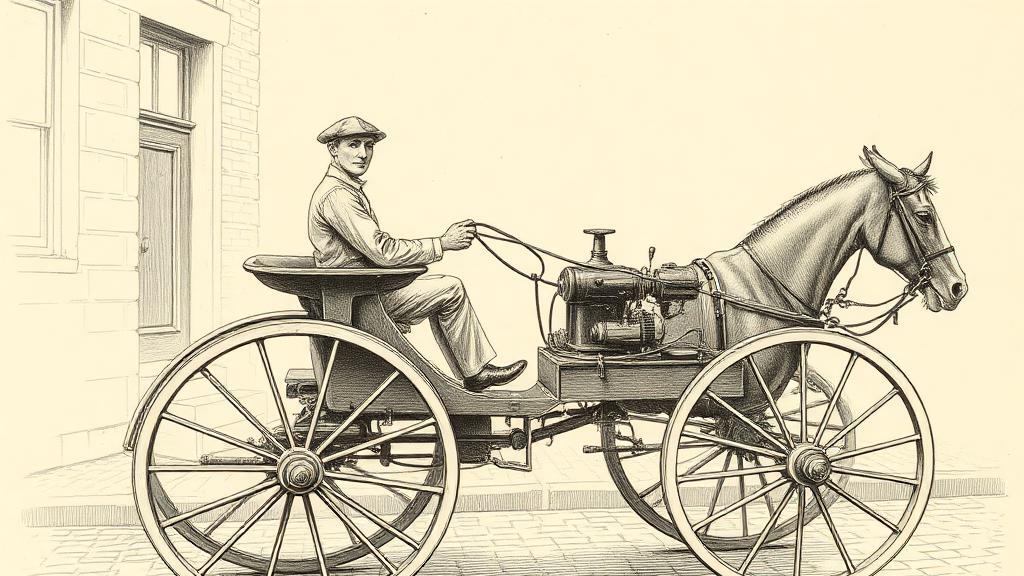
The Duryea Motor Wagon: the first American gasoline automobile
On a September morning in 1893, a converted buggy fired its single-cylinder engine and rolled down Taylor Street in Springfield, Massachusetts, under its own power. The transmission failed after a few hundred feet. Frank Duryea, twenty-four years old and the mechanical half of a two-brother operation, climbed down, adjusted the gearing by hand, and drove another half mile before dark. Nobody had been told to watch. The local paper, the Springfield Republican, didn’t run a story until November 10 — and kept it short, as if unsure what category to put it in.
Charles Duryea, eight years Frank’s senior, was a bicycle mechanic who had seen a Benz gasoline-powered car at an exhibition in Ohio and decided, with characteristic confidence, that he could build an American one. He drew the designs; Frank built and drove the machine. The division was precise and permanent: Charles was the visionary and salesman, Frank the engineer who made the designs function. They worked out of rented space at 47 Taylor Street, having come to Springfield because the city’s machine shops could supply what Canton, Illinois, could not.
Their vehicle was not elegant. They had bought a secondhand horse-drawn buggy for $70 and fitted it with a four-horsepower, single-cylinder gasoline engine of their own construction. The transmission that failed on Taylor Street was a friction design they had devised themselves — there was no other to borrow from. The carburetor was spray-type, the ignition low-tension, the wheels 54 inches across. The whole machine, when it worked, could reach 20 miles an hour on a flat road. When it didn’t work, it was a $70 buggy with extra parts.
The clearest proof of the machine’s worth came on November 28, 1895 — Thanksgiving Day in Chicago. The Chicago Times-Herald sponsored the first American automobile race: 54 miles from Jackson Park to Evanston and back. Six vehicles lined up at 8:55 a.m. in a snowstorm. Frank drove Car Number 5. He finished first — the only vehicle to complete the course — in just over ten hours, averaging 7.3 mph through slush and cold, and collected the $2,000 prize. It was as good an argument as anyone could have made, in the available weather.
Charles founded the Duryea Motor Wagon Company in March 1896, the first incorporated American firm built expressly to manufacture automobiles for sale. Workers at Taylor Street hand-built 13 identical vehicles that year — the largest automobile production in the United States at the time, a claim that would require more qualifications with every passing month. The brothers parted on bad terms not long after. The company folded in 1898. The original buggy, stored in 1894 and rescued in 1920 by a collector named Inglis Uppercu, ended up at the Smithsonian, where it remains.
By 1913, Henry Ford’s moving assembly line in Highland Park was producing a Model T chassis every 93 minutes. Between that factory floor and a single Taylor Street buggy inching through a November test run lay twenty years, and a continent waking up to what a gasoline engine could mean on a road.
Sources
- Duryea Motor Wagon — Wikipedia — technical specifications, first road test date, Springfield Republican notice, Inglis Uppercu acquisition.
- Duryea Motor Carriage, 1893 — Smithsonian National Museum of American History — collection record and object provenance.
- America’s First Car Hits the Road — Automotive History — first test details, transmission failure, 1895 Chicago Times-Herald race facts.
- The Duryea Motor Wagon — MotorCities — brothers’ backgrounds, company founding, 13-car production run.