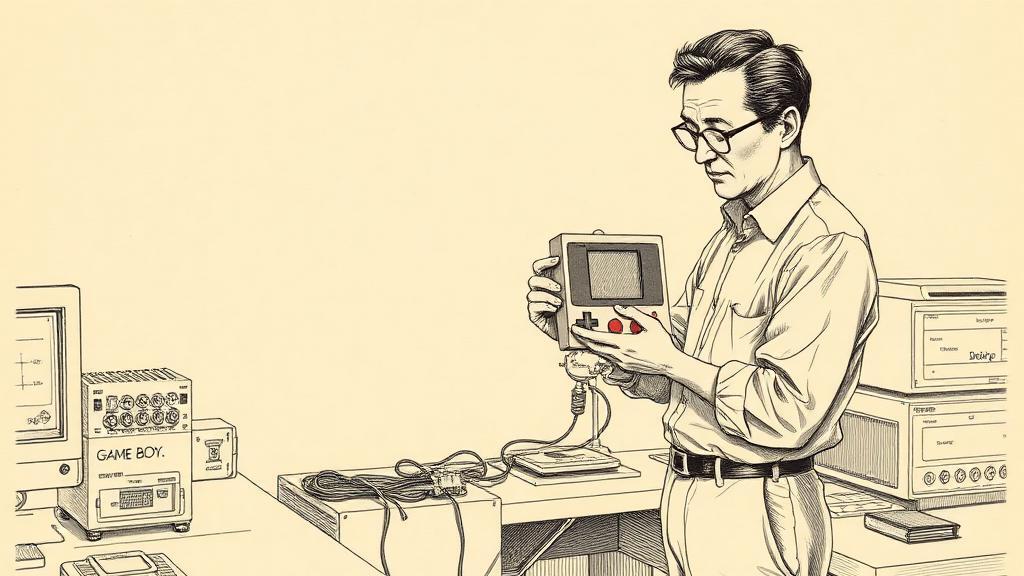
Game Boy: the gray brick that bet on batteries and won
On July 31, 1989, a gray plastic rectangle hit American toy shelves for $89.99 — no color, no backlight, a screen that fogged over in direct sunlight, and four AA batteries. The Atari Lynx had launched the same year with a backlit color display. Sega’s Game Gear, arriving in 1990, would offer color too. Both required six batteries and delivered a few hours of play before going silent in a child’s back seat. Nintendo’s gray brick, meanwhile, ran for thirty hours.
That arithmetic — battery life as the decisive battlefield — was entirely deliberate. Gunpei Yokoi, head of Nintendo Research & Development 1, built his career on what he called lateral thinking with withered technology: the art of finding new uses for components that engineers had already optimized to cheap reliability. He had applied the same logic to the Game & Watch in 1980, a line of single-game LCD handhelds reportedly inspired when Yokoi noticed a bored businessman fiddling with a pocket calculator on a Shinkansen train (Wikipedia). The Game Boy was that idea taken to its logical completion: a handheld console with swappable cartridges, built from mature, affordable parts. The Sharp SM83 processor inside ticked at 4.194304 MHz — slow by 1989 standards — and the 2.5-inch dot-matrix display rendered at 160×144 pixels in four shades of green-gray (Wikipedia). The device launched in Japan on April 21, 1989, at ¥12,500, and the first 300,000 units were gone within days.
Nintendo sold the Game Boy on a budget most families could actually meet, but the machine’s best argument arrived in the box with it. For the North American launch, Nintendo bundled Tetris, a puzzle game by Soviet programmer Alexey Pajitnov that had been quietly captivating everyone from teenagers to their grandparents. Where Super Mario Land appealed to the existing Nintendo crowd, Tetris had no demographic — it was a game for anyone who had ever stacked anything (Smithsonian Magazine). The pairing sold roughly 40,000 units on the first day in the US, and one million within weeks.
The competitors never recovered their footing. The Atari Lynx was technically superior by almost every specification on the box. The Sega Game Gear had a sharper, brighter display. Both were correct choices by people who believed that better specs win markets. They underestimated what it meant to be the machine that still worked on the third hour of a cross-country flight.
The Strong National Museum of Play inducted the Game Boy in 2009, crediting it as the platform that did “more to put gamers on the go” than any other (The Strong). That is an understatement. Before 1989, “video game” was synonymous with a fixed screen in a fixed room. After 1989, the game traveled with you — in a coat pocket, in a school backpack, in the hands of a person waiting for a bus. Combined sales of the Game Boy and its successor, the Game Boy Color, reached 118.69 million units by the time the line was discontinued in 2003.
Gunpei Yokoi died in a road accident in October 1997, a year after leaving Nintendo in the wake of the Virtual Boy’s failure — his only commercial stumble in thirty years. He didn’t see the gray brick reach 118 million sales, or Nintendo carry his battery-first philosophy all the way to the Switch. The cartridge slotted in the back; the battery held; the game went wherever you did.
Sources
- Game Boy — Wikipedia — launch dates, hardware specs, sales figures, and development history.
- Thirty Years Ago, Game Boy Changed the Way America Played — Smithsonian Magazine — Tetris bundling strategy, competitive context, and first-day US sales.
- Nintendo Game Boy — The Strong National Museum of Play — museum assessment of the Game Boy’s cultural significance and 2009 induction.