Generative adversarial networks: invented overnight in a Montreal brasserie
On the night of 26 May 2014, Ian Goodfellow walked home from a farewell party at Les 3 Brasseurs — a Montreal brasserie — with a problem he hadn’t intended to take on. Friends had cornered him at the bar and asked for help: they wanted to teach a computer to generate realistic photographs. His first response was skepticism. His second response, somewhere between the pint and the pavement, was an idea.
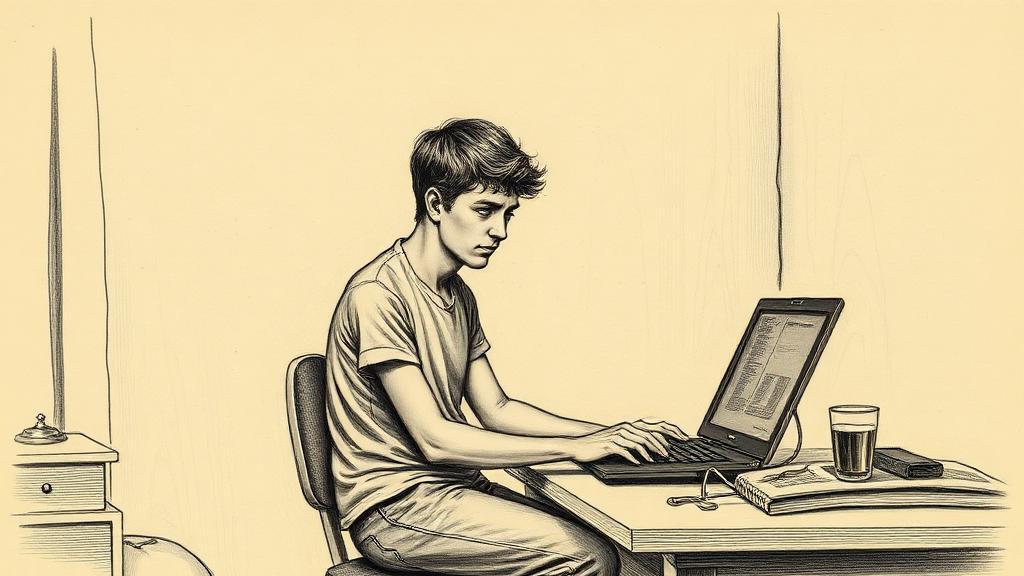
Goodfellow was a doctoral student at the Université de Montréal, working under Yoshua Bengio, with co-authors Jean Pouget-Abadie, Mehdi Mirza, Bing Xu, David Warde-Farley, Sherjil Ozair, and Aaron Courville. The deadline for the Neural Information Processing Systems conference was days away. He went home, opened his laptop while his girlfriend slept, and by the small hours had something running on MNIST — the handwritten-digit benchmark every deep-learning researcher keeps around for exactly this kind of reckless midnight experiment. It worked on the first attempt.
The idea has a brutal elegance. A GAN — Generative Adversarial Network — is two neural networks in permanent competition. The generator takes random noise and tries to produce outputs that resemble real data. The discriminator receives both real examples and fakes from the generator, and its only job is to tell them apart. Each network improves through the other’s resistance. Goodfellow reached for a counterfeiting analogy in the original paper — forgers versus police — but the deeper point was simpler: rivalry, structured correctly, is a learning algorithm.
What the architecture avoided mattered as much as what it did. Earlier generative models required explicit probability distributions, hand-engineered with care. GANs dispensed with all of that. The generator never directly models the data’s distribution; it learns, through the discriminator’s feedback, to produce things that pass. Goodfellow could prove in theory that training converges when the generator has matched the true data statistics exactly. In practice, the system learned long before anyone fully understood why.
“Generative Adversarial Nets” appeared at NIPS 2014 that December. Yann LeCun, then Facebook’s chief AI scientist, called it “the coolest idea in deep learning in the last twenty years.” The paper became one of the most-cited in machine-learning history — and one of the shortest paths from a bar conversation to a field-defining result.
What came afterward was its own decade. Alec Radford’s DCGAN in 2015 stabilized GAN training with convolutional architectures. By 2018, NVIDIA’s Progressive GAN was producing photorealistic faces of people who had never existed. StyleGAN followed, and with it deepfakes — synthetic video of real people saying things they never said. Quieter applications spread into medical imaging, drug discovery, and game-asset generation: anywhere a model needed plausible examples of things it hadn’t seen enough of.
The framework Goodfellow sketched in a single night went on to reshape how machines learned to create — and, as a side effect, how hard it became to trust what you see.
Sources
- MIT Technology Review — “The GANfather” — the Les 3 Brasseurs origin story, LeCun’s quote, the first-attempt success, Goodfellow’s career afterward.
- “Generative Adversarial Nets” — NIPS 2014 — the original paper; the forger-versus-police framing and the theoretical convergence proof.
- Generative adversarial network — Wikipedia — timeline of subsequent architectures (DCGAN, Progressive GAN, StyleGAN) and application domains.