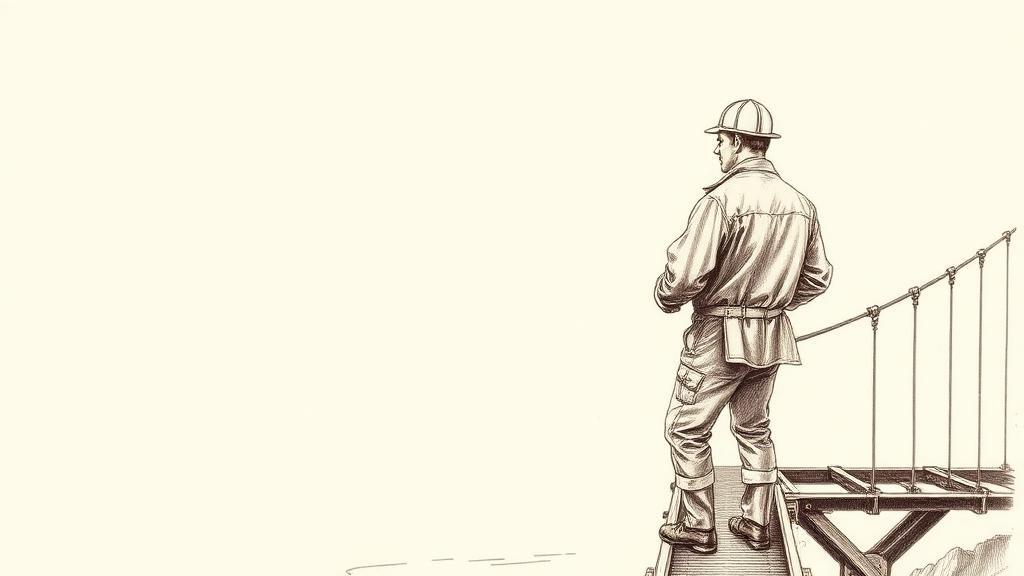
The Golden Gate Bridge, or the engineer the plaque forgot
On May 27, 1937, roughly 200,000 people walked across the Golden Gate Bridge before a single car had used it. They came on roller skates, on stilts, on unicycles. The bridge had been declared impossible: ferocious winds and blinding fogs, experts warned, would prevent both construction and operation. Apparently 200,000 San Franciscans were determined to personally verify the contrary.
The Golden Gate strait runs roughly 6,700 feet across, with strong tidal currents pushing through a channel 372 feet deep. Joseph Strauss, a compact, relentlessly promoting engineer from Cincinnati who had already built over 400 bridges, had been campaigning for a crossing since 1917. By 1928 he had a commission; by January 1933, he had workers in the water.
What Strauss had, and rarely acknowledged, was Charles Ellis. Ellis was a University of Illinois structural engineer who joined Strauss’s firm in 1922 and spent nine years calculating the loads that would make the bridge buildable: aerodynamic forces on the cables, stresses on towers 746 feet above the waterline, the geometry of a main span that would run 4,200 feet — longer than any suspension bridge then standing. When the final engineering drawings were filed at the Library of Congress, Ellis’s signature was on them. In December 1931, Strauss accused Ellis of inefficiency and fired him without severance or public credit. When the bridge opened and Strauss published his official account, Ellis’s name did not appear. He died in 1949. A plaque acknowledging his contributions was installed on the south tower in 2012, seventy-five years after the fact.
The two main cables — each 36.5 inches in diameter — contain 27,572 individual strands of galvanized wire; together, roughly 80,000 miles of it, enough to wrap the Earth three times. Consulting architect Irving Morrow chose the color: International Orange, selected partly because it reads through the Bay’s persistent fog better than silver or gray.
The safety record was mixed. Strauss insisted on a $130,000 safety net strung beneath the deck — the first such measure on a major bridge. It caught 19 workers, who formed an informal fraternity called the Halfway to Hell Club on the theory that a fall into the net was only half the journey a bridge death conventionally implied. On February 17, 1937, a scaffold collapsed and pulled the net down with it. Ten men died.
The next day — May 28 — President Roosevelt pressed a telegraph key in the White House and declared the bridge open to vehicles from 3,000 miles away. The bridge was plainly open already — 200,000 people had walked it the morning before — but Roosevelt had a point. The Golden Gate wasn’t merely a crossing. It demonstrated that suspension bridges could span distances and depths that engineers had previously reserved for their nightmares.
Every long-span suspension bridge built since — Mackinac, Humber, Akashi Kaikyō — owes something to the calculations a professor in Urbana spent nine years on before being shown the door.
Sources
- Golden Gate Bridge — Wikipedia — opening dates, crowd size, dimensions, cable specifications, casualties, Irving Morrow color choice.
- Joseph Strauss — Golden Gate Bridge District — Strauss biography, team composition, project timeline.
- Charles Alton Ellis — Wikipedia — Ellis’s design role, 1931 dismissal, 2012 plaque.
- Half Way to Hell Club — Wikipedia — safety net, 19 workers saved, club formation.