Gutenberg's press: forty-two lines that changed Europe
In the autumn of 1455, a workshop in Mainz smelled of oil-based ink and fresh paper. Somewhere on its racks, between 160 and 185 copies of a Latin Bible were drying — each set in crisp 42-line columns, each close to finished. Across town, at the Archbishop of Mainz’s court, the man who printed them was about to lose every one.
Johann Gutenberg had been perfecting his press for roughly five years. He was a goldsmith’s son, trained in metalwork, and he had borrowed the money to build his workshop from a Mainz merchant named Johann Fust. Fust lent him 800 guilders in 1450 and another 800 around 1452, at 6% interest, for what the court documents called the werk der bücher — the “work of the books.” The exact nature of the project was a secret. The interest was not.
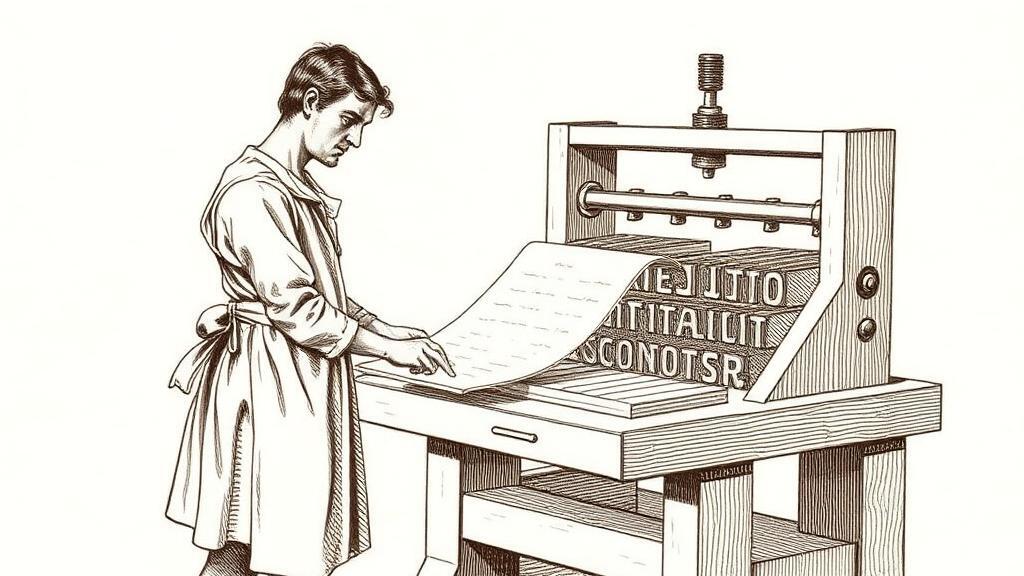
Three innovations made Gutenberg’s press different from everything that came before. The first was the adjustable mold: a device that could cast individual metal letters to any width, so a slender i and a broad m came from the same tool, each identical, each usable thousands of times. The letters were cast from an alloy of lead, tin, and antimony — hard enough to survive repeated impressions without deforming. The second was oil-based ink. Earlier woodblock printers used water-based formulas, which slid off metal type; Gutenberg’s version, thick and sticky, transferred cleanly onto vellum or damp paper. The third was the press itself — a wooden screw mechanism adapted from the wine and paper trades, capable of applying even, firm pressure across a full page in a single pull.
By 1455, a trained compositor could set a page and pull a proof in minutes. What had taken a scriptorium months now took an afternoon.
On November 6, 1455, Fust appeared before the Archbishop’s court. He sued for 2,026 guilders — principal plus accumulated interest. Gutenberg didn’t have it. The court found for Fust, who walked away with the press, the type, the unsold Bibles, and Gutenberg’s master printer, Peter Schoffer — who, it emerged, was Fust’s son-in-law. Gutenberg got nothing. The Helmasperger Notarial Instrument, the legal record of the suit, is the only surviving document that places Gutenberg in direct connection with the Bible that bears his name.
He opened another shop and kept working. In 1465, Archbishop Adolph von Nassau granted him the title Hofmann — gentleman of the court — with a small annual stipend, wine, and grain. He died in Mainz in 1468. His grave is gone; the Franciscan church where he was buried no longer exists.
Fust and Schoffer sold the Bibles. Within a generation, presses were operating in Venice, Paris, London, and Cologne. By 1500, roughly 20 million printed books circulated in Europe — more than all manuscripts produced in the previous thousand years. When Martin Luther nailed his 95 Theses to a Wittenberg door in 1517, the pamphlet was in print across Germany within weeks. The Reformation ran on a press Gutenberg no longer owned.
Of the 160 to 185 copies he printed, 48 survive substantially complete. Two are at the British Library in London. The press he lost is still running.
Sources
- Johannes Gutenberg — World History Encyclopedia — technical details of the press and type-casting process, post-lawsuit career, and Gutenberg’s death in 1468.
- Gutenberg Bible — National Geographic Education — printing dates, number of copies produced and surviving, and the scale of the printing revolution by 1500.
- Fust vs. Gutenberg: The Helmasperger Notarial Instrument — History of Information — the November 6, 1455 lawsuit, the 2,026-guilder debt, and what Fust took from the workshop.