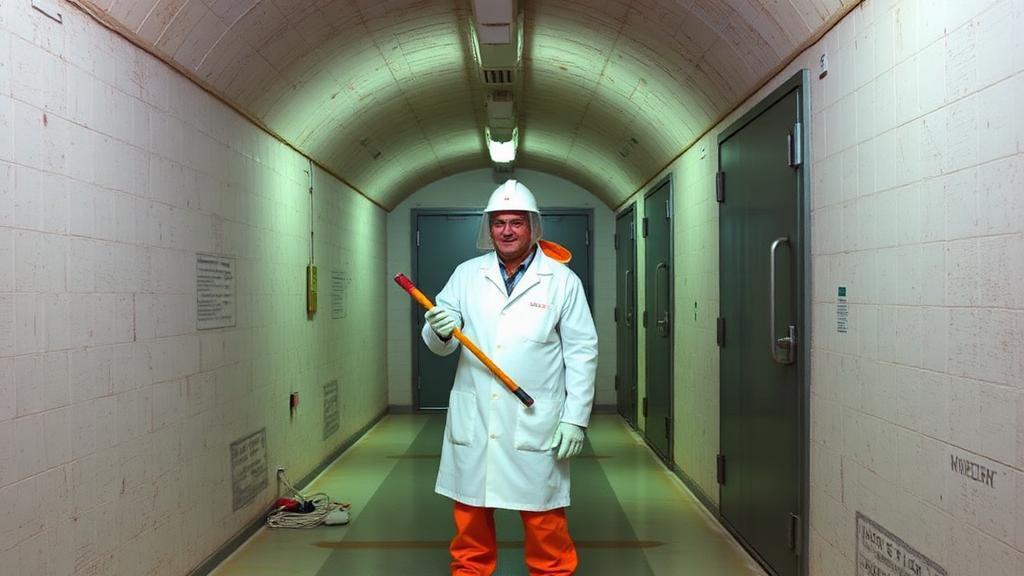
Half-Life, or how Valve put the story inside the corridors
On the morning of November 19, 1998, players across North America slid a CD into their drives and watched a scientist in an orange hazard suit step into a mine cart. No narrator explained what was happening. No cutscene preceded the action. The cart began to move, and for the next ten hours the game never once pried control from the player’s hands. This was not an accident. It was the whole design.
Half-Life was the debut game from Valve Software, a studio Gabe Newell and Mike Harrington had founded in 1996 in Kirkland, Washington, after leaving Microsoft with enough stock options to self-fund an idea. Neither had shipped a game before. They licensed the Quake engine from id Software, then rewrote roughly seventy-five percent of it — calling the result GoldSrc — to serve a game that needed to feel different from Quake in every respect. The protagonist they settled on was Gordon Freeman, a theoretical physicist who says nothing throughout the entire game. The silence was deliberate: collapse the distance between character and player, and the player becomes the character.
What the game built on that engine was the departure. Where Doom and Quake chopped their worlds into discrete arena-rooms, Half-Life presented Black Mesa as a seamless research installation — laboratories connecting to tram tunnels connecting to alien-overrun sub-basements, all continuous, no cutscene breaking the spell. The story was told through scripted events the player walked through: scientists arguing in cafeterias, security guards dying mid-sentence, alien portals tearing open while the player still held the crowbar. Valve hired Marc Laidlaw, a science fiction novelist, to shape the narrative around a single principle: the story had to live in the corridors.
Here is the part most accounts elide. In mid-1997, after a year of development, Valve gathered to play what they had. It was not good — too much felt like a Quake clone with a plot attached rather than a world that required a gun. The company scrapped it. Not revised, not patched: scrapped. The planned November 1997 release date came and went. Valve restarted using a process they called the “cabal” — rotating groups from different disciplines, meeting intensively to play, argue, and rebuild from observation. When Newell was asked about the delay, he offered the formula that became a studio axiom: “Late is just for a little while. Suck is forever.”
The rebuilt game scored 96 on Metacritic and won more than fifty Game of the Year awards. Valve had budgeted for 180,000 lifetime copies. Half-Life sold 500,000 in the first two months and nine million by 2008, earning the Guinness record for best-selling PC first-person shooter. IGN later observed that FPS history “breaks down pretty cleanly into pre-Half-Life and post-Half-Life eras.”
What Valve exported was a design premise: a player’s line of sight is sacred, and breaking it to run a cinematic is an admission the game couldn’t hold their attention on its own. The mod community that grew around Half-Life produced Counter-Strike within a year. Steam, the digital storefront that now dominates PC gaming, grew from Valve’s need to update Half-Life without printing new discs.
That premise — show, don’t stop and explain — is now so embedded in game design that violating it requires justification. Half-Life made it the default.
Sources
- Half-Life — Wikipedia — Valve founding, development history, GoldSrc engine, Gordon Freeman, Marc Laidlaw, commercial performance, and the mid-development rework
- Gabe Newell on game delays — GameSpot — Newell’s “Late is just for a little while. Suck is forever” philosophy and the 1997 delay decision