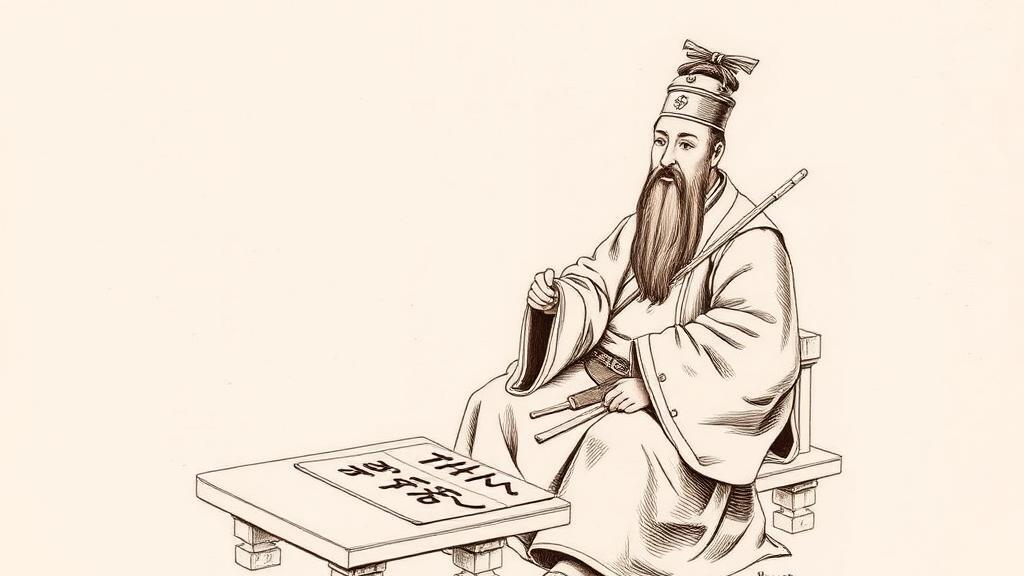
Hangul, or the alphabet that came with a user manual
In the twelfth month of 1443, the Annals of the Joseon Dynasty record, with characteristic brevity, that the king had personally created twenty-eight letters. No committee report, no debate, no record of the preceding months — just a fact deposited into the official chronicle like a stone into still water. The king was Sejong the Great, he was fifty-one years old, his eyesight was failing from decades of reading, and he had just invented an alphabet.
He called it Hunminjeongeum — “Correct Sounds for the Instruction of the People” — and he had done most of the work in secret.
The problem Sejong was solving was real. Korea had been transcribing its language with Chinese characters for centuries, a system so poorly suited to Korean phonology that only the educated elite could use it fluently. The yangban nobility controlled written knowledge, and they had good reason to keep it that way. A peasant who couldn’t read couldn’t challenge a land deed, write a complaint, or follow a law. Illiteracy was not just inconvenient; for the ruling class, it was useful.
Sejong’s solution was brutally ingenious. Each consonant in Hangul was drawn to represent the position of the mouth that produces it: ㄱ shows the back of the tongue pressing upward against the palate; ㅁ shows lips pressed together; ㅅ depicts the incisor teeth (Wikipedia). Additional consonants were built by adding strokes to represent “harsher” versions of the same sounds — a logical derivative system a child could learn in an afternoon. Vowels followed a separate geometric principle based on heaven, earth, and humanity. The whole system could be taught in a day.
The nobility, predictably, hated it.
In February 1444, Choe Malli, an associate professor in the Hall of Worthies — the same royal think tank Sejong had founded to advance Korean scholarship — filed a formal protest. Creating an independent script, he argued, was something only barbarians did. China had always set the cultural standard, and departing from it was a civilizational embarrassment. Seven scholars signed on. Sejong fired Choe, then reinstated him the next day in what appears to have been a face-saving arrangement. Choe resigned anyway and went home, where he died in 1445 — one year before Sejong formally published the Hunminjeongeum in September 1446, complete with a companion volume, the Haerye, explaining in precise phonetic theory exactly why each letter was shaped as it was.
That companion document is unusual to the point of being unique. Every other major writing system — Latin, Greek, Arabic, Chinese — arrived without instructions. Hangul arrived with a design rationale. Scholars today can tell you not just what Sejong built but precisely why each stroke went where it did.
The elite kept calling Hangul eonmun — “vulgar script” — or, more dismissively, “women’s letters.” That last epithet proved prophetic in a way its coiners didn’t intend. Denied the classical Chinese education reserved for men, Korean women adopted the new script and used it to write letters, stories, and eventually novels. Hangul survived the yangban’s contempt, a ban by King Yeonsan in the early sixteenth century, and Japanese colonial suppression from 1910 to 1945, by being exactly what Sejong designed: simple enough to teach yourself.
About 80 million people write in it today. Linguists still call its phonological design unmatched among the world’s alphabets. The letters Sejong shaped around the positions of the human mouth came with instructions, and the instructions turned out to be right.
Sources
- Hangul — Wikipedia — consonant design philosophy, letter count, publication in 1446, suppression and revival.
- The King’s Letters — Damn Interesting — creation timeline, the opposition, and how women kept the script alive.
- Ch’oe Manli — Language Log — Choe Malli’s specific objections and the firing-then-reinstatement.