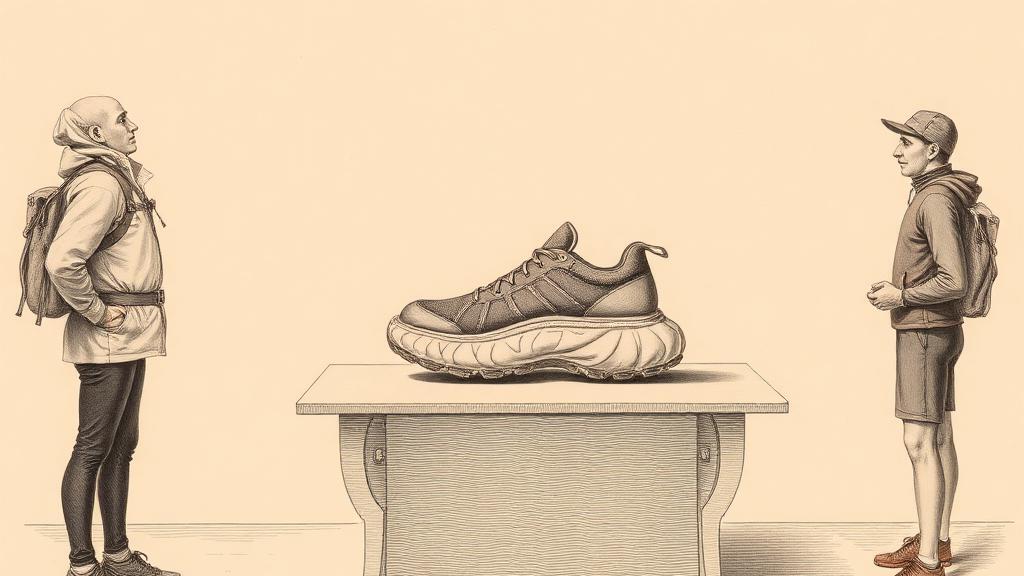
HOKA One One: the clown shoe that changed running
A physical therapist named Mark Plaatjes — the 1993 world marathon champion, now co-owner of a running shop in Boulder, Colorado — was working a trade show floor in December 2009 when a Frenchman pressed a prototype into his hands. The shoe was unlike anything Plaatjes had encountered in thirty years of running. Its midsole was enormous, deep enough to make the whole construction look unstable. The sole curved beneath the heel and toe in a continuous arc, like the bottom of a rocking chair. Plaatjes laced it up and jogged a few steps. “Clearly it was something new and different,” he said later, “but it made sense.” Boulder Running Company bought 770 pairs — the majority of HOKA’s entire first production run of a thousand.
The shoe had been conceived that same year in the French Alps, near Chamonix, by Jean-Luc Diard, Nicolas Mermoud, and Christophe Aubonnet — all three veterans of the Salomon product team, all three passionate trail runners who had grown tired of what descending a technical mountain at speed did to their legs. The problem they were solving was not comfort in the ordinary sense. It was force management on a steep downhill, where the body absorbs roughly three to four times its body weight with every footfall. They looked at powder skis, which float over unstable terrain by distributing load across a wide surface rather than cutting through it. They looked at mountain bike tires. The thick foam midsole with its curved, rolling sole was their answer. They named it after a Māori phrase that meant “to fly over the earth”: HOKA One One.
The timing was almost comic. That same year, Christopher McDougall published Born to Run, the bestselling account of the Tarahumara — a people of Mexico’s Copper Canyons who ran hundred-mile distances in thin leather sandals. The book argued that the modern running shoe, with its elevated heel and motion-control reinforcements, was the cause of running injuries, not the cure. Vibram FiveFingers — a shoe so minimal it was essentially five individual toe pouches stretched over a rubber sole — had been launched in 2005 and sales were about to surge. The entire direction of the industry in 2009 was toward subtraction.
HOKA went the other way.
Ultramarathon runners discovered the shoes first, which makes a certain logic: they are the athletes most punished by cumulative impact over hundreds of miles of trail. Karl Meltzer — who had won more 100-mile races than anyone in recorded history — tried a pair and called them “clown shoes.” He kept wearing them, and by 2015 had his own HOKA signature model: the Speedgoat, named for his Utah mountain running nickname. The wider running world followed, first bemused, then converted. The word “maximalist” entered footwear vocabulary as the direct antonym of the minimalist moment that HOKA had, without quite intending to, helped dismantle.
Deckers Brands — which also owns UGG and Teva — acquired HOKA in April 2013 for an undisclosed sum. By then the minimalist wave had already begun to recede under the weight of its own injuries. What HOKA had demonstrated, quietly, was that cushioning was as much a geometry problem as a materials problem. The meta-rocker sole did not just absorb impact; it redirected it, rolling the runner forward through the stride with less muscular effort on descent. That idea — that the shape of the shoe could do real mechanical work — ran directly into the next revolution in running footwear, where foam chemistry and carbon fiber would enter the conversation at the elite end of the road.
In 2024, HOKA sold $1.8 billion worth of shoes. The clown shoes were not a joke.
Sources
- Hoka (brand) — Wikipedia — founding year and location, Deckers acquisition (April 2013), MAFATE first commercial model, brand name and Māori origin, 2024 revenue.
- 10 Things You Didn’t Know About Hoka Running Shoes — Trail Runner Magazine — Mark Plaatjes December 2009 trade show encounter, Boulder Running Company purchase of 770 pairs, design inspiration from powder skis and mountain bike wheels, Karl Meltzer and the Speedgoat model.
- Born to Run — chrismcdougall.com — publication year (2009) and the Tarahumara context that defined the minimalist movement HOKA countered.