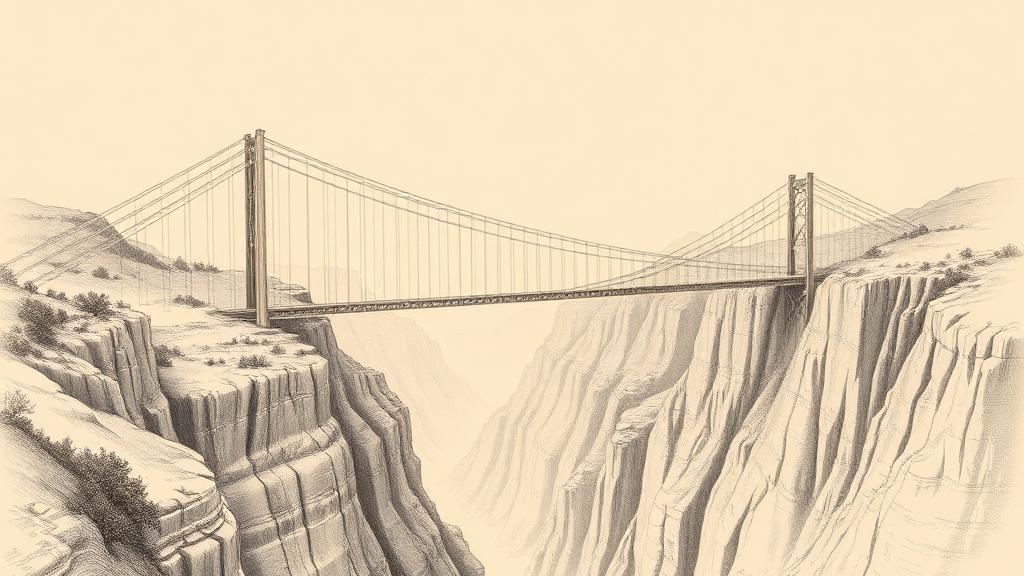
Huajiang Canyon Bridge: the highest bridge ever built
On April 29, 2026, a Guinness World Records adjudicator named Luo Qiong confirmed a measurement that Chinese engineers had already suspected: the deck of the Huajiang Canyon Bridge sits 626.01 metres above the floor of the gorge below. That is high enough that the Eiffel Tower would fit in the canyon with 296 metres of open air above its antenna. The Huajiang Canyon Bridge is the highest bridge ever built.
The bridge spans the Beipan River gorge in Guizhou Province, the crumpled limestone heartland of southwest China, connecting Guanling and Zhenfeng counties across a gap that had previously taken travellers nearly an hour to negotiate by road. Guizhou is not a province you think of first when thinking about bridge-building — but it should be. The mountains that made it among China’s poorest regions also made it the place where spanning gorges became a national project. When the Duge Bridge — 565 metres high, crossing the same river about 200 kilometres upstream — was certified by Guinness in 2018 as the world’s highest, it was the apex of that project. Guizhou had the record. Then Guizhou came back and took it again.
Construction on the Huajiang Canyon Bridge started January 18, 2022, and the bridge opened to traffic on September 28, 2025, in time for the national holiday week. It is a steel-truss suspension bridge — not the cable-stayed form of its predecessor — with a main span of 1,420 metres, the longest suspension span in mountainous terrain on earth. The two main towers stand at different heights because the canyon walls are not level: the north tower rises 262 metres, the south tower 205 metres, each anchored into limestone cliffs. The main structural components, manufactured in 93 segments, weighed about 22,000 tonnes in total — roughly the mass of three Eiffel Towers — delivered by cable crane across the chasm.
The karst limestone that makes Guizhou’s mountains spectacularly deep also makes them wet. During tunnel excavation at one bridgehead, workers broke into a hidden aquifer, an underground river pushing through the rock. The engineers did not pump it out and patch the walls. They diverted it into a 4,000-cubic-metre reservoir, routed it to the canyon rim, and turned it into a waterfall. The nightly light show that now plays against the cliff face runs on groundwater that the bridge accidentally found.
Guinness adjudicator Luo Qiong confirmed the figure at 626.01 metres — 60.61 metres above the Duge Bridge’s standing record — after repeated measurement and verification. By August 2026, 3.3 million people had visited. The canyon crossing that once required 70 minutes of mountain road now takes about two minutes at speed. For the province, that is the larger number: the mountains that isolated Guizhou for centuries are becoming, one span at a time, the reason it gets visited.
The gorge has not changed. The bridge hanging over it has changed what the gorge is for.
Sources
- Huajiang Canyon Bridge — Wikipedia — construction dates, dimensions, karst groundwater discovery, tourism infrastructure, visitor numbers.
- China’s Huajiang Grand Canyon Bridge certified as world’s highest — Xinhua — Guinness certification, adjudicator Luo Qiong’s statement, the confirmed height of 626.01 metres.
- Duge Bridge — Wikipedia — previous world record holder at 565.4 metres, certified 2018, same river system.