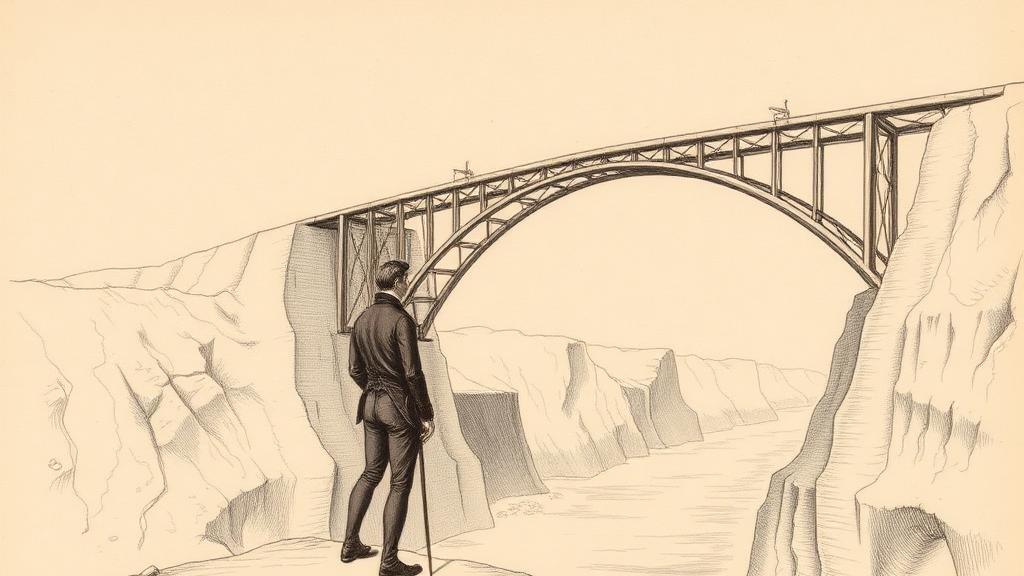
The Iron Bridge, or how a Shropshire gorge became the template for everything that followed
On the morning of New Year’s Day, 1781, the first toll-payers walked across a bridge in a Shropshire gorge and onto a surface no one had ever crossed before: 378 tons of cast iron, arcing across the River Severn in a single semicircular span of a hundred feet. The tollkeeper’s sign warned that even members of the Royal Family were liable to pay. Nobody was exempt from history.
The man responsible for that arch, Abraham Darby III, was twenty-seven when construction began in November 1777. His grandfather, Abraham Darby I, had changed ironmaking in the early eighteenth century by smelting with coke rather than charcoal, making affordable cast iron a practical reality. By the time the grandson took over the family furnaces at Coalbrookdale, the gorge was one of the most industrially dense places in Britain — and still the only way across the Severn was a ferry that regularly failed.
The original idea wasn’t Darby’s. Thomas Farnolls Pritchard, a Shrewsbury architect better known for designing chimneypieces, proposed a single-span iron arch in 1773. Parliament approved the plans, and in 1775 Darby was appointed treasurer and commissioned to cast the structure. Then, on 21 December 1777, one month after the first iron had been hoisted into the gorge, Pritchard died. Darby finished the bridge himself.
What makes the engineering curious is how backward it looks from one angle. The foreman Thomas Gregory designed the iron joints using the vocabulary of a carpenter: mortise-and-tenon joints, dovetails, wedged shoulders. There wasn’t yet a structural grammar for cast iron — it had never been used at this scale — so the Coalbrookdale team borrowed the language of wood and trusted it would translate. It did. The nearly 1,700 individual components fit together with a precision that has kept the arch in place for two and a half centuries.
It cost rather more than anyone had planned. The original estimate was £3,250; the final bill came to roughly £6,000. Darby personally absorbed much of the overrun — around £3,000 of it from his own pocket, equivalent to something close to £440,000 today — and was carrying that debt when the bridge opened (English Heritage). The investors’ patience was eventually rewarded. By the mid-1790s the tolls were returning an annual dividend of eight percent.
The proof of the structure came not from any designed test but from nature. In February 1795, the worst flood in living memory tore through the Severn valley. Wooden bridges upstream collapsed. Stone crossings were scoured clean. The Iron Bridge stood, and the Coalbrookdale community on its north bank — which had grown up precisely because the bridge existed — woke up to find their crossing intact while their neighbours had none. Cast iron entered the engineer’s standard toolkit the week that water receded.
Cast iron spread quickly from there. Thomas Telford, who served as Shropshire’s County Surveyor from 1787 and knew the Iron Bridge as a working neighbour, built his Pontcysyllte Aqueduct across the River Dee in North Wales in 1805, carrying the Llangollen Canal on cast-iron troughs. John Roebling’s steel wire suspensions were still a century away — but Roebling, and every bridge engineer between him and Darby, inherited a world in which iron was already the obvious answer to a long, heavy span.
The bridge still crosses the Severn. The joints holding it together still speak the language of a woodworker.
Sources
- The Iron Bridge — Wikipedia — construction timeline, Pritchard’s biography and death, Darby III’s role, dimensions, joinery techniques, cost figures, and the 1795 flood.
- History of Iron Bridge — English Heritage — technical specifications, engineering innovation, and the bridge’s survival of the 1795 floods.
- Iron Bridge — ASCE Historic Civil Engineering Landmarks — engineering significance, cast iron’s subsequent adoption, and the bridge as an international monument to civil engineering.