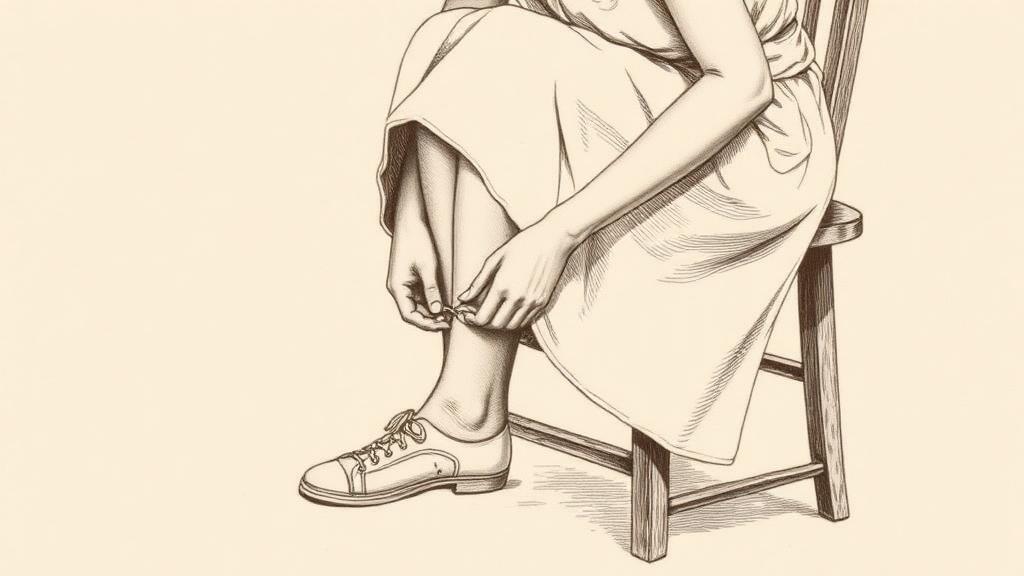
The shoe that earned its name in silence
In early 1916, a committee at the United States Rubber Company crossed a name off a list. The name was “Peds,” from the Latin for foot — clean, logical, already almost a word. Someone else held the trademark. The committee looked at what was left. Between “Keds” and “Veds,” they went with Keds because it had a stronger sound. That is the etymology of the most common noun in twentieth-century footwear: a phonetic tiebreaker.
The United States Rubber Company had been built on consolidation. In 1892, financier Charles Ranlett Flint merged nine Connecticut rubber manufacturers into one entity, immediately controlling half the nation’s footwear sales and landing a seat among the original twelve stocks in the Dow Jones Industrial Average. By 1916 the company had absorbed another two dozen shoe brands and decided to fold all thirty into one product with one name and sell it everywhere at once.
The shoe itself was not new. Its ancestor was the British “plimsoll,” a canvas-topped shoe with a flat vulcanized rubber sole worn at seaside resorts and tennis courts since the 1870s. The name came from a coincidence of geometry: the colored rubber band where upper met sole sat at the same height as the Plimsoll line on a ship’s hull — the load watermark that tells you how far you can safely sink. If the water rose above the band, the wearer got wet. British day-trippers had been finding out the hard way for decades.
What US Rubber did was industrialize it and move it inland. The Champion — a four-eyelet, lace-up oxford with a canvas upper and a flat vulcanized rubber sole — went into mass production in 1917. It sold for under a dollar, fit children and adults alike, and left no marks on wooden floors. It was the first canvas-top shoe manufactured at this scale for the general American market.
The quiet rubber sole was the detail that stuck. The word “sneaker” had appeared in print as early as 1887, when the Boston Journal noted it was the name boys gave to rubber-soled shoes — you could sneak across a floor without the click of leather on stone. In 1917, Henry Nelson McKinney, an advertising executive at N.W. Ayer & Son, ran a Keds campaign using the word. The rubber sole was so quiet, the copy claimed, that you could sneak up on a cat. McKinney did not invent “sneaker.” He put it in front of several million readers, and it never left.
By the early 1920s, the shoe had crossed from general merchandise to something closer to equipment. Olympic soccer players wore them. National tennis champions wore them. Helen Wills, who would win eight Wimbledon singles titles between 1927 and 1938, trained in them — and once US Rubber started calling the Champion “the shoe of champions,” the model’s name became official. A pair of Keds women’s shoes from this era later entered the Victoria & Albert Museum’s fashion collection in London, displayed alongside centuries of silk and leather. The journey from dry-goods shelf to museum vitrine took about thirty years.
The shoe that was designed not to make a sound became, in time, one of the loudest things a person could wear.
Sources
- Keds — Wikipedia — US Rubber consolidation of 30 brands in 1916, Champion shoe as first mass-marketed canvas-top sneaker, name origins (Peds trademarked, Keds vs Veds), McKinney’s 1917 use of “sneaker.”
- Sneakers — Encyclopedia.com — Plimsoll origins in 1870s Britain, the Plimsoll line naming convention, McKinney at N.W. Ayer & Son popularizing the term.
- Pair of shoes, Keds — V&A Collections — physical Keds canvas shoes in the Victoria & Albert Museum’s Textiles and Fashion collection, shown in the 2015–16 exhibition “Shoes: Pleasure and Pain.”