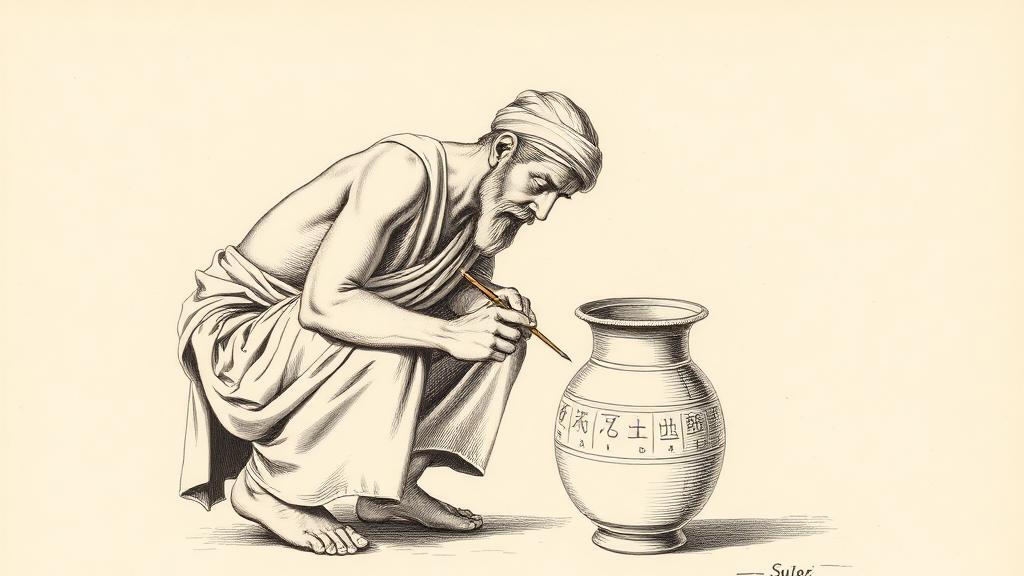
Linear Elamite: cracking the script no one could read for four thousand years
Somewhere in a London bank vault in 2015, a French archaeologist named François Desset was handling silver cups older than the Roman Empire. The ten vessels — called kunanki in Elamite — had been sitting in the Mahboubian family collection since the 1930s, their surfaces dense with a script no living scholar could read. Published photographs had always shown only one side of each cup. Seeing them in person, Desset realized he was looking at nearly 760 uninterrupted signs of Linear Elamite. He photographed everything, went home, and spent two more years staring at the result.
In spring 2017, the staring paid off.
Linear Elamite is the writing system of ancient Elam, a civilization that occupied what is now southwestern Iran from roughly the fourth millennium BCE onward. The script — its 77 signs carved onto stone monuments, clay cones, and the silver cups Desset was studying — had been found at Susa by archaeologists in 1903 and had resisted every attempt at reading for more than a century. Scholars knew it existed alongside cuneiform on bilingual inscriptions. They just couldn’t translate it. Elamite, the language it records, is a complete isolate: no known relatives in any direction, alive or dead.
The entry point, as with so many decipherments, was a proper noun. A limestone slab at the Louvre — the Table au Lion, inscribed in both Akkadian cuneiform and Linear Elamite — had given early researchers their first phonetic foothold by matching the names Puzur-Sušinak and the god Insušinak across both scripts. Early researchers had extracted nine phonetic values from those name matches by 1912. Then progress stalled for a century.
Desset’s breakthrough came when he spotted a four-sign sequence repeating across the kunanki. He guessed the third and fourth signs both corresponded to the syllable ha — and if so, the full sequence spelled Shilhaha, a known Sukkalmah-dynasty king from around 1900 BCE. One royal name unlocked eight additional signs, then more, then enough to reconstruct the system. In 2022, Desset and four co-authors published their result in Zeitschrift für Assyriologie und Vorderasiatische Archäologie: a near-complete decipherment, the first in 120 years of trying.
Not everyone was celebrating. The kunanki had been excavated irregularly by Benjamin Mahboubian in the 1920s and 1930s — looted, in blunt terms. Several scholars argued that Desset had no business publishing from stolen objects, however significant the results. Desset’s response was frank: “Without the silver kunanki the decipherment would have been impossible.” Oxford’s Jacob Dahl followed in 2023 with a technical critique, calling some of Desset’s proposed sign connections “shallow graphical similarities” forced into a preconceived pattern. The argument is ongoing. It usually is.
What the decipherment established is that Linear Elamite may be the oldest purely phonetic writing system ever found, predating Proto-Sinaitic by five centuries. That shifts the origin story of alphabetic writing from the Levant to the Iranian plateau. For the first time, as Desset’s team put it, “the Elamites are able to speak to us through their own indigenous script.” The texts on the silver cups turn out to be prayers: rulers asking the god Napirisha for zemi — prosperity — in exchange for kere, worship. Four thousand years of silence, and it turns out they were asking for the same things everyone else always has.
The next undeciphered script, sitting in some museum drawer or family collection, is waiting for someone patient enough to look at both sides.
Sources
- Linear Elamite — Wikipedia — origins, date range, artifact locations, script classification, and scholarly debate over decipherment.
- Breaking the Code: Ancient Iran’s Linear Elamite Script Deciphered — ANE Today — Desset’s account of the Shilhaha breakthrough, the kunanki as the essential artifact, the team’s methodology, and the ethical debate over looted objects.
- Decoding Linear Elamite — National Geographic — The London vault examination, the Table au Lion, and the significance of Linear Elamite as potentially the oldest purely phonetic script.
- Beyond Mesopotamia — London Review of Books — Jacob Dahl’s 2023 technical critique, the prayers on the kunanki (Napirisha, zemi, kere), and the Elamite language context.