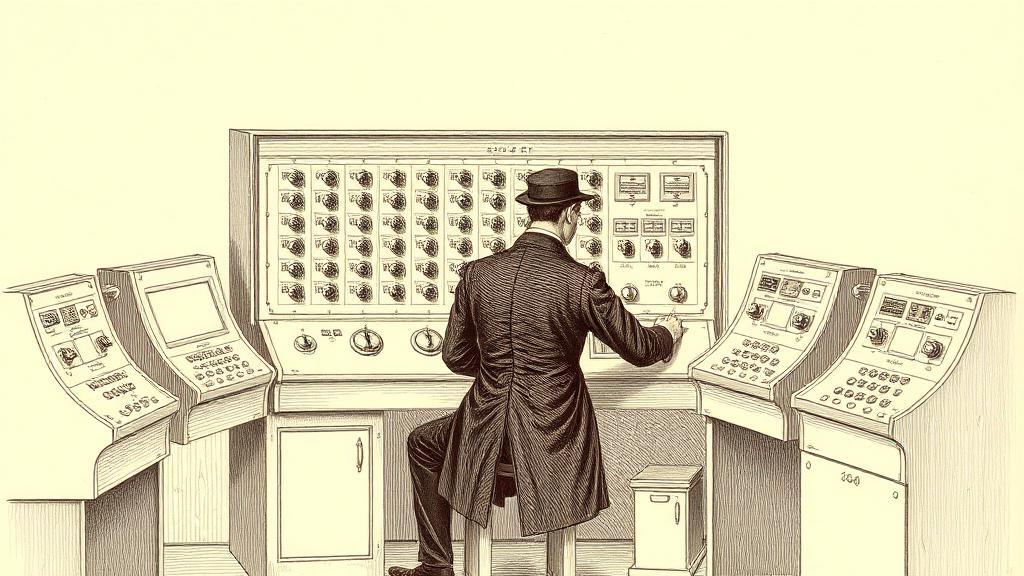
The model in the middle
On October 24, 2022, a machine learning engineer named Harrison Chase pushed 800 lines of Python to a new GitHub repository he called LangChain. He had been wiring language models to databases, search engines, and APIs at work, writing the same scaffolding every time. The 800 lines were his attempt to stop doing that. Within eight weeks, LangChain was the fastest-growing repository on all of GitHub.
The pattern Chase had spotted had been assembling for two years. In May 2020, a team at Facebook AI Research, University College London, and NYU published a paper called “Retrieval-Augmented Generation for Knowledge-Intensive NLP Tasks” — RAG for short. Lead author Patrick Lewis would later apologize for the acronym: “We definitely would have put more thought into the name had we known our work would become so widespread.” The paper fixed a central flaw in language models: the model knows a lot, but not the right things at the right time. RAG’s answer was to retrieve relevant documents from a database and hand them to the model as context. The model’s job shifted from remembering to reasoning about what it was given.
The second piece arrived in October 2022, when a team from Google Research and Princeton posted ReAct to arXiv — short for “Reasoning and Acting.” Where a chatbot generates an answer in one pass, a ReAct agent reasons out loud: decides what it needs, calls an external API, reads the result, adjusts, and loops until the task is done. Presented at ICLR 2023 in Kigali, Rwanda, ReAct outperformed imitation-learning baselines by 34 percent on interactive decision-making benchmarks. The model was no longer a text generator. It was a planner.
The third piece landed on June 13, 2023, when OpenAI announced function calling for GPT-4 and GPT-3.5 Turbo. A developer could now describe an external function to the model, and the model would respond not with prose but with a structured JSON object naming the function and its arguments. The model was handing off work to other software.
The public got its demonstration on March 30, 2023. A British game developer named Toran Bruce Richards uploaded AutoGPT — a project that handed GPT-4 a goal and let it plan and call tools recursively, without further prompting. Within twenty-two days it had 100,000 GitHub stars. Most AutoGPT runs crashed or looped into repetition. That was almost beside the point. What it proved was that the architecture was coherent enough to be alarming, and alarming enough to attract a hundred thousand people who needed to see what it would do next.
What it did next was become infrastructure. By 2023, a recognizable pattern had a name: an orchestrator LLM that reasons, plus tools it can invoke, plus a retriever for fresh context, plus memory between calls. The call graph was no longer written in code. The model decided, at runtime, what to retrieve, what to call, and in what order — in natural language, against no schema. Software architecture had spent fifty years defining clean, deterministic interfaces between components. Now the component choosing which interface to call was a probability distribution over tokens.
The databases and APIs haven’t changed. The caller has.
Sources
- Lewis et al., “Retrieval-Augmented Generation for Knowledge-Intensive NLP Tasks” (arXiv 2005.11401) — origin of the RAG term; NeurIPS 2020.
- NVIDIA Blog: What Is Retrieval-Augmented Generation — Patrick Lewis’s quote about the acronym; scope of adoption.
- Yao et al., “ReAct: Synergizing Reasoning and Acting in Language Models” (arXiv 2210.03629) — ReAct framework; ICLR 2023 results; 34% improvement figure.
- OpenAI: Function calling and other API updates — June 13, 2023 announcement of function calling for GPT-4.
- AutoGPT — Wikipedia — March 30, 2023 release by Toran Bruce Richards; 100,000 GitHub stars in 22 days.
- LangChain history — Taskade — Harrison Chase’s October 24, 2022 first commit; fastest-growing GitHub repository within eight weeks.