Marco Polo and the money made of trees
In a Genoese prison in the winter of 1298, a Venetian merchant dictated one of the stranger chapters in economic history. Marco Polo, captured at sea and awaiting ransom, passed the time by talking; his cellmate, the romance writer Rustichello da Pisa, wrote it down. The result included a chapter headed “How the Great Khan Causeth the Bark of Trees, Made Into Something Like Paper, to Pass for Money All Over His Country” — a title so impossible-sounding that much of Europe assumed it was fiction.
It was not. Polo had left Venice twenty-seven years earlier, in 1271, traveling east with his father Niccolò and uncle Maffeo across the Silk Road for three and a half years before reaching Kublai Khan’s court at Khanbaliq, the city that would later be called Beijing. He stayed seventeen years, serving the Khan in various administrative posts and traveling the empire’s roads. What he found running through the whole operation, the connective tissue of the world’s largest economy, was paper.
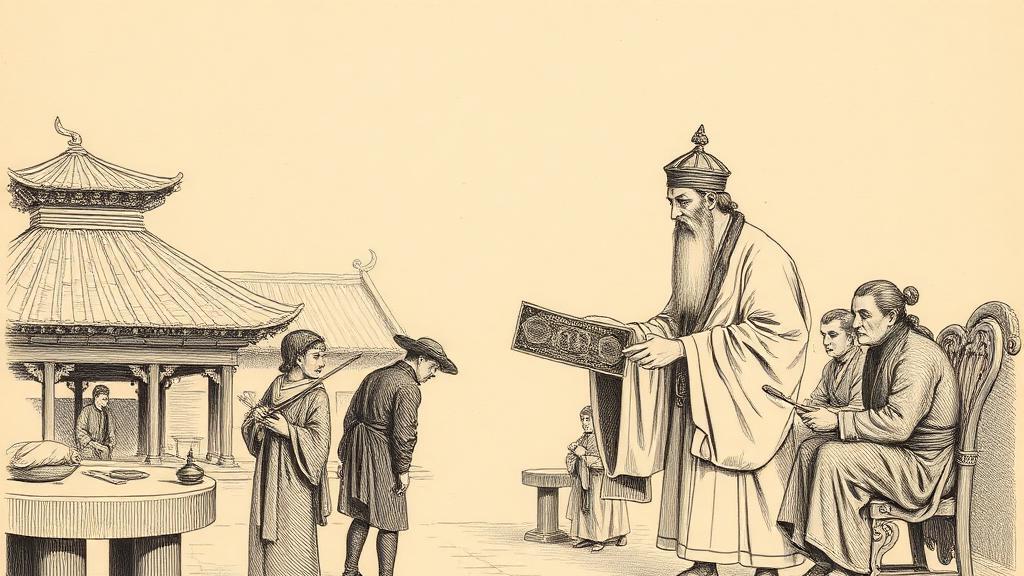
The Yuan dynasty’s chao — state-issued paper currency — was made from the inner bark of mulberry trees, the same trees whose leaves fed the silkworms. Cut into denominations from half a tornesel to ten bezants, each note passed through a formal authentication ceremony: a chain of officials signed it, the chief officer pressed a vermilion-dipped seal into the paper, and the Khan’s cipher confirmed the whole. The finished notes were issued, Polo wrote, “with as much solemnity and authority as if they were of pure gold or silver” (Wikipedia). Forging one carried the death penalty. Refusing one was not, Polo implied, a survivable career move either.
The detail Polo could not quite absorb was the economics of it. He described Kublai Khan as possessing “the secret of alchemy in perfection”: money that cost almost nothing to produce, yet commanded silk, horses, and imperial loyalty across a continent. Merchants arriving with actual gold were required to exchange it for chao at rates the Khan set. They accepted, Polo noted, partly because they had no alternative, and partly because the notes worked everywhere the Khan’s authority ran — which was everywhere that mattered (FEE).
When the manuscript circulated in Europe around 1300, skeptics were plentiful. The book passed under the sardonic nickname Il Milione and was widely treated as a traveler’s fancy. Polo died in Venice in 1324; a priest visiting his deathbed reportedly urged him to recant the wilder claims. “I have not told half of what I saw,” Polo replied (UCLA CMRS).
Europe did not issue its own paper money until 1661, when the Bank of Sweden printed notes to cover a copper shortage; the Bank of England followed in 1694. Four centuries separate Polo’s account from those notes. In the interval, Columbus sailed in 1492 carrying a heavily annotated copy of Polo’s Travels — not looking for paper money, but with the idea already in hand. The concept that a government’s guarantee, not the metal in a coin, was what made money money had been in European circulation all along, filed somewhere between wonder and disbelief.
The mulberry bark was long gone by then. The promise was still running.
Sources
- Marco Polo — Wikipedia — Journey timeline, Khanbaliq service, Il Milione composition, death and deathbed account.
- Marco Polo on Money — Foundation for Economic Education — Direct quotes from the Travels, Yuan currency mechanics, “alchemy in perfection” description, forced-exchange structure.
- Marco Polo: The travel writer who shocked medieval Europe — UCLA CMRS — European reception, Il Milione nickname, skepticism, Columbus’s annotated copy.