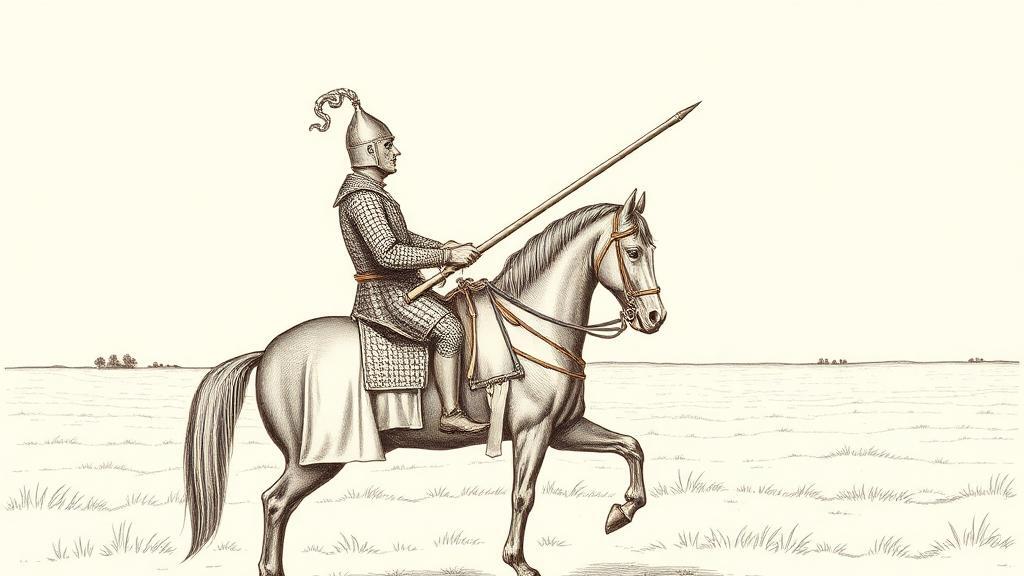
The tournament, or how France turned cavalry drill into spectacle
Somewhere in northern France in 1066, a baron named Geoffroi de Preuilly died at a tournament he had reportedly helped devise. That is the capsule biography of organized sport’s first recorded rulemaker: he wrote the regulations, and then the regulations killed him. The Chronicle of St Martin of Tours recorded his death and noted that he had created the rules of the tournament — a distinction that 13th-century chronicler Matthew Paris would later describe simply as the Conflictus Gallicus, the Gallic style of fighting, as though France had invented a new kind of war and handed it to the rest of Europe as entertainment.
The medieval tournament grew out of Frankish cavalry tradition. For centuries, mounted warriors had practiced charging en masse, wheeling, reforming — drills that built the coordination that decided battles. By the late 11th century that practice had acquired a format, a geography, and a competitive logic of its own. The principal event was the mêlée: two sides, sometimes 200 knights each, organized by regional origin — Normans against French, or English against the rest — sent against each other across miles of open countryside. Streams, forests, and villages were all in play. The goal was not to kill but to capture: a knight who unhorsed his opponent claimed the man’s horse, armor, and ransom, paid in cash, often immediately, on the field.
By the early 12th century the format had spread to Germany, Flanders, and England, attracting crowds of spectators, merchants selling food and equipment, and heralds keeping records of who had captured whom. The tournament had become, without anyone quite deciding this, a professional circuit.
The clearest proof is William Marshal. Born in 1146, the younger son of a minor English nobleman with no land to inherit, Marshal went on the tournament circuit and stayed there for nearly two decades. From 1167 to 1183 he competed across northern France and England — some historians count nearly 500 knights captured over his career — and was reportedly never defeated in single combat. The winnings funded a household, then a reputation, then political capital. By his death in 1219, he was Earl of Pembroke, regent of England for the young Henry III, and — in the verdict of the Archbishop of Canterbury — “the greatest knight that had ever lived.” He had built an earldom on tournament prize money. That is, as careers go, a fairly direct line from athlete to head of state.
The form itself kept changing. By the 13th century the one-on-one joust — two knights charging each other down a central barrier with wooden lances — had eclipsed the chaotic mêlée as the headline event, cleaner and more legible for the grandstands that had by then gone up around the fields. Heralds announced competitors by their coats of arms, ladies sponsored individual knights and awarded prizes, and the full apparatus of spectator sport — dedicated venues, formal scoring, crowd management, pageantry that existed purely as pageantry — had assembled itself around a competition whose original purpose had been entirely practical.
The tournament mattered because it formalized what competitive sport requires: shared rules, an audience, and stakes high enough that someone trains seriously. The mêlée gave Europe its first traveling circuit, its first professional competitors, and its first clear demonstration that organized athletic competition could be a self-sustaining institution. The weapons got lighter, the arenas larger, and the essential structure — rules, spectators, prize — remained.
The lances are long gone. The structure is still running.
Sources
- Medieval Tournament — World History Encyclopedia — Frankish cavalry origins, Geoffroi de Preuilly’s death and rule-making in 1066, William Marshal’s undefeated record 1167–1183, spread to England and Germany.
- Tournaments in the Middle Ages: The Ultimate Medieval Spectacle — Medievalists.net — how the mêlée operated, the ransom economy, William Marshal’s career trajectory, and the social function of the tournament circuit.