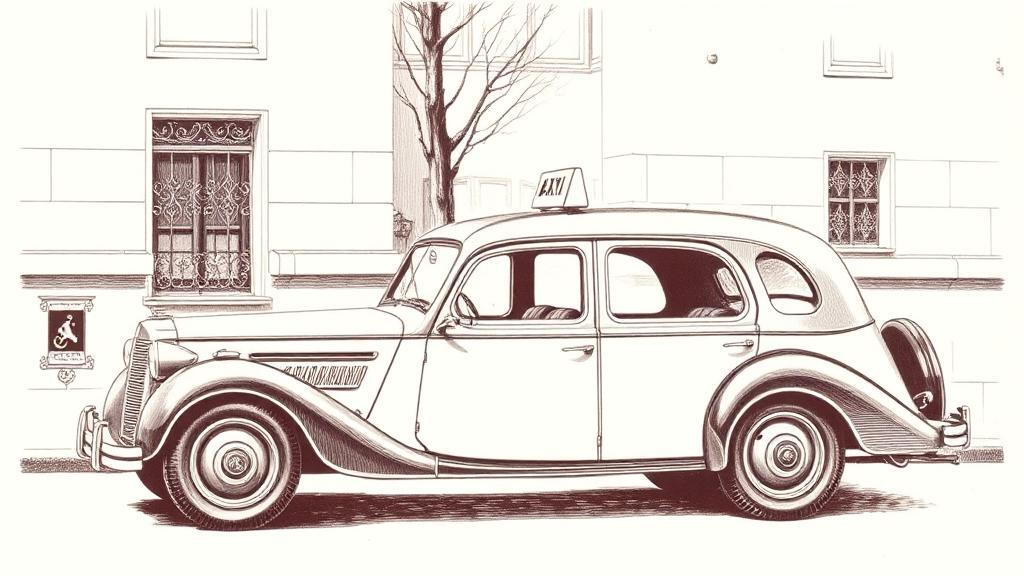
The 260 D: the first diesel passenger car
The car at Stand 22 of Berlin’s International Automobile and Motorcycle Exhibition in February 1936 looked, from ten paces, like an ordinary Mercedes saloon. From five paces, it smelled different — not petrol, not oil exactly, something darker and more agricultural. From one pace, the engine note was unmistakable: a measured, rattling clatter entirely unlike anything a visitor had heard from a passenger car before. Mercedes-Benz had put a diesel engine in it.
The 260 D — factory code W 138 — debuted on 15 February 1936, the opening day of the Berlin show. It was not an experiment: 13 pre-production units had already been quietly built during 1935. The engine, the OM 138, was a 2.6-litre four-cylinder unit borrowed and scaled down from Mercedes-Benz’s commercial vehicle programme, fitted with a Bosch injection pump and a pre-chamber combustion system that took the edge off diesel’s characteristic roughness. It produced 45 horsepower at 3,200 rpm — modest by petrol standards, but it burned just 9 litres per 100 kilometres against 13 or so for an equivalent petrol car.
The body sat on the long-wheelbase chassis of the petrol-powered Mercedes 200, giving it a stately, almost taxi-appropriate silhouette. Top speed was 95 km/h, and the car weighed 1,530 kilograms — not nimble, but not built to be. Body options included a four-door saloon, a landaulet, and a cabriolet. By December 1940, when wartime pressures finally shut the line, 1,967 units had been built. Most went to work.
The taxi drivers found it almost immediately. Diesel fuel in 1936 Germany cost just 17 Pfennigs per litre, well below petrol, and the OM 138 proved famously durable under the continuous load that cabs inflicted. The first 170 units off the line — pullman-landaulets, roomy enough for luggage — went straight to taxi fleets. Those fleets kept using them. 260 D cabs were still a common sight on German streets well into the 1950s, more than a decade after the model had gone out of production.
The 260 D was a conservative vehicle in most respects: unhurried, functional, nothing to look at. But it answered a question diesel’s critics had kept open: could compression-ignition be civil enough for a passenger car? Rudolf Diesel had died in 1913, his engine dominant in ships, trains, and trucks yet largely excluded from private transport. The 260 D settled the argument. Mercedes-Benz resumed diesel passenger cars with the 170 D in 1949, and within three decades diesel had transformed from a truck engine to the dominant choice in European passenger-car showrooms.
The OM 138’s descendants are still in production. Some of the quietest, most fuel-efficient engines now fitted to passenger cars trace their lineage to that agricultural clatter on the Berlin exhibition floor in February 1936.
Sources
- Mercedes-Benz 260 D — Wikipedia — Technical specifications, production figures, body variants, and the timeline from debut to end of production.
- Diesel Passenger Car Premiered 75 Years Ago — eMercedesBenz — Development history, fuel cost detail (17 Pfennigs/litre), and taxi fleet longevity through the 1950s.