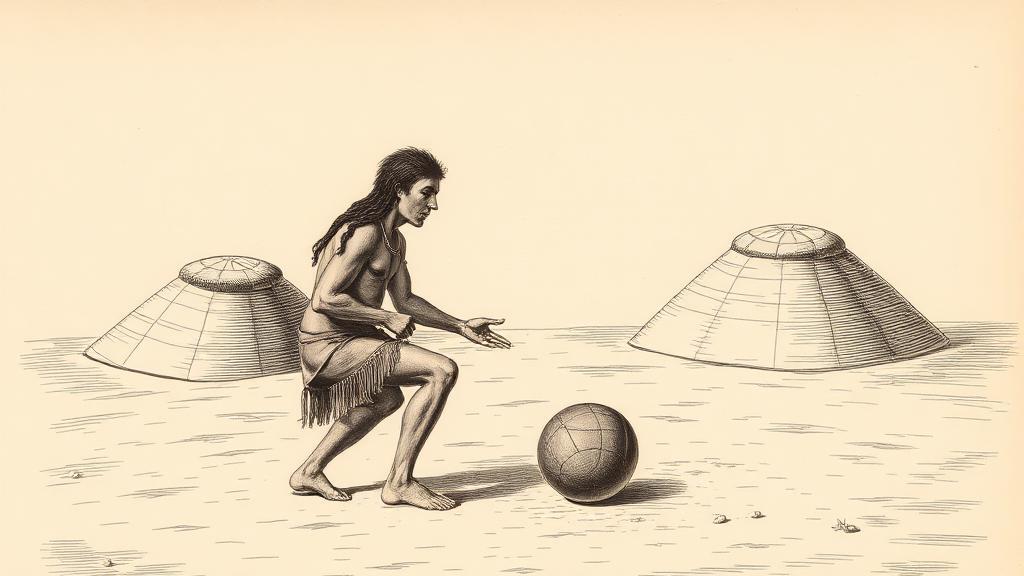
Eight clay ballplayers and the world's first court
In a shaft tomb at El Opeño, Michoacán, someone was buried around 1700 BCE with eight ceramic figurines arranged as if mid-game: each wearing protective equipment, each positioned on what appears to be a playing field. It is the oldest visual record we have of the Mesoamerican ballgame — and that someone chose athletic competition, rather than a deity or a domestic scene, as their companion into the afterlife is its own kind of evidence.
The actual balls come from a different site. Five solid rubber spheres recovered from the sacrificial bog at El Manatí, near the early Olmec center of San Lorenzo on Mexico’s Gulf Coast, have been radiocarbon-dated to approximately 1700–1600 BCE — the oldest rubber objects on earth. The rubber was not accidental: Mesoamerican craftsmen mixed latex from Castilla elastica trees with the juice of white morning glory vine (Ipomoea alba), a combination that crosslinked the polymer chains to produce a ball with genuine bounce. Three thousand years before anyone named it chemistry, someone was doing polymer engineering.
The oldest-known ballcourt comes from the Pacific side of the isthmus. Archaeologists Warren Hill, Michael Blake, and John E. Clark excavated a structure at Paso de la Amada, in the Soconusco region of what is now Chiapas, dating to approximately 1400 BCE: an 80-metre alley defined by two flanking earthen mounds with terraced benches. Players on a court this long needed stamina; the mounds gave spectators somewhere to sit. It is, as far as the archaeology shows, the oldest sports venue on record.
Highland villages were building their own courts within a century. A 2020 paper in Science Advances by Jeffrey Blomster and Víctor Salazar Chávez reported two superimposed ballcourts at Etlatongo, Oaxaca, the earlier dating to roughly 1374 BCE. Termination deposits yielded 14 figurines, each wearing a yoke and loincloth, each posed as a player. The game had moved upland almost immediately.
Sixteenth-century Dominican friar Diego Durán documented the rules as they were still practiced in his lifetime: hips and knees only, no hands, a ball of solid rubber roughly six inches across. Getting it through the vertical stone ring set into the court wall was so rare that Durán estimated even a man throwing by hand at close range could not do it once in a hundred tries. The stakes could be severe: Aztec ruler Axayacatl once wagered a year’s tribute income and several towns against the lord of Xochimilco, lost the match, and had him assassinated. A sport that could end that way had developed a particular kind of seriousness.
Over 1,300 ballcourts have been excavated across Mesoamerica, the game reaching as far north as Arizona and as far south as Nicaragua. Its modern descendant, ulama, is still played in Sinaloa under the same fundamental rules: solid rubber, no hands, keep the ball in the air. The court at Paso de la Amada has been silent for three thousand years, but the game it hosted has not stopped.
Sources
- Mesoamerican ballgame — Wikipedia — El Opeño figurines (1700 BCE), Paso de la Amada excavation and dimensions, rubber composition, distribution across Mesoamerica.
- The Ball Game of Mesoamerica — World History Encyclopedia — El Manatí rubber balls dated 1700–1600 BCE, game spread and ritual significance.
- Blomster & Salazar Chávez, Science Advances 2020 (via PMC) — Highland ballcourts at Etlatongo, Oaxaca, dated ~1374 BCE; figurine termination deposits.
- The Rubber Ball Game — Penn Museum Expedition — Durán’s documented rules, ring-shot rarity estimate, Axayacatl wager and its outcome.