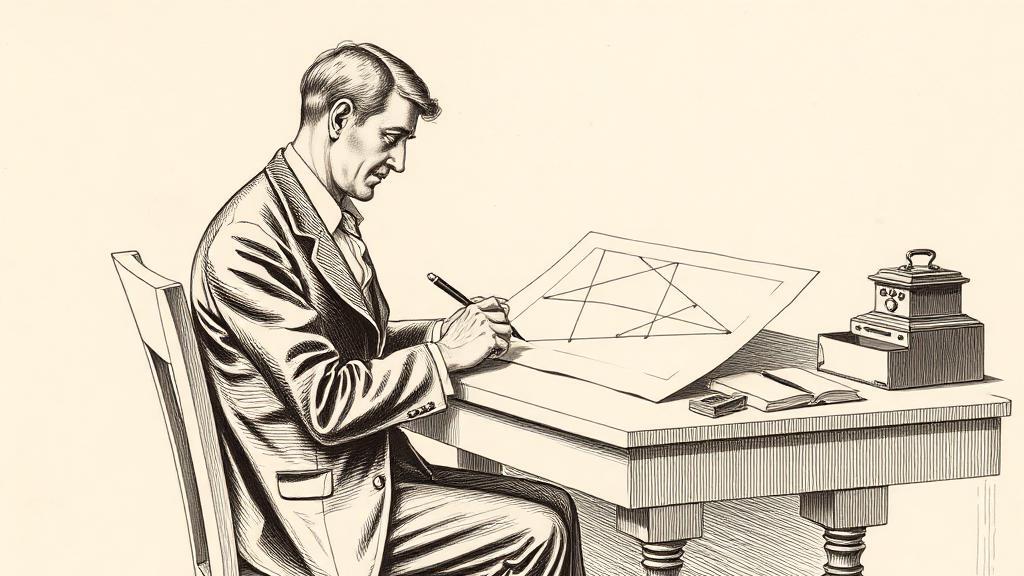
Minsky and Papert draw the line a perceptron cannot cross
Mark four points on a plane: (0,0), (0,1), (1,0), and (1,1). Color (0,1) and (1,0) black; leave the others white. Draw a straight line that separates all the blacks from all the whites. You cannot. The problem is XOR — exclusive or — and in 1969, Marvin Minsky and Seymour Papert turned this simple geometric impossibility into a 222-page argument about what neural networks could never learn.
The book was Perceptrons: An Introduction to Computational Geometry, published by MIT Press in 1969. Minsky, who had co-founded MIT’s AI Laboratory a decade earlier, and Papert, a mathematician trained under Jean Piaget in Geneva, had spent several years building the mathematical case. The central theorems were impossibility results: a single-layer perceptron cannot compute XOR, cannot decide whether a figure is connected, cannot determine parity. These were not approximation failures; they were exact proofs. Allen Newell, reviewing the book in Science, called it “a great book.”
What the book proved was precise: perceptrons are linear classifiers. Training one is equivalent to drawing a hyperplane through data, and some problems sit on neither side of any hyperplane. Minsky and Papert noted that multi-layer networks could in principle overcome these limits but were skeptical that an efficient training method would be found. The field absorbed the critique and missed the caveat.
The rivalry sharpened the reception. Minsky and Rosenblatt had attended the same school — the Bronx High School of Science — and their professional paths had since diverged sharply. Rosenblatt’s perceptron had attracted lavish press coverage; the New York Times had called it a “new navy device that learns.” Minsky, who had staked his reputation on symbolic approaches, found the enthusiasm overblown. Perceptrons read, in the community, as a verdict. Rosenblatt died in July 1971, in a boating accident on Chesapeake Bay on his forty-third birthday, and never got to respond.
The institutional consequences arrived in waves. In 1973, the British mathematician Sir James Lighthill delivered a report to the Science Research Council arguing that AI had failed to deliver on a decade of promises, and that combinatorial explosion would prevent general reasoning at any useful scale. British universities dismantled their AI programmes. A year later, DARPA cut a three-million-dollar annual contract with Carnegie Mellon after a speech-recognition system arrived years behind specification. Neural network funding dried up across both continents. The period historians call the first AI winter settled in from roughly 1974 to 1980.
What thrived in the cold was symbolic AI: rule-based systems, formal logic, expert programs that knew what they knew because a human had written it down. The irony is that Minsky and Papert had always believed in this approach. They had not intended to freeze the field — only to correct one overreach. The correction proved harder to reverse than they anticipated.
In the 1988 edition of Perceptrons, Minsky and Papert added a preface acknowledging what had happened in the intervening years. Backpropagation, published in 1986, had finally supplied the missing training method for multi-layer networks. Their four points on a plane, it turned out, were not the last word — only the end of the first argument.
Sources
- Perceptrons (book) — Wikipedia — publication details, theorems proved, Newell’s review in Science, and the 1988 edition preface
- Cornell Chronicle, “Professor’s perceptron paved the way for AI — 60 years too soon” (2019) — Bronx High School connection, press coverage, Rosenblatt biography and death
- AI winter — Wikipedia — Lighthill report 1973, DARPA contract cancellation 1974, first AI winter timeline (1974–1980)