Mongolian wrestling and the world's first crowd
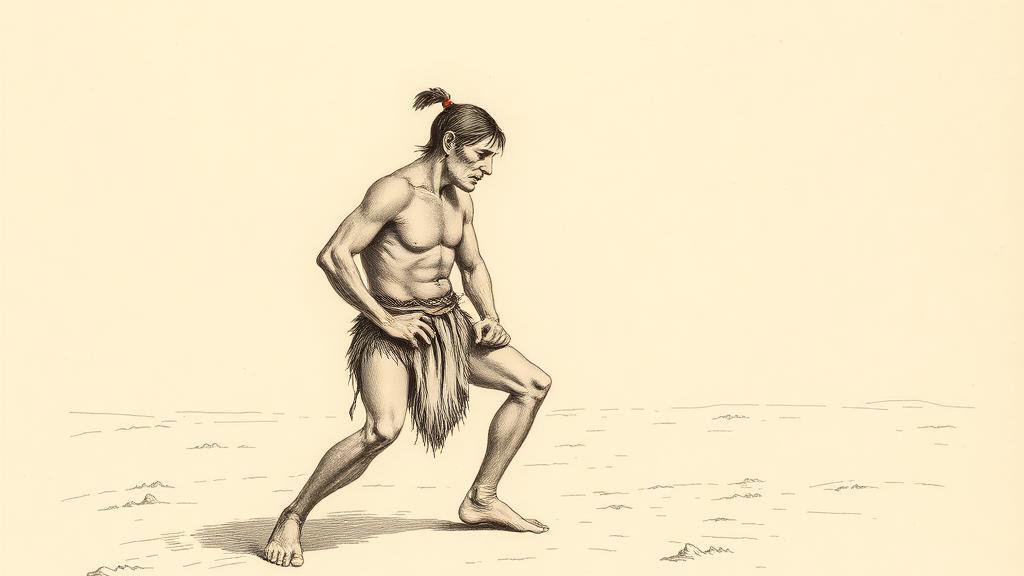
The two men are naked and grappling. Around them, scratched into the rock face of a cave in the Bayankhongor Province of central Mongolia, stands a crowd. Someone put them there around 7000 BCE with a sharp stone and an apparent conviction that what they were watching mattered enough to record. That conviction was correct. It has not stopped mattering since.
What distinguishes those cave paintings from every earlier depiction of two humans fighting is the audience. Bodies grappling for survival need no spectators. What the Bayankhongor artist chose to record was not a fight but a match — with all the social apparatus that implies: contestants, observers, a contest with a shape, and presumably a winner. Sports history surveys identify these paintings as the earliest known evidence of organized athletic competition.
The sport those paintings gesture toward is called bökh, and its rules have aged with unusual dignity. A wrestler loses the moment any part of his body above the knee touches the ground — elbow, back, hand, it makes no difference. No striking, no choking; the only permitted goal is to break the other man’s balance until gravity settles the question. Mongolian wrestling — Wikipedia traces bökh’s documented institutional history back through the Xiongnu Empire (206 BCE–220 CE), whose bronze plates already show men arranged in the distinctive wide-stance grip that defines the sport today.
The oldest named wrestler in Mongolian literature appears in the Secret History of the Mongols, written in 1240 CE. It records a match between Buri the Wrestler and Belgutei — a half-brother of Genghis Khan — held somewhere in eastern Mongolia on the Year of the Monkey, 1200 CE. The text is brief, but the weight of the encounter is clear: when two men connected to the Khan’s inner circle grappled in public, the match had stakes beyond sport. Genghis Khan later formalized wrestling into the Naadam festival alongside archery and horsemanship, in part because he understood that a wrestling competition produces strong soldiers, costs nothing, and gives an audience exactly the kind of hierarchy-display that holds a steppe empire together.
The Naadam still runs every July in Ulaanbaatar. Up to 1,024 wrestlers compete in a knockout bracket over two days, wearing the traditional open-chested zodog jacket and the brief shuudag shorts — a costume designed, practically, so that no woman can enter the competition disguised as a man. The rules and the setting have been refined. The social act has not.
What the Bayankhongor paintings established — without intending to establish anything — was the template for organized sport: two participants, agreed-upon rules, a winner, and a crowd to witness it. Every later sport, from the Olympian pentathlon to the FIFA World Cup, is an elaboration on those four elements. The only things that have changed are the scale and the distance from which the crowd watches.
They came to watch. Nine thousand years later, we are still building them places to sit.
Sources
- Mongolian wrestling — Wikipedia — Bayankhongor cave paintings (~7000 BCE), Xiongnu bronze plates, bökh rules, the Secret History of the Mongols wrestling match, and Naadam structure including the zodog costume.
- What Are the Oldest Sports in Human History — Dr. Paul McCarthy — survey of prehistoric athletic evidence placing the Mongolian cave paintings c. 7000 BCE as the earliest documented organized sport.