Nescafé, or how Brazil's burning surplus became everyone's instant coffee
The Brazilian government was burning coffee by the locomotive-load. After the Wall Street crash of 1929 sent commodity prices into freefall, Brazil — then the world’s largest coffee producer — found itself sitting on reserves it could neither sell nor store. The government eventually shoveled an estimated 52 million sacks of surplus beans into fireboxes to keep the trains running. Someone in the chain of creditors and bureaucrats, facing warehouses that had become liabilities, had the idea of calling Nestlé.
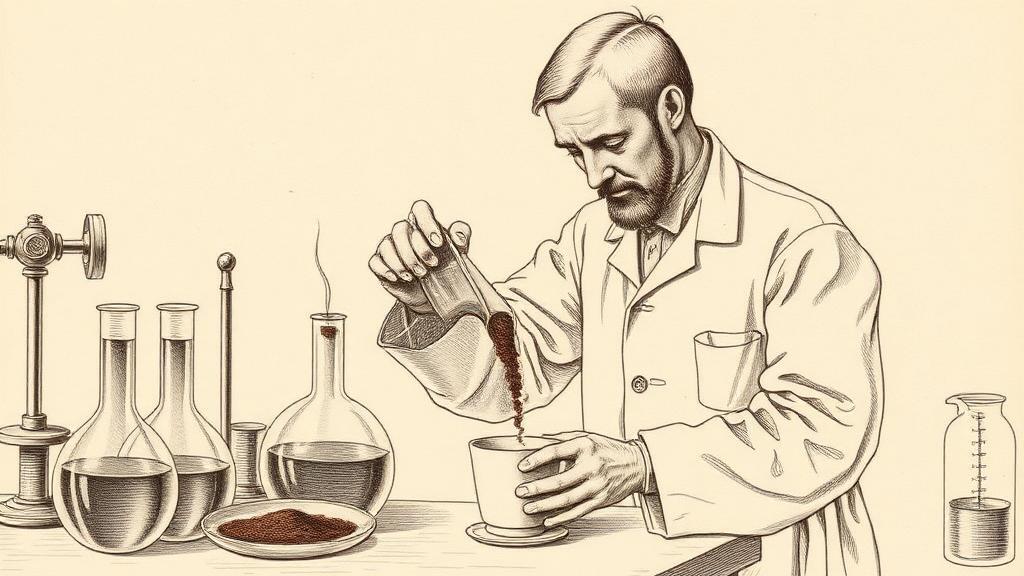
In 1930, a French-Italian bank called Sudameris that had financed Brazil’s coffee industry approached Nestlé in Vevey, Switzerland, with an unusual commission: find a way to turn this surplus into something durable, portable, and commercially viable. Wikipedia Nestlé assigned the problem to Max Morgenthaler, a food chemist in his early thirties who had previously specialized in adding vitamins to dairy products. He was told to build a soluble coffee that tasted like coffee. That deceptively simple brief would take eight years.
The technical obstacle was aroma. Previous attempts at instant coffee had produced something hot, brown, and caffeinated — but the volatile compounds that make coffee smell like coffee evaporated the moment it was dried to powder. Swiss National Museum Morgenthaler eventually found that adding carbohydrates to the spray-dried extract stabilized the flavor in a recognizable way. Nestlé’s executive board, unimpressed with the pace of progress, canceled the project in August 1935. Morgenthaler kept going at home, using his own beans, on his own time. By April 1937 he had something worth presenting: a round tin of brown powder that dissolved in hot water and, crucially, tasted of coffee.
Nestlé named the new product by stitching together the first three letters of the company name and the French word for coffee. The launch date — April 1, 1938 — was, for what it’s worth, April Fool’s Day. Swiss grocery shelves took the round tins, and sales exceeded all projected figures within weeks. The brand appeared in Britain two months later and in the United States in 1939.
The war did the rest. By 1942 the United States government had classified Nescafé as a commodity vital to the war effort, and all production from Nestlé’s American plant was redirected to the military. Wikipedia It appeared in ration kits and CARE packages distributed across Western Europe and Japan — wherever Allied forces needed something hot, light enough to carry, and requiring nothing but hot water. Millions of servicemen who had never considered instant coffee before the war came home as steady customers.
The product Morgenthaler finished in his apartment in 1937 is now, by volume, the best-selling coffee brand on Earth. Specialty coffee purists have always known how far that tin sits from a freshly pulled shot. But quality was never really the point: the problem Brazil could not solve by burning its surplus turned out to have an answer that fit in a kit bag.
Sources
- Nescafé — Wikipedia — launch date (April 1, 1938), wartime classification as vital commodity, WWII military adoption, name etymology, UK and US rollout timeline.
- Swiss history: the invention of coffee without the pot — Swiss National Museum — Morgenthaler’s development process, the August 1935 cancellation, home research, 52 million sacks burned as locomotive fuel, launch sales figures.