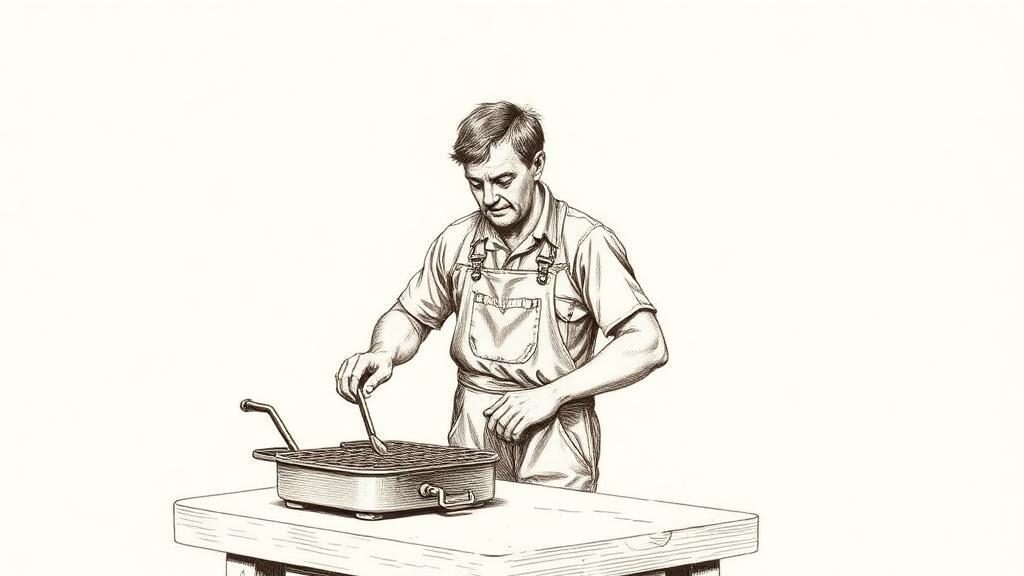
The waffle iron that launched Nike
One morning in 1971, Bill Bowerman sat down to breakfast in his home in Coburg, Oregon, looked at his wife Barbara’s waffle iron, and did something that would destroy the iron and eventually reshape an industry. He went to his workshop, poured two cans of liquid urethane into the iron’s heated grid, and waited. When the sole hardened, he pulled it out. Barbara’s iron — a 1936 Bersted wedding gift that had made thirty-five years of waffles — never opened again.
Bowerman was 63, the head track coach at the University of Oregon, and the kind of obsessive who had spent his career calculating the cost of every ounce. He had figured out that removing one ounce from a running shoe would spare a runner from lifting roughly 55 extra pounds per mile — a six-foot stride, multiplied 800 times. The problem: Hayward Field had recently replaced its cinder surface with a synthetic urethane track, and traditional rubber soles lost grip on it. Metal spikes added weight and didn’t translate to road running. Nothing worked. Bowerman wanted traction that cost nothing.
The waffle iron showed him how to have it. Inverted, the grid pattern would produce a sole whose raised polygon studs bit a surface from multiple directions simultaneously — grip without the heft of a spike. He began buying second-hand waffle irons to iterate, which at least spared Barbara from further experiments. The result was the Moon Shoe, a hand-built prototype so named because the tread left lunar-surface impressions. Roughly twelve pairs were made by 1972, worn at the U.S. Olympic Track and Field Trials in Eugene. Then Bowerman flew to Munich to coach the U.S. Olympic team, and Nike’s small staff was left to figure out how to manufacture the thing.
Nike — Bowerman’s company, co-founded with Phil Knight, a former Oregon miler who had started by selling Japanese running shoes out of the trunk of his car — released the Waffle Trainer commercially in 1974. The U.S. Patent Office had granted Patent No. 3,793,750 on February 26 of that year. The shoe had nylon uppers, weighed less than its competitors, and gave casual runners the grip previously available only to elite track athletes. By 1975, orders topped 100,000 units; it was the best-selling training shoe in the country.
One of the twelve original Moon Shoes sold at auction in 2019 for $437,500 — a record for any sneaker at the time. Barbara’s ruined waffle iron is on display at Nike’s headquarters in Beaverton.
The 1970s running boom — roughly 25 million Americans who took up the sport in the decade following Frank Shorter’s marathon gold at Munich — needed a shoe built for roads. The Waffle Trainer was there. Nike’s revenue climbed from $10 million to $270 million over the following decade, and the company that had started in the trunk of a car eventually became the largest athletic footwear brand in the world.
Bowerman died in 1999, aged 88. The patent expired; the waffle grid became common property. What hasn’t is the question he took to his workshop in 1971: a sole has to grip, and every ounce counts.
Sources
- Nike Moon Shoe & Waffle Iron — Nike Corporate — origin story, Barbara’s waffle iron, the twelve-pair Moon Shoe, 1972 Olympic Trials debut.
- Nike Waffle Sole Patent — History.com — February 26, 1974 patent grant, No. 3,793,750, and Bowerman’s background.
- 50 Years of the Nike Waffle Trainer — The Fashion Law — commercial timeline, 1974 Waffle Trainer launch, 1975 sales figures, design details.
- Bill Bowerman’s Waffle Iron — Natural Running Center — Bowerman’s weight calculus, Barbara’s account of the morning.