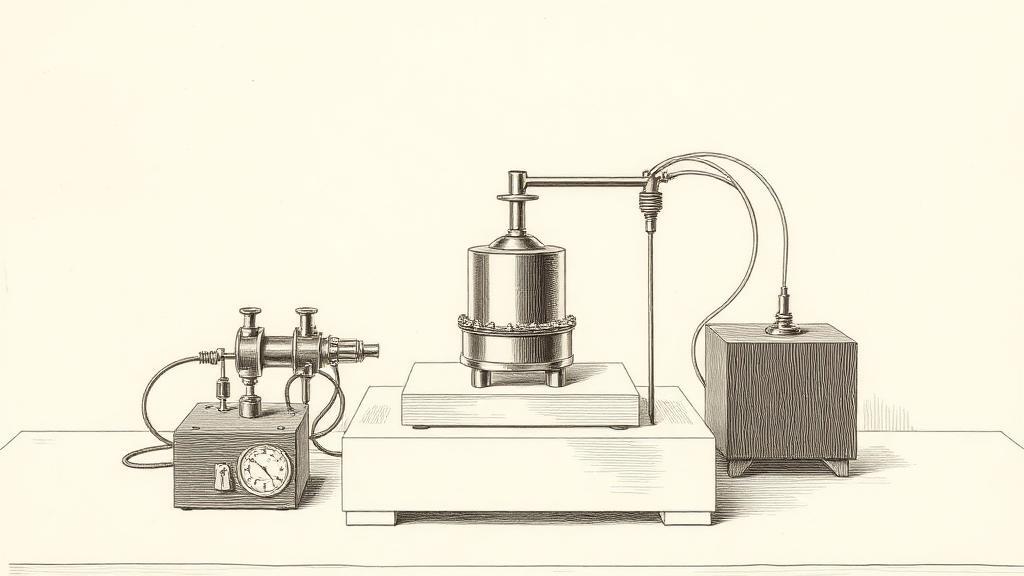
The aluminum ion clock, or how NIST gave time nineteen decimal places
The aluminum ion sits in an electric trap in Boulder, Colorado, ticking 1.12 quadrillion times per second. Nobody can read it directly: aluminum ions oscillate at a frequency that resists simple laser interrogation — probing them disturbs the very thing being measured. So in July 2025, when researchers at the National Institute of Standards and Technology published the most accurate clock ever built, it contained two ions. The aluminum does the timekeeping. A magnesium ion, parked beside it in the same trap, does the talking.
The technique — quantum logic spectroscopy — works by borrowing a trick from quantum computing. The magnesium ion cools the aluminum to near absolute zero, absorbs its quantum state, and converts it to a frequency the instruments can actually read. The aluminum oscillates; the magnesium reports. Mason C. Marshall, the paper’s first author, and project leader David Hume had been refining this particular arrangement for twenty years at NIST. Their result, published in Physical Review Letters on July 14, 2025, was a systematic uncertainty of 5.5 × 10⁻¹⁹ — nineteen decimal places — and 41 percent more accurate than any clock before it.
For context: this clock, if started at the moment of the Big Bang, would be off today by roughly a quarter of a second. The cesium fountain clocks that currently define the SI second — at a systematic uncertainty of about 10⁻¹⁶ — would have accumulated more than forty.
Speed had always been the limiting factor. Getting a reliable frequency measurement from an aluminum ion clock required three weeks of continuous data collection — long enough that environmental drift became a real problem. The Marshall-Hume team cut that to 1.5 days by routing an ultra-stable reference laser 3.6 kilometers through fiber optic cable to the clock chamber, eliminating the noise source that had been the bottleneck for years. The accuracy record came with a practical one: a clock useful in the field, not only on a lab shelf.
The timing is deliberate. The international metrology community has been working toward a redefinition of the SI second for over a decade — the official unit on which every GPS timestamp, financial transaction, and network synchronization ultimately rests. The second has been defined since 1967 by the cesium atom’s microwave transition: exactly 9,192,631,770 oscillations. Optical clocks tick at visible-light frequencies, roughly 100,000 times faster, and are correspondingly more stable. The Bureau International des Poids et Mesures has set a target for a new definition in the early 2030s, based on one of several optical frequency standards under evaluation worldwide. The NIST aluminum clock is one of them.
Before 1967, the second was defined by the Earth’s rotation. Before that, by the position of the Sun at noon. Each redefinition handed the second to something smaller and more stable — from orbit to atom — and each time the second itself became harder to lose. The next transfer is already underway.
Sources
- NIST Ion Clock Sets New Record — NIST.gov — announcement, accuracy figures, team credits, twenty-year development timeline.
- World’s Most Precise Clock — Phys.org — technical detail on quantum logic spectroscopy, the Al⁺/Mg⁺ pair mechanism, and the fiber-link improvement.