The shoe that was sprayed into existence
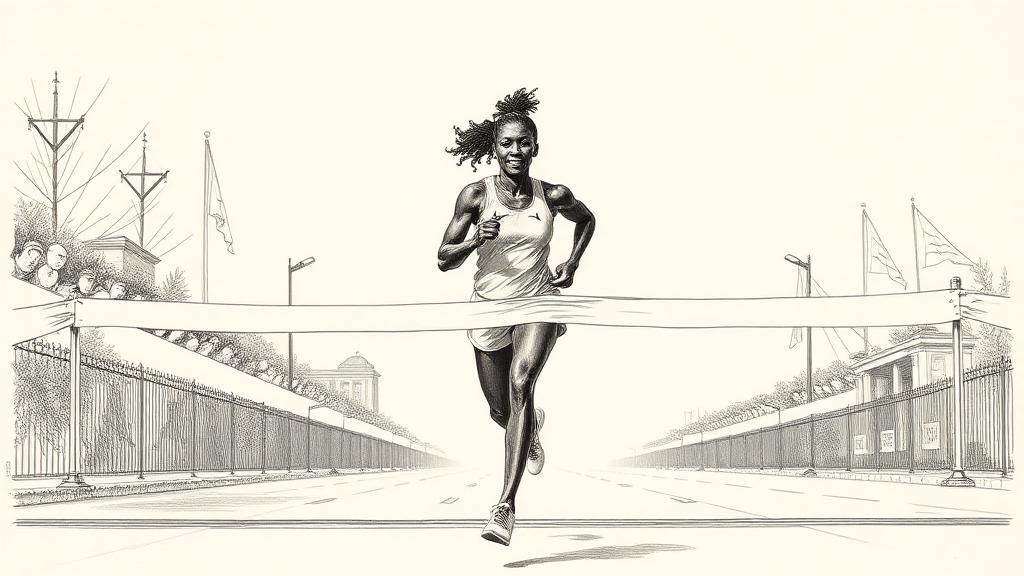
On April 15, 2024, Hellen Obiri of Kenya crossed the finish line on Boylston Street with a time of 2:22:37, defending her Boston Marathon title in a pair of shoes that looked, frankly, like something a spider had assembled overnight. No laces. No visible seams. Just a translucent, webbed upper that appeared to have grown onto the midsole rather than been attached to it.
The shoe was the Cloudboom Strike LS, and it had been made by a robot in Zurich. Obiri was the first woman to defend the Boston title since Catherine Ndereba in 2005. The shoe was making its competitive debut.
On Running — the Swiss brand founded in 2010 — had spent years developing what they called LightSpray. The manufacturing process is about as far from a traditional sneaker factory as you can get. A robotic arm, guided by precise software, sprays a continuous strand of thermoplastic filament directly onto a rotating foot-shaped mold. One filament. Roughly 1.5 kilometres of it, wound in a helix pattern, fusing to itself as it is laid. The entire upper takes three minutes to produce and weighs as little as 30 grams — lighter than a slice of bread.
Traditional shoe uppers are assembled by cutting panels of fabric, stitching them together, and gluing them to the midsole; the process touches around 200 pairs of human hands before a shoe is boxed. LightSpray uses none of that. No cuts, no stitches, no glue. The robot uses exactly the material the upper requires and nothing more.
The origin of the technology is not what you would expect from a serious engineering lab. According to the engineers at On Labs in Zurich, the initial inspiration was a video of someone making Halloween decorations — the kind where you shoot hot-glue strings from a gun to simulate spider webs. Someone watched that video and asked, sincerely, whether you could do that to a shoe.
The answer, after several years of development, was yes.
On Running claims the process produces 75% fewer carbon emissions than traditional upper manufacturing at comparable scale. That number applies to the upper alone, but it points toward something more significant: a technique that, in principle, could be deployed in small facilities close to the customer. Traditional shoe production concentrates in a handful of countries partly because assembly requires skilled hand labor and specialized equipment. LightSpray’s machinery fits in a room. The shoe can, at least in theory, be made near the runner.
Obiri tried the prototype in training and decided to race in it at Boston, despite skepticism from teammates. She ran 2:22:37. The shoe reached limited public release in late 2024 and wider availability in 2025, priced at $330.
Ten thousand years of footwear, and every single pair was assembled by human hands. The robot arm in Zurich changed that. One strand. Three minutes.
Sources
- 2024 Boston Marathon — Wikipedia — race date, Obiri’s time, edition number, title defense context.
- On LightSpray — On official site — process specifications: 1.5 km filament, three minutes, 30-gram upper, 75% CO₂ reduction.
- LightSpray running shoes — New Atlas — Zurich lab development, Halloween hot-glue inspiration, the 200-hand comparison.
- Hellen Obiri’s spray-on sneakers — Robb Report — Obiri’s training trials, teammate skepticism, Olympics context.