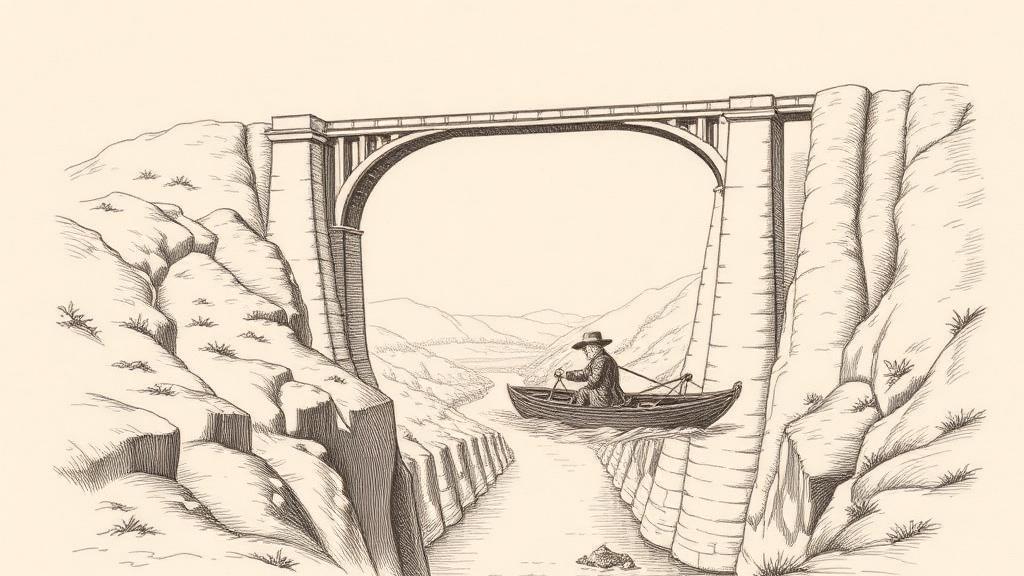
The Pontcysyllte Aqueduct, or how Telford carried a canal 127 feet above the Dee
On 26 November 1805, the first narrowboat to cross the Pontcysyllte Aqueduct floated 127 feet above the River Dee in a channel of cast iron barely twelve feet wide. The trough’s eastern side had a towpath, where the horse plodded steadily on. The western side had nothing — just the open drop to the valley floor, because Telford had apparently not got around to fitting the safety railing. The holes for it were there. The railing was not.
Thomas Telford was 38 years old when he arrived in northeastern Wales in 1793 to survey the Ellesmere Canal, a proposed waterway meant to link the rivers Mersey and Severn. The stretch across the Dee valley presented the usual problem: descend through a staircase of locks, cross the river low, and climb back up. Telford and his supervising engineer William Jessop proposed instead to carry the canal over the valley without touching the ground. Work on the aqueduct began on 25 July 1795.
What they built was, for 1805, improbable. Eighteen stone piers rise from the valley floor — hollow from 70 feet up to reduce their weight — each tapered to look more elegant than load-bearing masonry has any right to. Across their tops runs a trough of cast-iron plates bolted flange to flange in 52-foot spans: 1,007 feet of iron channel carrying four feet of water and any narrowboat light enough to enter it. The structure is 307 metres long and 39 metres above the river — the longest and highest canal aqueduct in Great Britain — and cost £47,000, roughly three million pounds in today’s money.
The waterproofing deserves a mention, because it is not obviously the work of a rational mind. Telford sealed the joints between iron plates with Welsh flannel soaked in a mixture of white lead, iron filings from boring waste, and — the records say — sugar. He then filled the trough with water and left it for six months, inspecting for leaks before he was satisfied enough to open it to traffic. The mixture worked for twenty-five years before tar replaced it. Only one worker died during the entire decade of construction — an accident rate that would embarrass a modern site manager.
The Pontcysyllte was the largest iron structure in Britain when it opened, and it demonstrated something masonry never had: that iron could carry water as a fluid container, not merely span it as a beam. Telford took that lesson north. Within two decades he was designing the Menai Suspension Bridge, 580 feet of iron chain across the Menai Strait, and a web of Highland roads and harbours that earned him the nickname “the Colossus of Roads.” In 1820 he became the first president of the newly founded Institution of Civil Engineers. The portrait they commissioned shows him at his desk; in the background, the only structure the painter included is this aqueduct.
It is still in use today. Viewed from the valley floor, the trough floats — a canal with no apparent means of support, which is precisely what everyone told Telford before he built it.
Sources
- Pontcysyllte Aqueduct — Wikipedia — construction timeline (1795–1805), dimensions, hollow pier design, and cast-iron trough specifications.
- Pontcysyllte Aqueduct — Linda Hall Library — Telford and Jessop’s roles, waterproofing recipe, and the six-month water test before opening.
- Historic UK — construction safety record, the missing western railing, Telford’s subsequent career, and the ICE portrait.