One script for all China: the Qin standardization, 221 BCE
In 221 BCE, Qin Shi Huang’s armies finished their work. Seven states had become one empire overnight, and one of the first problems the First Emperor faced was thoroughly unglamorous: nobody in this new territory wrote the same way. The Qi state’s character for “grain” looked different from Qin’s. Chu documents puzzled Qin scribes. Four centuries of political fracture had let the regional scripts drift into what historians call the “scripts of the six states” — close enough to be recognizable, different enough to be a problem.
The emperor assigned the matter to his chancellor, Li Si. Li Si’s approach was not subtle: the Qin state’s own script, already the most conservative, the least drifted from Zhou tradition, would become the template for all of China. He and his colleagues refined it into xiǎo zhuàn, small seal script — codified in a primer called the Cangjiepian, setting out around 3,300 characters in their approved forms. Every other form was abolished. The policy had a name: shu tong wen zi, “writing the same script.”
Qin Shi Huang had already standardized weights, measures, and the width of the axle — so that Qin-built carts could roll in the ruts of every conquered road. Writing was one more variable to eliminate. That the policy also made dissenting ideas harder to circulate was not incidental. In 213 BCE, the same administration ordered the burning of books. If one cannot erase the past, at least one can refuse to transcribe it.
Li Si understood that a chancellor’s decree and a scribe’s working hand are different things. For the daily work of empire — the ceaseless flow of orders, tallies, and reports — a faster, more cursive hand emerged almost immediately alongside the formal seal script: lì shū, clerical script, strokes flattened and quickened to suit the pace of administration. The official language of empire and the working hand of empire were different from the first year. Uniformity at the top, pragmatism underneath — a compromise that every bureaucracy since has quietly inherited.
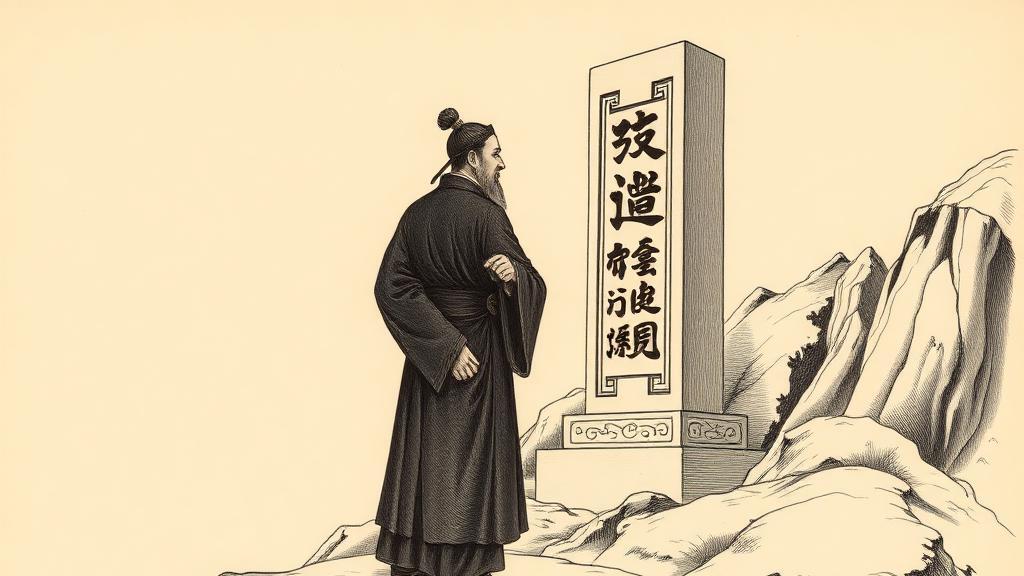
Two years after the decree, in 219 BCE, Qin Shi Huang climbed Mount Langya in Shandong and ordered a stele carved: 497 characters praising his achievements, each stroke in Li Si’s small seal script. The stone survives in the National Museum of China, worn to 87 characters. It looks like what it is: a statement that this is how the language looks now, and the matter is settled.
What the standardization actually unlocked was larger than administrative convenience. China’s spoken languages had always been mutually unintelligible across regions — they still are. The written script became the medium in which a Cantonese speaker and a Mandarin speaker could correspond, govern, and share literature across two thousand years. Stability in the written form is why a Han dynasty text remains legible to a modern reader in ways that Chaucer requires annotation.
Every character a student traces in a Beijing classroom today descends from a decision Li Si made in 221 BCE, set in stone on a hillside two years later, and still visible — if you know which 87 to read.
Sources
- Small seal script — Wikipedia — Li Si’s role, the Cangjiepian primer, the “scripts of the six states,” standardization scope, and surviving evidence.
- Langya Stele — Baidu Encyclopedia (English) — The stele’s carving in 219 BCE, original 497 characters, 87 surviving, National Museum of China location.
- Qin dynasty — Wikipedia — Standardization of axle widths, weights, and measures; book burning of 213 BCE.