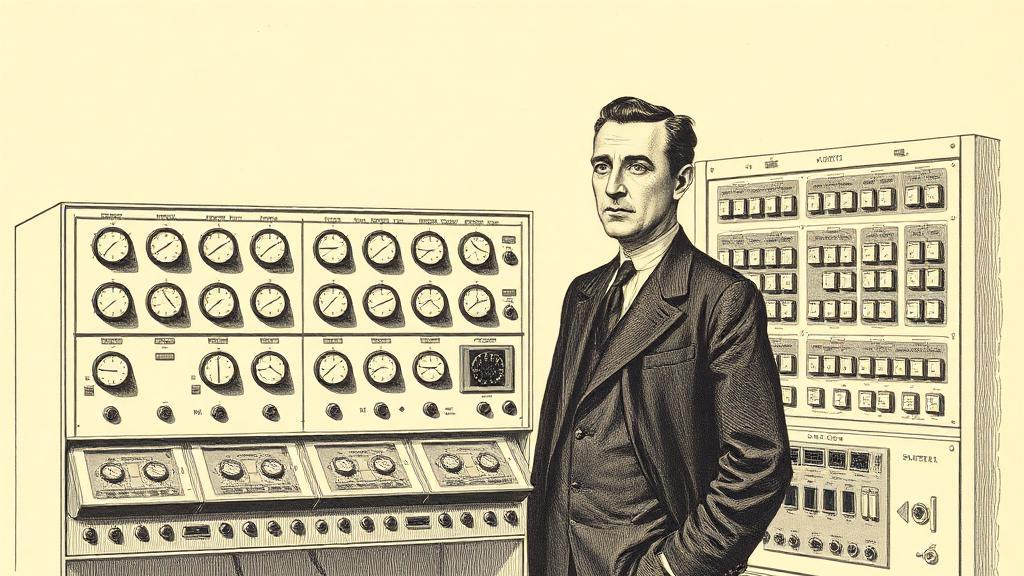
Rosenblatt's perceptron: the machine that could learn
On July 8, 1958, the United States Office of Naval Research held a press conference to announce a machine that would one day “walk, talk, see, write, reproduce itself and be conscious of its existence.” The New York Times headline the following morning read: “NEW NAVY DEVICE LEARNS BY DOING.” The machine was called the Perceptron. Its creator was a 29-year-old psychologist named Frank Rosenblatt, and the announcement — overblown, credulous, wildly premature — was also, in the way that matters, completely correct.
Rosenblatt had spent the previous year simulating his idea on an IBM 704 at the Cornell Aeronautical Laboratory in Buffalo, New York, where his work was funded by the Office of Naval Research and the Rome Air Development Center. The concept was biological in origin: a network of artificial neurons, connected at adjustable weights, that could be trained on examples rather than explicitly programmed. By late 1959 the physical machine existed. The Mark I Perceptron studied the world through a 20-by-20 grid of 400 photocells. Behind those eyes sat 512 association units — small motor-driven potentiometers, each adjustable in response to errors — and eight output neurons that delivered the verdict.
Nobody wrote a program telling the Mark I what a circle looked like. Instead the machine was shown circles and squares, over and over, and each time it guessed wrong, its weights shifted automatically. After enough repetitions it achieved 99.8 percent accuracy distinguishing squares from circles across ten thousand training images. Given twenty examples of the letter X, it learned to tell X from E with perfect accuracy and held 90 percent even when the letters were randomly rotated. The learning was real.
The Navy’s prophecy about consciousness was Rosenblatt’s extrapolation, amplified by publicists and a credulous press. But Rosenblatt believed the trajectory. He was, by his colleagues’ account, a man who reached for the largest problems in view — he had also built a backyard observatory to search for extraterrestrial intelligence and ran experiments attempting to transfer memories between rats. One graduate student recalled: “Frank was the thinker, and we were the worker bees.”
In 1969, Marvin Minsky and Seymour Papert at MIT published Perceptrons, a rigorous mathematical analysis proving that single-layer networks could not solve certain problems — the XOR function being the canonical example. The book noted, carefully, that multi-layer networks could solve these problems. The AI research community read the headline and took it as a verdict on the whole enterprise. Funding for neural network research collapsed. The period historians later called the first AI winter settled in.
Frank Rosenblatt died on July 11, 1971, in a boating accident on Chesapeake Bay. It was his forty-third birthday. He had spent two years in the aftermath of Perceptrons, working through the funding drought on a speech-recognition system called Tobermory, and was eulogized on the floor of the House of Representatives. He never saw what happened in 1986.
That year, David Rumelhart, Geoffrey Hinton, and Ronald Williams published a paper on backpropagation — the training method for multi-layer networks that Minsky and Papert had quietly gestured toward. It solved the XOR problem. Neural networks revived, then deepened, then in 2012 won an image-recognition competition by a margin that ended the argument. The Mark I Perceptron is now in the Smithsonian.
Rosenblatt was right about the thing that mattered: a machine could learn. Getting the math to agree took another generation.
Sources
- Cornell Chronicle, “Professor’s perceptron paved the way for AI — 60 years too soon” (2019) — NYT headline, press conference context, Rosenblatt’s biography and colleagues’ recollections
- Frank Rosenblatt — Wikipedia — biography, Cornell Aeronautical Laboratory, funding sources, death
- Mark I Perceptron — Wikipedia — hardware specifications, photocell layout, accuracy benchmarks, assembly timeline
- Electronic Neural Network, Mark I Perceptron — National Museum of American History, Smithsonian — physical machine provenance and description