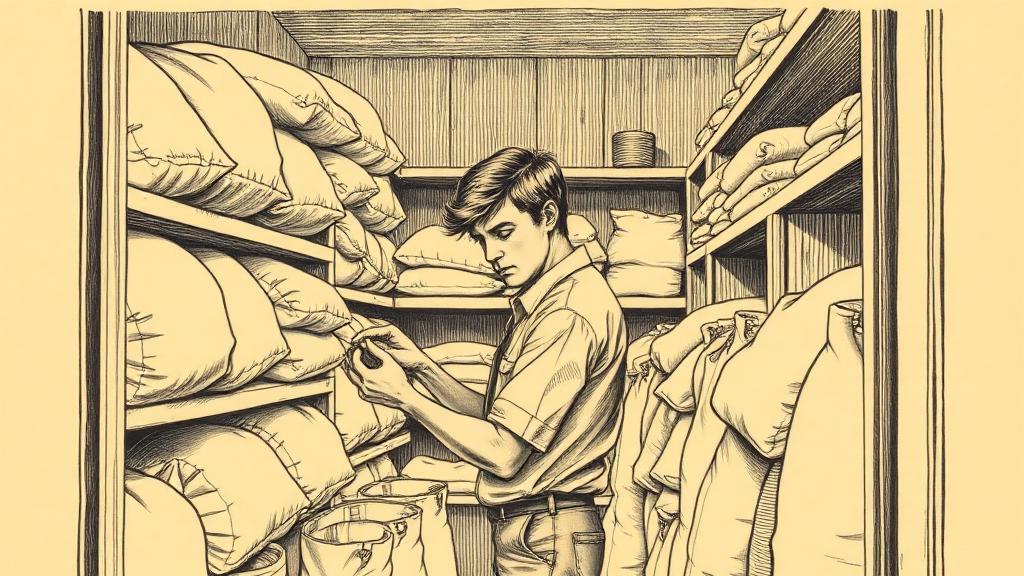
The bean shop on Western Avenue
On the morning of March 30, 1971, a small shop opened at 2000 Western Avenue in Seattle, near the fish-throwers and flower stalls of Pike Place Market, and sold a man named Daniel Jack Chasan a bag of Sumatra beans for $5.36. No espresso. No cups. No whipped milk. Just coffee to take home and grind yourself.
That was the original Starbucks.
Three friends — Jerry Baldwin, Zev Siegl, and Gordon Bowker, all born the same year, all recently out of the University of San Francisco — had scraped together $1,500 each, borrowed $5,000 from a bank, and rented a storefront for $137.50 a month. Their product wasn’t a drink; it was an education. The shelves held whole coffee beans in bulk bins, loose teas, spices, and the hardware to brew them properly at home. Baldwin, Siegl, and Bowker had come to believe, in the fashion of true converts, that most Americans had never tasted real coffee — only the stale, pre-ground, canned version that had dominated the country since the Second World War.
The man who made them believe this was Alfred Peet. Zev Siegl had stumbled into Peet’s Coffee in Berkeley in 1970, tasted Peet’s dark-roasted, single-origin beans, and understood immediately what he had been missing. Peet, a Dutch immigrant who had worked for coffee importers in Indonesia and England before opening his Berkeley shop in 1966, agreed to supply the new Seattle store with his roasted beans. He later taught Baldwin the techniques himself, and in 1973 trained their first Roastmaster, Jim Reynolds, in person. Peet’s Coffee became, in effect, the seed stock for the specialty-coffee industry that followed.
The naming came from an old piece of Seattle mythology. Bowker found the word “Starbo” on an 1860s mining map of the Cascades and connected it to Starbuck, the calm and resolute first mate of the Pequod in Melville’s Moby-Dick. Designer Terry Heckler added a twin-tailed mermaid lifted from a 15th-century Norse woodcut. The name and the logo were stranger than any focus group would have approved — which probably helped.
The store did well enough to open a second location in University Village within two years. First-year gross revenue came to $46,832. A columnist from the Seattle Times named Don Duncan wrote about the store, and the piece generated enough word-of-mouth that Baldwin later cited it as the moment the business stopped feeling like a gamble.
Howard Schultz joined as head of marketing in 1982, flew to Milan the following year, and came back changed. The espresso bars of northern Italy — the standing drinkers, the social ritual, the small cups dispatched in ninety seconds — struck him as a model that Seattle, and then America, was missing. Baldwin and Bowker were skeptical; they were in the bean business, not the hospitality business. Schultz eventually left to build his own espresso-bar chain, Il Giornale, and in 1987 he bought the original Starbucks outright and merged the two concepts. Within a decade, the corner shop that sold Sumatra to home brewers had become the defining institution of what the industry calls second-wave coffee: a mass market built on espresso, milk-forward drinks, and the proposition that coffee was something worth thinking about.
The third wave of coffee — single-origin, pour-over, tasting notes on a chalkboard — would arrive partly in reaction to Starbucks and partly because of it. The hard work of convincing a country to care had already been done.
Sources
- Starbucks: The Early Years — HistoryLink.org — founding date, first customer and purchase details, startup costs, Alfred Peet connection, Jim Reynolds, first-year revenue, Don Duncan article.
- Starbucks — Wikipedia — founders’ backgrounds, Howard Schultz transformation, Il Giornale, second-wave coffee context.