cars · 3 min read
Tesla Model S, 2012: the car that made range anxiety a solvable problem
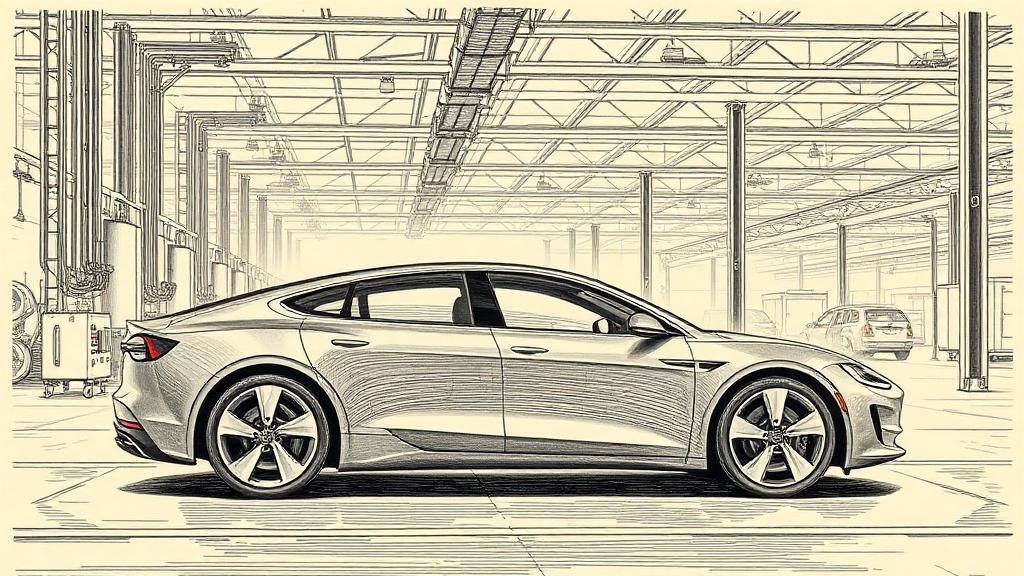
On the morning of June 22, 2012, about a thousand people crowded into the Fremont, California plant that had once built Pontiacs and Corollas as a joint venture between General Motors and Toyota. Tesla Motors had taken over the facility in 2010, and now Elon Musk stood on its factory floor, describing what his company called the world’s first long-range electric sedan. The atmosphere, by several contemporary accounts, was closer to a revival meeting than a product launch.
The car needed that energy. Every battery-electric vehicle on sale in 2012 — the Nissan Leaf, the Mitsubishi i, the Ford Focus Electric — was EPA-certified to between 62 and 76 miles of range. Enough for a commute, not for the question that ended every electric-car conversation: what do you do on a road trip? The Model S, fitted with the largest available battery pack at 85 kilowatt-hours, was EPA-certified at 265 miles — more than three times the Leaf’s range. The agency also rated it at 89 miles-per-gallon-equivalent, the highest efficiency score ever recorded for a large car.
What made the number credible was what surrounded it. The Model S was not a commuter pod or a proof-of-concept with a trailing cable. It was a full-sized luxury sedan — five adult seats, 94 cubic feet of interior space, and a 260-kilowatt drivetrain that sent the performance variant to 60 mph in 4.4 seconds. Motor Trend awarded it Car of the Year for 2013, the first time in the prize’s sixty-four-year history that it had gone to a car without an internal-combustion engine.
The first production Model S did not go to Elon Musk. In 2009, at a Tesla board meeting, venture capitalist Steve Jurvetson pulled a blank check from his wallet and wrote it on the spot to reserve the first car off the line, beating Musk — who had the same idea — by a matter of moments (Green Car Reports). Musk received car number two. By the time the official delivery ceremony began, Jurvetson had already been photographed around Stanford’s campus with the license plate TSLA S1, the car apparently complete enough for a drive but not quite public enough for comment.
What the Model S shifted was less about range than about the category it staked out. Before June 2012, the electric car was a commuter appliance — practical but constrained. The 265-mile certification put it in the same mental space as a gasoline car: something you could plan a weekend around. Tesla would spend the next five years building on this architecture to produce the Model 3, a $35,000 sedan aimed at buyers who couldn’t afford the Signature Series. By 2015, the Model S was the world’s best-selling plug-in electric vehicle.
Musk told the crowd that morning: “What this is really all about is breaking the illusion that electric cars are not as good as gas cars.” The carmakers who weren’t in Fremont that June had a few years to decide what to do about it.
Sources
- 2012 Tesla Model S: EPA Range of 265 Miles, 89 MPGe — Green Car Reports — EPA certification details, competitor range comparison, efficiency rating.
- 2012 Tesla Model S Gets EPA Certified 265-Mile Range — Motor Authority — independent confirmation of the 265-mile EPA figure and 89 MPGe rating.
- First 2012 Tesla Model S Delivered to Steve Jurvetson — Green Car Reports — the blank-check anecdote, Jurvetson’s delivery, Musk’s #002 placement.
- Tesla Model S — Wikipedia — Motor Trend award, production history, market significance, global sales records.
- Governor Brown to Attend Tesla Delivery — California Governor’s Archive — Musk’s remarks at the June 22 delivery event and delivery ceremony details.