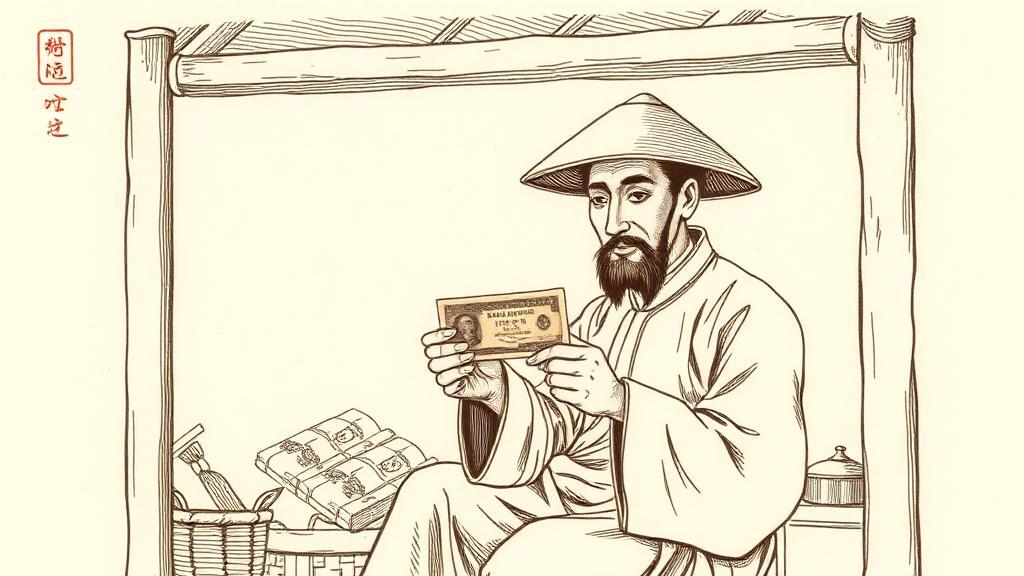
The jiaozi, or what happens when your money needs its own ox cart
Walk into any market in tenth-century Chengdu and the first problem was physical. Iron coins, not copper, were the currency of Sichuan — the region’s geology gave iron in abundance and copper only sparingly — and iron coins were wretched to spend. A thousand large coins weighed twenty-five catties, roughly twelve kilograms. Buying a bolt of silk required ninety catties of iron or more; buying a horse meant loading coins onto an ox cart and hoping the cart held (ADP ReThink Q). Commerce, under those conditions, was a feat of logistics as much as finance.
Around 1008, sixteen of Chengdu’s largest merchant families pooled their credibility to fix this. They formed a consortium called the jiaozi hu (交子戶) — the Paper Note House — and began issuing receipts printed on bamboo-bark paper, stamped with hidden markings, passwords, and red-and-black seals to frustrate forgery. A merchant deposited iron coins or goods with the house; the house returned a jiaozi (交子), a “note of exchange,” redeemable on demand. The note weighed almost nothing. The ox cart stayed home.
For a few years the system held. Sixteen reputable families, shared risk, mutual scrutiny. Then, one by one, some of the merchant houses overextended — speculative bets, bad debts — and went insolvent. Holders of their jiaozi had paper worth rather less than its stated face value, which is the oldest story in finance except that, before 1008, it had never been told on paper before (Wikipedia).
The Northern Song government intervened in 1023. The court established the Jiaozi wu (交子務) — a formal Office of Jiaozi Affairs — nationalized the issue, and banned private printing. The first official state banknotes followed in 1024: notes worth between 700 and 10,000 copper wén, each printed in multiple colors, stamped with multiple seals, valid for two years, then redeemable at the office for fresh currency. Circulation was capped at just under 1.26 million notes. The government held iron reserves to back them. This was, recognizably, monetary policy — almost a millennium before the phrase was coined.
The two-year expiry date is the detail that surprises. Every jiaozi arrived in your hand with a death clock already running. The logic was deliberately deflationary: age the notes out of circulation rather than let them pile up and erode value. The office even charged a small exchange fee — thirty wén per note — to slow the churn. Whether it was wisdom or just fiscal caution, it worked for roughly two centuries.
Military disaster unwound it. Wars against the Jurchen Jin dynasty in the north, then the Mongol campaigns, demanded money the treasury did not have. The government printed. By 1204, roughly four million notes were in circulation against iron reserves barely a fifth of that; the exchange rate, once par, had fallen to 400 cash coins per note and then lower (Hoover Institution). Sichuan’s ox-cart problem had been replaced by a new one: paper that nobody would take.
The Mongols who absorbed the Song kept the paper-money system and amplified it, eventually banning metal coins altogether. Marco Polo, arriving around 1271, was so astonished by its universality that he described the Great Khan’s printing operation in tones usually reserved for alchemy — the emperor commands trees to become money, and they do. What the jiaozi had demonstrated, for the first time in history, was that money did not need to be a thing. It needed only to be a credible promise.
Getting the promise right, it turned out, was the hard part.
Sources
- Jiaozi (currency) — Wikipedia — Merchant consortium origins, 1023 government takeover, denominations, two-year expiry system, 1204 inflation figures.
- The birth of paper money in China — ADP ReThink Q — Iron-coin weight problem in Sichuan, the ox-cart detail, bamboo-bark paper, physical note design, government rationale.
- The Rise and Demise of Paper Money in Imperial China — Hoover Institution — Song circulation management strategies, military inflation pressure, Mongol adoption and expansion.