The transistor: a razor blade, some gold foil, and the death of the vacuum tube
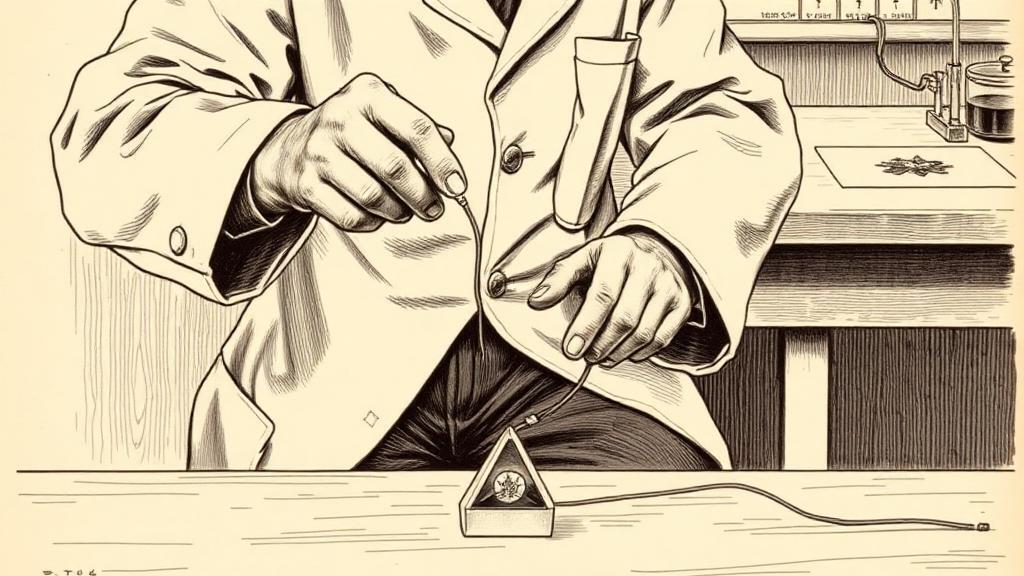
The thing looks almost insultingly small. On December 23, 1947, in a laboratory at Bell Telephone Laboratories in Murray Hill, New Jersey, Walter Brattain presses a plastic wedge against a thumbnail-sized slab of germanium. The wedge holds two gold contacts separated by about fifty micrometers — gold foil glued to its edge, sliced at the tip with a razor blade. He switches the circuit on. Speech comes back through the headphones: amplified, clear, unmistakably louder. The Bell Labs managers leaning in have just heard the vacuum tube receive its death sentence.
The group that built this had been chasing the problem since 1945, when William Shockley reorganized Bell’s solid-state physics group to find a semiconductor replacement for the vacuum tubes running the telephone network. Shockley’s own approach — using electric fields to modulate current through a germanium crystal — kept failing for reasons he couldn’t explain. Theoretical physicist John Bardeen worked out why: electrons were pooling at the crystal’s surface in quantum traps, neutralizing any applied field before it could penetrate the interior (Nobel Prize, 1956). That insight redirected Bardeen and his experimental colleague Brattain toward the surface — and toward the device on that December bench.
The point-contact transistor exploited those surface states rather than fighting them. Voltage applied to one gold contact altered the current flowing through the other, amplifying a weak signal (Computer History Museum). Brattain’s lab notebook recorded the first successful measurement on December 16 with practiced restraint: “power gain 1.3, voltage gain 15.” What the notebook doesn’t capture is the contrast: an equivalent vacuum tube was the size of a light bulb, ran hot, failed regularly, and consumed power by the watt. The germanium-and-gold device did the same job in something you could balance on a fingernail.
Here is the part that Bell Labs’ institutional history tends to glide past. Shockley had organized the group, proposed the original approach, and watched two of his staff solve the problem he had failed to solve — without him. He received the news, reportedly described it as “a magnificent Christmas present,” and then spent January 1948 locked away developing a superior device of his own: the bipolar junction transistor, derived from quantum mechanics rather than cut from gold foil. It was more reliable, more manufacturable, and went on to dominate the industry (History of the Transistor — Wikipedia). The Nobel Prize in Physics 1956 was shared equally by all three. A tidy ending to a considerably less tidy competition.
Bell Labs announced the transistor publicly at a New York press conference on June 30, 1948. The name came from engineer John Robinson Pierce, chosen by an internal ballot in May: “transfer” plus “resistor,” partly because engineers already liked the “-istor” suffix. By 1954, the first commercial transistor radio was on the market. By the early 1960s, integrated circuits were packing dozens of transistors onto a single chip, and the question of how many could fit had become the defining question of the industry.
The germanium in Brattain’s original device gave way to silicon within a decade — cheaper, more stable, and more amenable to miniaturization. Silicon never stopped shrinking.
Sources
- 1947: Invention of the Point-Contact Transistor — Computer History Museum — physical description of the point-contact device, December 16 and 23 demonstrations, what the device amplified
- The Nobel Prize in Physics 1956 — NobelPrize.org — award citation, Bardeen’s surface states theory, Shockley’s role and the background research
- History of the Transistor — Wikipedia — Brattain’s lab notebook entries, Pierce’s naming ballot, the bipolar junction transistor, silicon transition