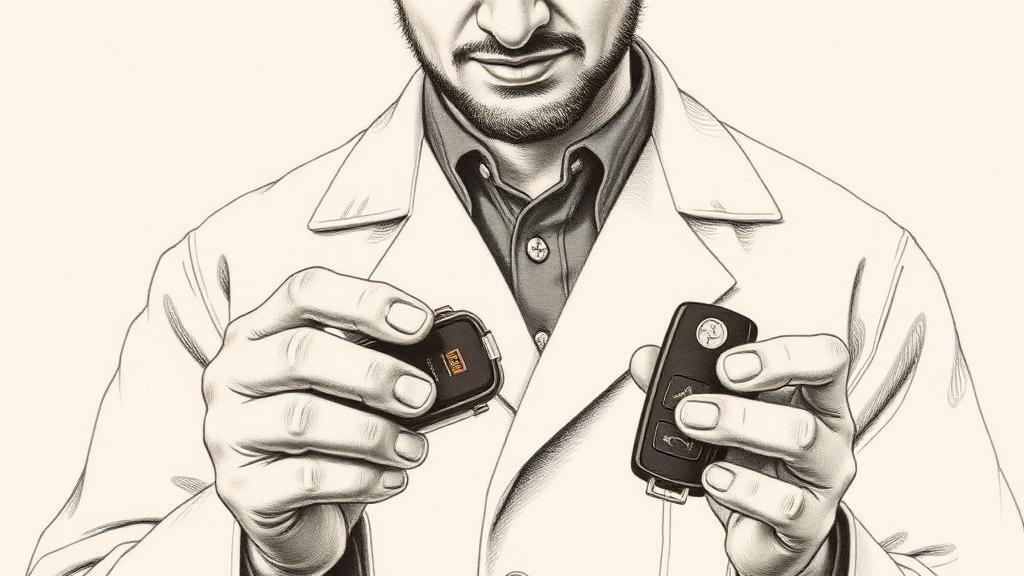
The transponder key, or how Ford put the lock inside the engine
In 1991, car thieves in the United States stole roughly 1.7 million vehicles — one approximately every nineteen seconds, by the annual arithmetic. Most took under three minutes, required no mechanical skill, and left no evidence beyond a gouged steering column and crossed ignition wires. The mechanical car key, barely changed since the 1920s, was a lock on the door that had never thought to say anything about the engine.
That particular defect had one person working on it in France a decade earlier. Paul Lipschutz, an engineer at Nieman, a French automotive security supplier, had patented an infrared key fob in 1981 that could lock or unlock a car door from a short distance. When the Renault Fuego went on sale in September 1982 equipped with his system — marketed as PLIP, after its inventor — it became the first production car to offer remote central locking. The effective range was five feet. Drivers had to stand close enough to touch the car to use it. But the principle was established: the key could transmit, and the car could listen.
Radio frequency replaced infrared in the mid-1990s, solving the range problem. What followed was the harder step. Starting in 1993, the first European manufacturers began embedding a Texas Instruments TIRIS chip inside the plastic head of the ignition key — passive, drawing no battery, invisible from the outside. The chip came alive when it came within range of an antenna coil wrapped around the ignition barrel, broadcast a unique 40-bit code at 125 kHz, and waited for the engine control unit to recognize it. Match: start. No match: two seconds of cranking, a blinking theft light, and nothing more.
Ford brought this system to the American mass market in 1996, on the Mustang. Their Passive Anti-Theft System — PATS — used a fixed code on the first iteration, which researchers eventually found ways to clone. PATS II, introduced in 1998, switched to rolling codes: a challenge-and-response handshake that produces a new authentication string with every use, making any captured code useless the moment it has been used once.
The Kia and Hyundai models sold in the United States without transponder chips — a cost-cutting measure on certain entry-level trims — went unnoticed for years, until 2022. A TikTok trend circulated tutorials on hot-wiring them. Counties in Ohio and Wisconsin recorded hundreds of thefts in weeks. The chip’s absence had turned those cars into the most stealable objects on any street they were parked on. It was an unintentional controlled experiment, and the result was unambiguous.
A 2016 study in the Economic Journal found that electronic immobilizers had reduced the overall rate of car theft by roughly 40 percent between 1995 and 2008, with crime-prevention benefits more than three times greater than the cost of fitting the chips. Germany made them mandatory on all new cars from January 1998; the United Kingdom followed that October. Ford made PATS standard on every U.S. passenger vehicle it sold by 1999.
The key’s shape stayed the same. The cut of the blade still mattered for the door. The difference was that the engine now had something to say about who was carrying it.
Sources
- Transponders and Remotes in 2017 — Locksmith Ledger — professional trade account of transponder key history; first European systems (1993); Ford PATS introduction (1996 Mustang); rolling-code evolution.
- Remote keyless system — Wikipedia — Paul Lipschutz’s 1981 patent, 1982 Renault Fuego and the PLIP system, RF standardization in 1995.
- Transponder car key — Wikipedia — U.S. car theft peak (1.7 million, 1991), transponder chip operation, Germany and UK mandates.
- Immobiliser — Wikipedia — 40% theft reduction (Economic Journal 2016), Kia/Hyundai vulnerability and the 2022 TikTok theft wave.