writing-systems · 3 min read
The clay tags of Umm el-Marra, or where the alphabet may have started
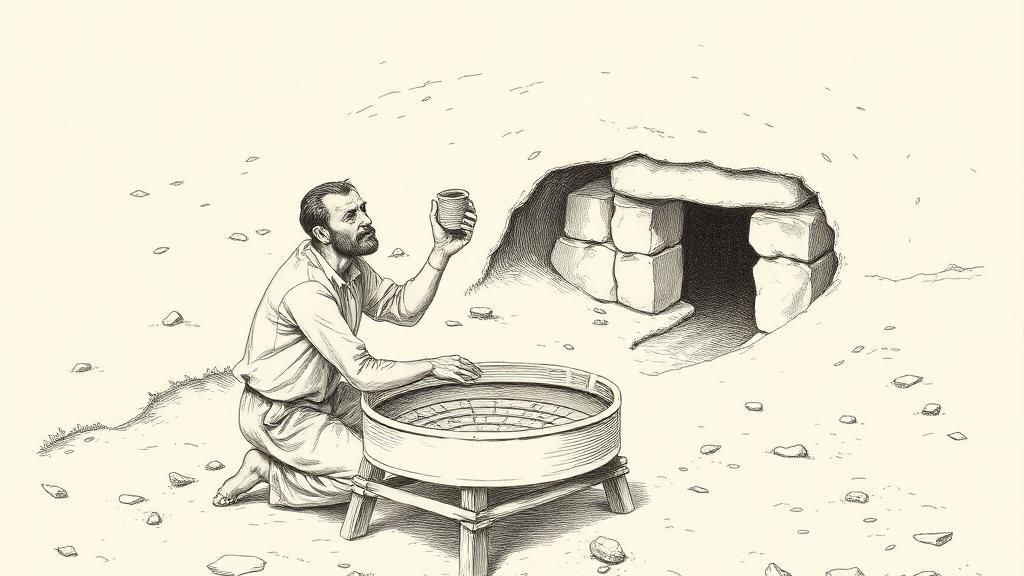
In 2004, a graduate student named Elaine Sullivan was sifting excavation soil through a mesh screen at a Bronze Age burial site in northwestern Syria when she felt something small and cylindrical between her fingers. “When I picked the first cylinder up, I thought it was merely a compacted piece of surface dirt,” she later recalled. Only after brushing it off did she realize she was holding an artifact — two inches of lightly baked clay inscribed with unfamiliar symbols. She called over her supervisor, Glenn Schwartz of Johns Hopkins University. By the time they finished excavating Tomb 4 at Tell Umm el-Marra, they had four such cylinders, each perforated lengthwise as if once strung on a cord.
Umm el-Marra sits roughly 35 miles east of Aleppo in northern Syria, and around 2400 BCE it was one of the first medium-sized walled cities in the western Fertile Crescent — a settlement with streets, a palace district, and a necropolis for the wealthy. Tomb 4 held six skeletons, pottery, bronze vessels, and jewelry belonging to what Schwartz describes as “a wealthy and powerful family.” The four cylinders, each about two inches long, lay among them. The symbols scratched into their surfaces looked nothing like cuneiform, the wedge-script already in widespread use across the region.
When radiocarbon results came back in 2021, they placed the burials at approximately 2400 BCE. That date mattered a great deal. The oldest previously known alphabetic writing — the Proto-Sinaitic inscriptions from the turquoise mines at Serabit el-Khadim in Egypt’s Sinai Peninsula — dates to around 1800 BCE. If the Umm el-Marra cylinders truly carry alphabetic symbols, they would predate the Proto-Sinaitic corpus by six centuries and push the invention of the alphabet north, out of Sinai and into the Syrian interior.
The case has been building carefully. At a 2019 conference in Milan, epigrapher Christopher Rollston of George Washington University and Semitic scholar Madadh Richey examined the cylinders and found the morphology of the symbols consistent with early alphabetic forms. Semitist Ted Lewis identified one sequence as possibly reading “silanu” — a name. Rollston was nevertheless measured in his enthusiasm: “Paradigm-shifting discoveries gain acceptance gradually, not rapidly,” he noted, and without a bilingual inscription or clear lexical context, translation remains largely speculative. When Schwartz’s paper reached the American Journal of Archaeology in early 2026 and National Geographic ran the story on January 26, scholars split roughly between cautious optimism and genuine skepticism. This one is still gaining.
What can be said with more confidence is what the cylinders probably were. The perforations suggest they were threaded on cord and tied to objects — Schwartz imagines them as labels for goods placed in the tomb, perhaps marking the contents of jars or identifying donors. If so, the alphabet may have been invented for the same mundane reason as a shipping tag. The oldest writing in Mesopotamia — proto-cuneiform — was also bookkeeping. The pattern, if it holds, is almost funny: writing, every time we find its origins, turns out to be a receipt.
The site at Umm el-Marra is now inaccessible. The Syrian civil war ended excavations after 2010, and the team has not returned. Whatever else Tomb 4 might have held — additional cylinders, more inscriptions, a richer context for the symbols Sullivan found — remains in the ground. The four small clay objects she nearly mistook for dirt are now carrying an argument about where and when humanity first thought to represent a sound with a single sign.
The alphabet may have started as a label on a jar. It has spent the intervening four millennia becoming everything else.
Sources
- Is this the world’s oldest alphabet? — National Geographic — Full account of the Umm el-Marra cylinders, Rollston and Richey’s analysis, the “silanu” reading, and the January 26, 2026 publication context.
- Oldest known alphabet unearthed in ancient Syrian city — EurekAlert — Johns Hopkins press release with Schwartz’s details on cylinder function and the ASOR conference presentation.
- How a UC Santa Cruz professor unearthed the oldest alphabet yet — UC Santa Cruz News — Elaine Sullivan’s first-person account of the sieving method and the moment of discovery.