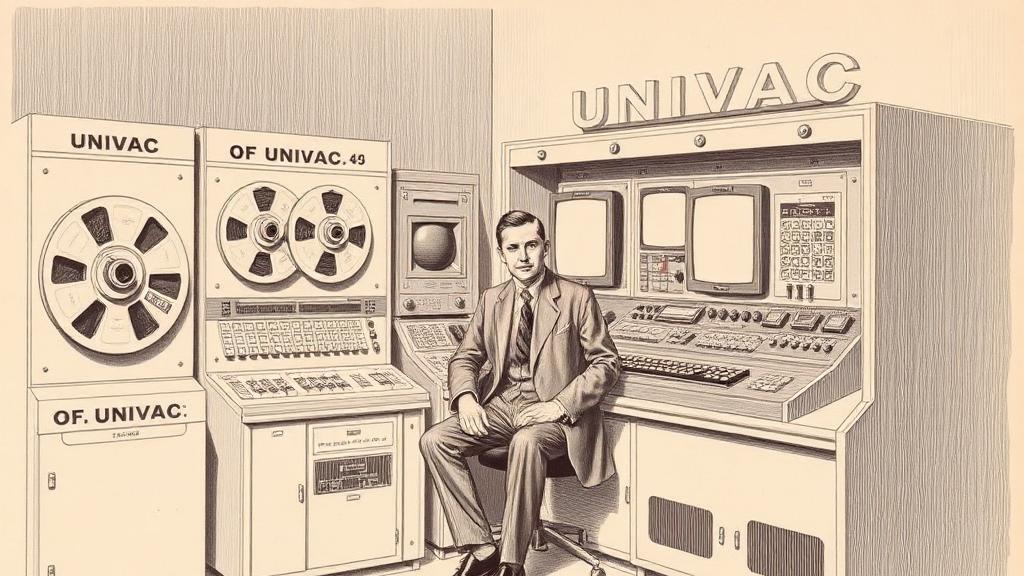
UNIVAC predicts an Eisenhower landslide
On the evening of November 4, 1952, Charles Collingwood stood before a dummy terminal in a CBS studio in New York and told the nation something nobody in the building quite believed. A machine in Philadelphia, he explained — “a fabulous electronic machine” — had just predicted the outcome of the presidential race with barely three million votes counted. Odds: 100 to 1 for Eisenhower.
The machine was UNIVAC I, serial number five, operated by Remington Rand. Its designers were J. Presper Eckert and John Mauchly, the same pair who had built ENIAC in a basement in Philadelphia in 1945. After the war they tried to go into business for themselves, founding the Eckert-Mauchly Computer Corporation — and discovered they were considerably better engineers than businessmen. Remington Rand acquired the company in 1950. The first UNIVAC was accepted by the U.S. Census Bureau on March 31, 1951, making it the first commercially produced electronic computer in the United States: a machine you could not simply commandeer for the war effort but actually, theoretically, buy.
What you were buying was a great deal of machine. UNIVAC I weighed 16,686 pounds, consumed 125 kilowatts of power, ran on 6,103 vacuum tubes, and occupied more than 382 square feet of floor space. It read data from magnetic tape rather than punch cards and could perform roughly 1,905 operations per second. By 1952 the price had settled between $1.25 and $1.5 million — if Remington Rand would sell rather than lease.
CBS’s producers were not entirely sure they should trust the thing. The polls that autumn showed a competitive race between Eisenhower and Democrat Adlai Stevenson. When UNIVAC’s statistician loaded 3,398,745 early returns and the machine printed a forecast of 438 electoral votes for Eisenhower against 93 for Stevenson — with popular vote totals precise to the single ballot, 32,915,949 to 28,261,542 — the network quietly adjusted the inputs to produce a more conventional result before Collingwood went on air. When the actual returns came in and UNIVAC’s original numbers proved closer to the truth, they adjusted back. At the end of the broadcast CBS disclosed what it had done. Eisenhower won 34,075,029 votes and 442 electoral votes; UNIVAC’s first unaltered prediction was within 3.5% of his actual popular vote total.
One additional detail. UNIVAC’s printout had read “00 to 1” rather than “100 to 1” — its programmers had never anticipated needing three digits for a probability.
Before that night, computers were things that processed census forms in federal basements. After it, they were things that could tell you who was going to win, live, on television, while the votes were still coming in. Collingwood’s description of the machine — “He’s sitting there in his corner humming away” — landed in living rooms across the country and gave computing a presence it had never had. By the end of the 1950s, “UNIVAC” had become a generic word for computer, the way “Hoover” became a word for a vacuum cleaner.
Eckert and Mauchly had built ENIAC to calculate artillery tables and UNIVAC to process payrolls. On November 4, 1952, what it processed was doubt — and by morning, the doubt belonged entirely to the humans.
Sources
- UNIVAC I — Wikipedia — technical specifications, first delivery to the Census Bureau, the 1952 election prediction, CBS adjustment story, and final vote totals.
- UNIVAC Predicts an Eisenhower Win — Computer History Museum — Eckert’s design role, the three-digit probability error, and Collingwood’s broadcast quotes.
- Today in Media History: UNIVAC predicted the 1952 election — Poynter — vote count at prediction time and the evening’s broadcast timeline.